Thursday, 24 April 2025

Security Vulnerabilities in SAML OAuth 2.0 OpenID Connect and JWT

Security Vulnerabilities in SAML, OAuth 2.0, OpenID Connect, and JWT

Single Sign-On (SSO) protocols are critical for enterprise security but have a history of severe vulnerabilities. This report provides a data-rich overview of known security flaws in four major SSO technologies – SAML, OAuth 2.0, OpenID Connect (OIDC), and JSON Web Tokens (JWT) – including both historical exploits and recent findings. We compare the frequency and impact of these vulnerabilities, and analyze how enterprise, cloud, and open-source implementations have responded. Links to CVEs, advisories, and authoritative research are included for direct reference.

Introduction and SSO Protocol Overview

Modern SSO protocols allow users to authenticate with one identity provider and gain access to multiple services. The most common standards are:

  • Security Assertion Markup Language (SAML 2.0) – An XML-based framework for exchanging authentication and authorization data between an Identity Provider (IdP) and a Service Provider (SP). Widely used in enterprise web SSO and federation scenarios.
  • OAuth 2.0 – An authorization framework (not strictly authentication) that permits third-party applications to obtain limited access to a web service (often issuing access tokens). It underpins many "Login with X" features and API auth schemes.
  • OpenID Connect (OIDC) – An identity layer built on OAuth 2.0. OIDC issues ID Tokens (often as JWTs) in addition to OAuth access tokens, enabling client applications (relying parties) to verify user identity. Formal security analyses have generally found OIDC sound if implemented correctly.
  • JSON Web Tokens (JWT) – A compact token format (JSON payload, signed/encrypted) used by OAuth/OIDC and other systems to represent claims. JWT is not a full protocol by itself, but its security is crucial to any SSO design that uses it for tokens.

Despite their widespread adoption, each of these has exhibited critical vulnerabilities. Implementation bugs and subtle design flaws have led to authentication bypasses, token forgeries, and account compromise. Below we catalog major known vulnerabilities for each protocol, from early exploits to 2024–2025 discoveries.

Security Vulnerabilities in SAML

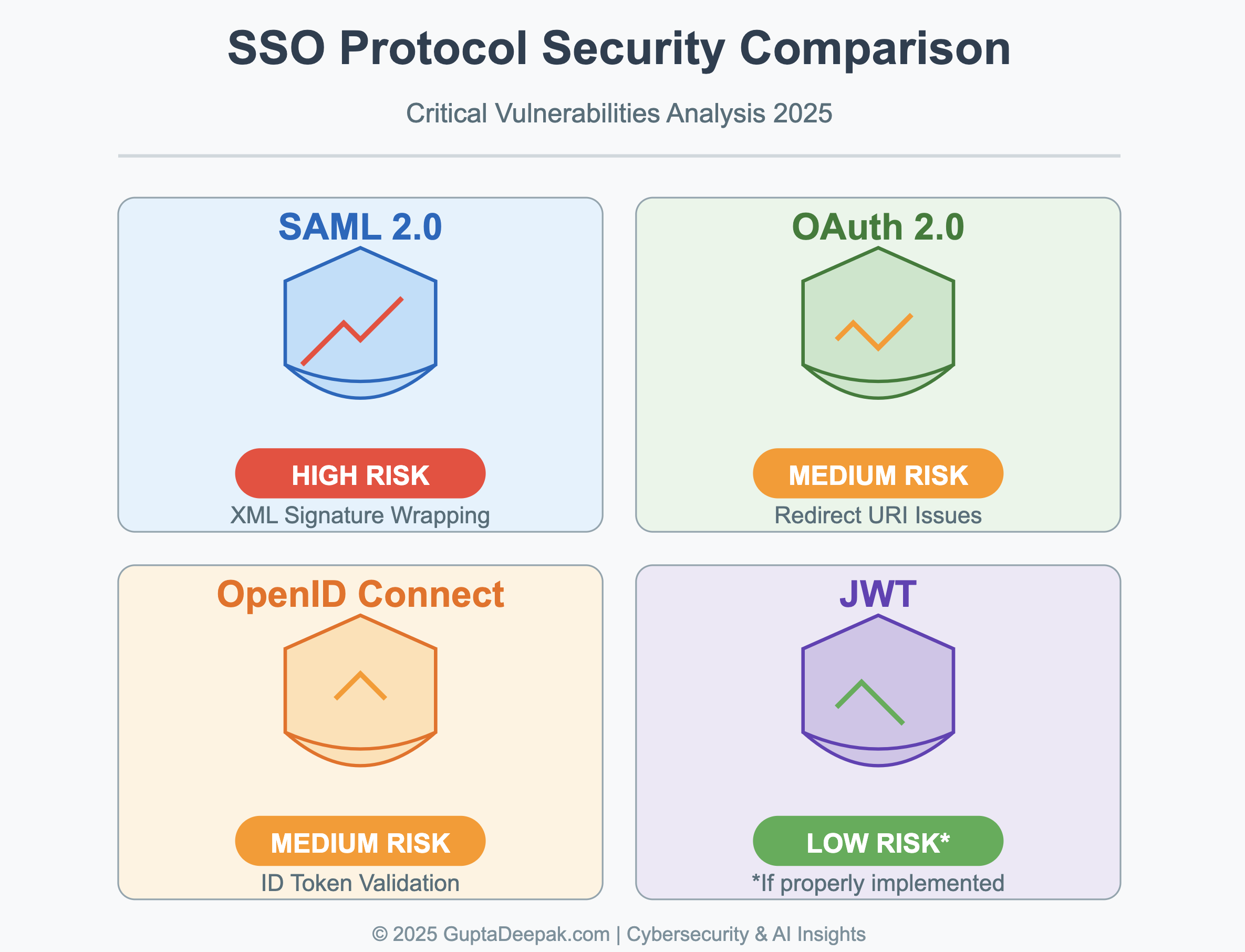
SAML has been plagued by a series of high-impact vulnerabilities, largely due to the complexity of XML signature processing and token handling. Key vulnerability classes include XML signature wrapping, incorrect XML canonicalization, replay attacks, and flaws in specific SAML product implementations. Many of these allow an attacker to forge or alter SAML assertions and thereby impersonate users.

  • XML Signature Wrapping (XSW) Attacks: This is the most infamous SAML flaw. First documented in the late 2000s, XSW exploits the flexibility of XML signatures. An attacker injects elements into a SAML response such that the IdP's signature still validates, but the SP interprets a different, unsigned portion as the asserted identity. Essentially, the attacker "wraps" a fake assertion around a valid signature. XSW vulnerabilities have reappeared repeatedly over the years. For example, in 2024, a critical bug (CVE-2024-45409) in the widely used Ruby SAML library allowed an attacker to log in as any user by forging a SAML response. This issue impacted platforms like GitLab and other Ruby-based SAML SPs. The recurring nature of XSW is highlighted by security researchers: "this attack keeps coming up again and again… affecting huge swaths of the internet". Recent CVEs related to XSW include CVE-2024-6202 (HaloITSM, critical SAML user impersonation) and CVE-2024-6800 (GitHub Enterprise Server, SAML SSO bypass).
  • XML Canonicalization and Parser Bugs (2018 Multiple Libraries): In 2017–2018, researchers from Duo Security (Kelby Ludwig et al.) discovered a broad class of SAML implementation bugs affecting numerous open-source SAML toolkits. These libraries failed to properly handle certain XML structures (comments and DOM traversal), allowing portions of an unsigned SAML message to be interpreted as valid despite not being covered by the signature. The result was an authentication bypass – an attacker could modify SAML data after the signature, and the SP would still accept it as valid, logging in the attacker. CERT Coordination Center issued VU#475445 on this issue, and multiple CVEs were assigned across different SAML SDKs, including OneLogin's python-saml (CVE-2017-11427) and ruby-saml (CVE-2017-11428), the saml2-js library (CVE-2017-11429), OmniAuth SAML for Ruby (CVE-2017-11430), Shibboleth's OpenSAML in C++ (CVE-2018-0489), and others. These flaws were easy to exploit and had critical impact (authentication bypass). Vendors responded with patches in early 2018 once the issue became public, and advisories (e.g., from Shibboleth and others) urged immediate library updates. Okta's security team noted the attack "can be used to bypass authentication in a sinisterly simplistic way". (Notably, Okta itself was not vulnerable, as it did not use the affected libraries.)
  • Assertion Replay / Missing Expiration Enforcement: Some SAML bugs involved failure to enforce token expiration or replay protections. For instance, CVE-2018-14637 was a flaw where a SAML SP ignored the expiration (NotOnOrAfter) on SAML assertions, allowing an attacker to reuse an old SAML response (replay attack). While less complex than signature attacks, the impact (session hijacking) is still serious. Proper checking of SAML Conditions timestamps and one-time use of assertions (via <Assertion ID> or one-time tokens) is essential to mitigate replay.
  • Vendor-Specific Flaws: Enterprise SSO products built on SAML have had their share of issues. For example, Oracle Access Manager (an enterprise SSO/Federation server) suffered a critical vulnerability (CVE-2021-35587) that allowed unauthenticated remote takeover of the SSO system. Oracle's advisory doesn't detail the mechanics, but a CVSS 9.8 suggests a trivial exploit path, possibly an open endpoint that accepts malicious SAML or a default credential. Another example: Shibboleth's SAML SP software in 2023 had an SSRF (Server-Side Request Forgery) flaw in its XML parsing – a malicious <KeyInfo> element in a SAML response could trick the SP into fetching external URLs. This SSRF bug (fixed in OpenSAML XMLTooling V3.2.4) could lead to DoS or be combined with other attacks. While not an auth bypass itself, it illustrates the ongoing hardening needed in XML-based SSO implementations.

Impact and Exploitability: SAML vulnerabilities are often high impact, typically allowing full authentication bypass – essentially letting an attacker impersonate arbitrary users at the service provider. For instance, the XSW flaw in Ruby SAML (CVE-2024-45409) was rated 9.8 Critical (network exploitable, no auth needed, complete compromise of confidentiality/integrity).

Exploit complexity varies: some attacks require the attacker to entice a user to visit a malicious IdP or interception of a SAML message, whereas others (like XSW) can be executed by directly crafting a SAML response if the SP will consume it (often the attacker needs a position to inject the response in the SSO flow). The XML-centric nature (XPath, XML DSig) means many vulnerabilities arise from subtle parsing logic – tough to spot in code, but once public, they are straightforward to exploit with off-the-shelf scripts.

Importantly, these issues keep recurring because the SAML spec is complex and "begs engineers to [make mistakes]" in validation logic. The frequency of critical SAML bugs has been significant: major waves in ~2012, 2018, and mid-2020s, plus sporadic CVEs in between. On the positive side, vendor response has become more responsive over time – after the 2018 CERT advisory, most library maintainers patched quickly (within days or weeks) and disseminated fixes.

However, fully eliminating XSW has proven difficult, as evidenced by its resurgence in 2024. Enterprise vendors now incorporate SAML patches into regular updates (e.g., Oracle's Critical Patch Updates) and cloud SSO providers closely audit their SAML flows (many have moved to OIDC/ OAuth tokens where possible to reduce XML attack surface).

Security Vulnerabilities in OAuth 2.0

OAuth 2.0 is an authorization framework, but its widespread use for login (via "OAuth dance" or as part of OIDC) means its security flaws can lead to account breaches and token leaks. The core OAuth 2.0 spec has known weaknesses (some design trade-offs), and many implementation bugs have been uncovered in OAuth deployments. Unlike SAML's cryptographic XML issues, OAuth vulnerabilities often involve logic and web security issues: open redirects, improper state parameter usage (CSRF), mis-validating redirect URIs, and insecure token handling. Below we summarize notable OAuth-related vulnerabilities:

  • OAuth "Open Redirect" (Covert Redirect) Weakness: OAuth relies on redirecting users between the client (relying party) and authorization server. Attackers have long abused open redirectors on trusted domains to craft URLs that hijack OAuth flows. In 2014, a widely discussed issue named Covert Redirect showed how if a provider or client has a poorly validated redirect_uri, an attacker could intercept the authorization code or token by redirecting to a malicious site. For example, an attacker could initiate an OAuth flow pointing to redirect_uri=http://attacker.com/auth on a client that doesn't strictly validate the domain. After user login, the authorization server (e.g., Facebook) would redirect with the token/code to the attacker's domain. Many OAuth providers added stricter validation to mitigate this (requiring exact match redirect URIs or disallowing open redirects), but some third-party apps still misconfigure this. Research in 2023 found several major IdPs were vulnerable to redirect URI manipulations (path confusion or parameter pollution) that could be exploited to leak tokens.
  • CSRF and Lack of State Parameter: OAuth 2.0's implicit and authorization code flows are susceptible to cross-site request forgery on the client, potentially causing an OAuth login CSRF. The spec recommends a state parameter to carry a nonce, so the client can confirm the response is tied to the request. Yet many implementations historically forgot to use or verify state. This led to real-world bugs where an attacker could trick a user into logging in to the attacker's account or otherwise misdirect the OAuth response. For instance, a HackerOne report described an OAuth client not validating state, allowing an attacker to craft a consent URL such that the victim, when logging in, gets logged into the attacker's session. Essentially, the victim's OAuth grant is hijacked to the attacker's account on the target service. This is a login CSRF – not a takeover of the victim's account, but rather a confusion attack that could be a stepping stone to other attacks (for example, linking the victim's social login to an attacker's account). Modern best practice is to always use state (and in OIDC, also nonce) and many libraries enforce this, but older or custom OAuth clients may still be vulnerable if they ignore state.
  • Authorization Code Interception (Without PKCE): OAuth's authorization code flow historically had an issue for native/mobile apps. Before the advent of PKCE (Proof Key for Code Exchange), if a native app used a custom URL scheme for redirect (e.g., myapp://callback), a malicious app on the device could register the same scheme and intercept the authorization code. The malicious app could then redeem that code to get the access token (essentially impersonating the legitimate app). This was a realistic threat on mobile platforms. PKCE (RFC 7636) mitigates it by binding the code to a code_challenge and verifier – the intercepted code alone is useless without the attacker also knowing the random verifier. PKCE became recommended for all clients (and is mandatory in OAuth 2.1). The vulnerability here was not a "bug" in OAuth per se, but a gap in the original design addressed by a later extension. Still, apps not implementing PKCE remained vulnerable to token theft via code interception until they upgraded.
  • Bearer Token Leakage (Implicit Flow and Otherwise): OAuth access tokens (and OIDC id_tokens) are often bearer tokens – any party that possesses the token can use it. The older implicit flow, where the access token is returned in the URL fragment, has been criticized for leaking tokens (e.g., through browser history, referer headers, or injected scripts). If an app served the access token in the redirect URL without response_mode=form_post, it could end up in the browser address bar or logs. Attackers could steal tokens via XSS or sniffing network traffic if TLS is not enforced. Additionally, long-lived tokens or absence of TLS can turn any token interception into a full compromise. Modern guidance deprecates the implicit flow due to these risks. Even with authorization code flow, mismanagement of tokens on the client side (storing in localStorage vulnerable to XSS, not using HTTPS, etc.) can lead to leakage. These are more general web security issues but directly affect OAuth token security.
  • Ambiguities in JWT Profiles (spec vulnerability): OAuth 2.0 has optional mechanisms for client authentication and for passing tokens (JWT profiles, JAR, etc.). A recent formal analysis in 2025 identified a subtle vulnerability in how JWT audience values are used in OAuth/OIDC protocols. The issue, disclosed by the OpenID Foundation, is that the specification for private_key_jwt (an OAuth/OIDC client auth method using JWTs) had ambiguities that could potentially be exploited. It was assigned CVE-2025-27371 for OAuth 2.0's spec (and CVE-2025-27370 for the OpenID spec). While details are complex, it could allow an attacker to craft a JWT that an authorization server might accept illegitimately due to confusion about the audience claim. Notably, no known compromises occurred from this, as it was caught by researchers proactively. The OAuth and OpenID communities updated the specifications and certification tests to close this gap. This example shows the maturity of OAuth/OIDC: even spec flaws are now being formally checked and promptly addressed.
  • Implementation-Specific Vulnerabilities: Numerous CVEs exist for specific OAuth implementations:
    • OAuth Frameworks/Libraries: E.g., CVE-2025-31123 in Zitadel (open-source IdP) – it failed to check key expiration when using JWT for auth grants, allowing an attacker with an expired key to still obtain access tokens. Another example: a race condition in Duende Software's .NET OAuth token management (CVE-2025-26620) could mix up tokens between requests (a less common scenario).
    • Vendor OAuth Services: While big providers (Google, Microsoft, etc.) seldom have publicly known CVEs, there have been logic bugs. For instance, Microsoft had a known issue where abusing MS OAuth endpoints in certain ways led to token injection (sometimes dubbed "OAuth 2.0 Mix-up" or similar, as reported in conferences).
    • OAuth in Cloud Products: An example is CVE-2025-27672 in PrinterLogic (Vasion) which allowed an OAuth security bypass – likely an implementation bug where an attacker could skip the OAuth flow altogether.

Impact and Response: OAuth vulnerabilities can sometimes be as severe as SAML's (e.g., complete login bypass or token theft), but many are less direct. Often, an OAuth attack requires phishing or an open redirect to trick a user into granting access, whereas a SAML XSW can be exploited against a vulnerable SP in a single crafted response. Thus, exploitability is often medium – requiring user interaction or specific misconfigurations – and impact ranges from session hijacking to account impersonation. Still, critical cases exist (e.g., improper validation allowing straight token forgery is on par with SAML issues).

Frequency: logic flaws in OAuth integrations are discovered regularly by security researchers (often reported via bug bounty programs or academic papers). Many are unique to a particular service or library rather than systemic in the protocol.

Vendor response in the OAuth space is generally quick: cloud providers quietly fix issues in their authorization servers once reported. Open-source OAuth libraries (e.g., the Python oic library in CVE-2020-26244) also patch promptly when cryptographic flaws are reported. The OAuth 2.0 spec itself evolved (with PKCE, security BCPs) to mitigate earlier weaknesses. In summary, while OAuth's simpler design avoided XML-specific bugs, it has required constant vigilance for logic errors and evolved best practices to maintain security.

Security Vulnerabilities in OpenID Connect (OIDC)

OpenID Connect builds on OAuth 2.0, inheriting all the OAuth issues above, and adds its own ID token handling and discovery mechanisms, which have introduced additional vulnerabilities. The most critical OIDC-specific issues revolve around ID Token validation (or lack thereof) and IdP mix-up between multiple providers.

  • Failure to Validate ID Token Signatures and Claims: OIDC's ID Token is a JWT that must be validated by the client (relying party). Mistakes in this validation have led to serious bugs. For example, the Python oic library (used for OIDC client implementations) had multiple vulnerabilities (CVE-2020-26244) where it did not automatically check the ID Token's signature algorithm or none usage, and could even return an ID token without verification. Specifically, this CVE enumerated: (1) the library did not verify the JWT's alg unless the calling code explicitly passed an expected algorithm; (2) it allowed the alg: none (no signature) token in all flows; (3) it returned ID tokens to the app without validating them, leaving it up to the implementer to call a separate verify function; (4) it didn't check the iat (issued-at) for sanity. Combined, these flaws could let an attacker provide a bogus ID token (unsigned or wrongly signed) that the client would accept – resulting in user impersonation. Many of these are essentially JWT issues manifesting in OIDC; similar bugs were seen in other languages or earlier libraries (e.g., an old Auth0 library version accepted alg:none tokens). Proper OIDC client implementations must verify the ID token's signature using the IdP's public keys, ensure the iss (issuer) and aud (audience) claims match the expected values, and enforce token freshness (exp and iat). Any lapse in these checks is a potential critical vulnerability.
  • OIDC "Mix-Up" Attack: Discovered by researchers in 2017, the mix-up attack is a protocol-level vulnerability that can occur when a client (relying party) talks to multiple identity providers. An attacker could initiate an OIDC login with a malicious IdP and cause the client to mix up responses from a legitimate IdP vs. the attacker's IdP, potentially leading the client to accept an ID token from the attacker's IdP as if it came from the legitimate one. In practice, this attack is mitigated by the OIDC spec's requirement that clients check the iss (issuer) in the ID token against the provider they intended to send the request to. Additionally, OIDC introduced a iss parameter in the authorization response for cases where multiple IdPs might use the same redirect URI, and the client can also record which issuer it expected. The mix-up attack is more theoretical (no known widespread exploits in the wild after it was disclosed), but it underscores the importance of strict issuer validation and not assuming one IdP's token can be accepted in place of another.
  • Nonce and Session Fixation Issues: OIDC extends OAuth by using a nonce parameter in authentication requests to bind the ID token to the session that initiated the request. If the nonce is not checked, an attacker might perform an ID token replay or a session fixation attack. A concrete case was CVE-2024-10318, a session fixation flaw in the NGINX OpenID Connect reference implementation. The IdP's response nonce wasn't being validated at the client, meaning an attacker could reuse a valid ID token (with a known nonce) to log in a victim or themselves as the victim on a target service. Essentially, an attacker could trick a user into accepting an ID token that wasn't actually freshly issued for that login. The fix was to properly verify the nonce value corresponds to the one sent in the OAuth/OIDC request. This type of bug is similar to not verifying the state parameter – it breaks the intended binding of responses to request origins.
  • Account Linking and Audience Confusion: Many applications allow logging in via multiple IdPs (Google, Facebook, enterprise IdP, etc.). Implementation oversights in how they link accounts can create vulnerabilities. For example, if an application doesn't properly distinguish ID tokens from different issuers, an attacker might be able to use an ID token from one context in another. OIDC's design expects that each client is configured per issuer, but misconfiguration could lead to accepting a token from a social provider where a corporate IdP token is expected (and vice versa). No specific CVE for this scenario, but it has been noted in penetration testing guides (always check the iss and client ID audience). The recent OpenID Foundation disclosure about ambiguous audience values in client-auth JWTs also hints at how confusion in token audience/issuer can introduce vulnerabilities if not tightly specified.
  • Discovery and Dynamic Client Registration Issues: OIDC has a discovery mechanism (metadata JSON documents) and dynamic client registration. Flaws in parsing discovery could lead to using a malicious IdP unintentionally. For instance, a vulnerability in XWiki's OIDC implementation (CVE-2022-39387) allowed a user to supply a custom OIDC provider in the request even if the wiki had a fixed IdP configured. This means an attacker could potentially use their own IdP to issue tokens that XWiki would trust (since it didn't enforce the configured provider), an obvious authentication bypass. Similarly, if an OIDC client erroneously trusts information from an unvalidated discovery URL, it could be pointed to a hostile IdP.

Impact and Response: OIDC vulnerabilities, when they occur, typically allow user impersonation or token theft, similar to OAuth. However, thanks to extensive formal security analysis (e.g., by researchers like Fett, Küsters, Schmitz in 2017), the core OIDC protocol is robust – many potential flaws were identified and addressed in the design. Most issues now arise in implementation.

The frequency of OIDC-specific CVEs is moderate; many issues reported are actually generic OAuth or JWT issues. When OIDC bugs do surface (like CVE-2020-26244 in a client library), they are patched swiftly given the security-conscious user base. Vendors of OIDC providers (e.g., cloud IdPs like Azure AD, Okta) usually fix things behind the scenes; open-source projects like mod_auth_openidc or IdentityServer also have good track records of prompt fixes.

For example, the NGINX OIDC nonce bug (CVE-2024-10318) was fixed by November 2024 with an update to the module. The OpenID Foundation's coordinated disclosure in 2025 of spec ambiguities, with no known compromises, demonstrates a proactive approach. In summary, OIDC's additional ID token layer adds some complexity (and thus a few new vulnerability avenues), but also provides more explicit security features (issuer, audience, nonce) that, when used correctly, greatly limit attacks.

Security Vulnerabilities in JSON Web Tokens (JWT)

While not an SSO protocol by itself, JWT is integral to OAuth2/OIDC (and even used in some SAML token exchanges as an alternative format). JWTs have had their own share of vulnerabilities, primarily due to issues in how libraries validate tokens. The two most notorious bugs in JWT implementations are the "alg:none" attack and signature verification algorithm confusion:

  • "alg": "none" (Unauthenticated JWTs): The JWT standard defines an alg header that specifies the signing algorithm, and it includes "none" as a valid value (meaning the token is unsecured). This was intended only for scenarios where the token's integrity is guaranteed by external means, but early JWT libraries mistakenly treated alg:"none" as if it were a valid signature method even when a secret/key was expected. In 2015, researchers showed that in several libraries, if an attacker changed the JWT header to "alg": "none" and removed the signature, the library would accept the token as valid. Result: the attacker could modify the payload freely (e.g., set "admin": true or change the user ID) and the server would trust it, effectively bypassing authentication or authorization. This vulnerability was extremely easy to exploit (just tweak a JWT with base64 decoding/encoding) and catastrophic in impact (authentication bypass). It was documented under CVE-2015-2951 (for JOSE4J library in Java) and other identifiers, and was widely publicized by the Auth0 security team. Fortunately, most implementations quickly added a check to disallow none unless explicitly configured. As the Auth0 report noted, "most (hopefully all?) implementations now prevent this attack" by requiring a no-key scenario for none or disallowing it entirely.
  • HMAC-Signature Confusion (Public Key as Secret): JWT supports both symmetric (HMAC, e.g. HS256) and asymmetric (RSA/ECDSA, e.g. RS256) algorithms. In 2015, it was found that some libraries didn't properly handle tokens that used a different algorithm than expected. If a server was using an RSA public/private key pair (RS256) to verify tokens, an attacker could submit a token with header "alg": "HS256" and reuse the server's public key as the HMAC secret key. A vulnerable server would attempt to verify the HMAC using what it thinks is the secret – but it's actually the public key provided (since it mistakenly believes the token is now using a symmetric key). Because the attacker also knows the public key (it's public), they can sign the token with that key (as HMAC secret) and the server will accept it. In other words, the server interprets the public key as a shared secret, which the attacker also possesses. This allows forging an arbitrary token that passes verification. This flaw is essentially a failure to enforce algorithm consistency – the server should know it only expects RS256 tokens and reject ones claiming HS256, but if it doesn't, the attacker can confuse it. Like the alg:none issue, this was addressed by libraries adding explicit algorithm whitelisting or requiring the application to specify expected alg. The recommended fix is for the verify function to not trust the token's alg header and instead use server-side configuration. CVE-2016-10555 was assigned for one implementation of this bug (in a Node.js library), and generally multiple libraries were patched around 2015–2016 to fix it.
  • Key Management and Injection Flaws: Other JWT-related vulnerabilities include mistakes in key parsing or kid (Key ID) handling. For instance, if an application allows an attacker to supply their own public key and the server doesn't properly validate the token's kid, the attacker could trick the server into using a wrong key to verify. There have been CVEs (e.g., CVE-2018-1000531 mentioned in a JWT security analysis) where JWT libraries were too lenient in accepting keys or algorithms, leading to forgery. Another issue can be alg downgrade attacks in systems that accept multiple algs: if not careful, an attacker could get the system to use a weaker alg (though modern libraries typically tie a key to one algorithm).
  • JWT Replay and Storage Weaknesses: Even when JWTs are correctly validated, misuse can lead to vulnerabilities. For example, not all systems properly manage JWT revocation or expiration. If a JWT (especially a long-lived one like a refresh token or an OIDC id_token meant for one-time use) is captured by an attacker, they can reuse it until it expires. Some enterprise SSO solutions had issues where logout did not invalidate existing JWTs or where the same JWT could be used across applications not intended to share sessions. These aren't CVE-level bugs in JWT itself but design issues that security architects must consider (e.g., audience restrictions, short token lifespans, token binding to client IP or context, etc., to limit replay value).

Impact and Response: The critical JWT implementation bugs (alg confusion) were extremely impactful – effectively allowing an attacker to become any user – but those were largely handled in 2015–2016.

The frequency of new JWT-specific CVEs has dropped as libraries matured. One notable later issue was the Python OIDC CVE-2020-26244 we described, which again was about not enforcing alg and accepting none – essentially a re-emergence of past mistakes in a less popular library. This indicates that new or niche implementations might still make these mistakes if they aren't using well-known libraries.

Exploitability of JWT flaws is typically trivial once a vulnerable library is identified (for alg:none or key confusion, it's just crafting a token). On the flip side, if libraries are up-to-date, JWTs are secure by design (using strong cryptography like RS256 or ES256).

Vendor response time for JWT bugs has been good, in part because the vulnerability is usually in a self-contained library – maintainers can patch the library and all downstream applications that update will be secured. For example, when Auth0's team discovered the original issues, they provided patches or guidance and most major JWT libraries integrated those checks.

Developers and security teams today are generally aware of JWT risks; there are OWASP cheat sheets and tooling to test JWT handling. It's worth noting that JWT usage spans enterprise, cloud, and open-source: e.g., Microsoft's Azure AD issues JWTs for OIDC, open-source projects like Keycloak use JWTs, etc. Ensuring consistency in validation across these is crucial. Misconfigurations (like not pinning expected algorithm, or failing to rotate secrets) remain a potential weak link.

Comparative Analysis and Discussion

In this section, we compare the four technologies across several dimensions – frequency of vulnerabilities, ease of exploitation, typical impact severity, and how different vendor types respond. The following table summarizes the comparison:

Protocol Common Vulnerability Types Notable CVEs / Incidents Frequency & Recent Trend Exploitability Impact Vendor Response
SAML 2.0 – XML Signature Wrapping (XSW) attacks<br>– XML canonicalization & parsing bugs<br>– Replay of assertions (missing expiration checks)<br>– Implementation logic flaws (SSRF, injection) CVE-2017-11427…11430 (multi-library auth bypass);<br>CVE-2018-7644 (SimpleSAMLphp signature verification bypass);<br>CVE-2024-45409 (Ruby SAML, login as arbitrary user);<br>CVE-2024-6202 (HaloITSM, XSW user impersonation);<br>CVE-2021-35587 (Oracle Access Manager, takeover) Historically high volume of critical vulns. Big waves in 2012, 2018, 2024. Recent trend: XSW resurfacing in 2023–24 across languages. Continual patching needed; spec complexity means new variants keep appearing. Many SAML bugs are easy to exploit once known – e.g., crafting an XML with a forged assertion. Attacker often needs ability to feed a fake SAML response to SP (via user's browser or a malicious IdP). Requires knowledge of SP's SAML endpoint, but tools are available. Critical – Typically full authentication bypass (impersonation of any user). Attackers can gain unauthorized access to applications as legitimate users, including admin accounts, without credentials. Replay issues allow session hijack. Some bugs (SSRF) lower impact, but most affect authentication directly. Enterprise vendors issue patches in security advisories (e.g., Shibboleth, Oracle) and many moved to safer defaults (e.g., requiring signed entire response). After 2018's disclosures, open-source libs were patched promptly. Cloud SAML (e.g., Google, Azure) remained largely unaffected by those library bugs or patched internally (some have shifted emphasis to OIDC). However, SAML being older means some deployments run legacy versions – upgrades can lag, leaving long-tail risk.
OAuth 2.0 – Open redirect and improper redirect_uri validation<br>– Missing/weak state parameter (CSRF)<br>– Implicit flow token exposure<br>– Misuse of OAuth flows (e.g., using public clients without PKCE)<br>– Spec ambiguities in JWT profiles "Covert Redirect" (not a single CVE, but widely reported issue in 2014);<br>CVE-2025-27371 (JWT audience ambiguity in OAuth spec);<br>CVE-2025-31123 (Zitadel, expired key allows token issuance);<br>CVE-2025-27672 (PrinterLogic, OAuth bypass); <br>CVE-2019-9837 (Doorkeeper OIDC, open redirect via redirect_uri) Steady stream of medium-severity findings. Recent trend: focus on securing redirect URIs, PKCE now standard, formal analysis of spec in 2025 found rare flaw (fixed in spec). Fewer critical universal flaws than SAML; issues often specific to implementers. Moderate – Many attacks require tricking a user (social engineering) or exploiting a misconfig on the client side. For example, open redirect attacks require a user to click a crafted link. Attack complexity can be low if the target app is misconfigured (then attacker just crafts a URL), but overall more steps than injecting a single malicious token. Ranges from High to Moderate. Worst-case (like spec flaw or a token forgery bug) can allow account takeover (stealing tokens to access user data). Many OAuth bugs lead to token leakage or unintended login, which are serious but often need chaining of actions. The impact can be limited by scope – e.g., stealing an access token for one app might not compromise others. OAuth providers (Google, Facebook, etc.) respond quickly to security reports, often fixing quietly. Open-source projects (e.g., OAuth libraries) also tend to patch fast due to broad use. The OpenID/OAuth community actively updates recommendations (PKCE, threat mitigations) – e.g., OAuth 2.1 draft formalizes many security best practices. Enterprise products include OAuth fixes in routine updates (e.g., IBM, Oracle include in quarterly patches). Because OAuth issues often involve multiple parties (IdP, RP), coordination and clear communication (CERT bulletins, etc.) happen for bigger vulnerabilities.
OpenID Connect – ID token validation flaws (signature, issuer, audience, nonce)<br>– OIDC "mix-up" attack between multiple IdPs<br>– Insecure dynamic client registration or discovery<br>– Libraries inheriting OAuth issues (state, redirect) CVE-2020-26244 (Python OIDC lib, multiple ID token verification flaws);<br>CVE-2024-10318 (NGINX OIDC, nonce not checked – session fixation);<br>CVE-2022-39387 (XWiki OIDC, use of rogue IdP via request params);<br>CVE-2023-24424 (Jenkins OIDC plugin, session not invalidated – session fixation);<br>CVE-2025-27370 (OIDC spec private_key_jwt vulnerability) OIDC itself is newer; frequency of fundamental flaws is low (benefited from formal security proofs). Implementation issues still arise, often similar to OAuth's. Recent trend: ensuring libraries properly enforce nonce, alg, issuer checks (e.g., 2020 and 2024 CVEs above). Also, ecosystem addressing spec-level issue in Federation in 2025 before it caused harm. Moderate, akin to OAuth. Exploiting OIDC often means exploiting the client's validation: e.g., attacker must supply a crafted ID token or manipulate the flow (requires some access or trickery). If an RP is misconfigured to trust the wrong IdP, that's easy to exploit (just use your own IdP). If a library fails to verify signature, an attacker crafts a token – trivial if you know the flaw. Mix-up attacks are complex and largely theoretical with modern mitigations. When an OIDC validation bug exists, impact is Critical – e.g., forging an ID token lets attacker log in as any user (full account takeover). If only a nonce check is skipped, impact can be session fixation (attacker replaying a login response), which can also lead to impersonation in certain contexts. Many OIDC issues ultimately result in impersonation or authentication bypass, matching the severity of SAML/OAuth. OIDC providers (Azure AD, Okta, etc.) quickly patch server-side issues – often before public disclosure. OpenID Foundation oversees the standard's security: the 2025 spec vulnerability was handled by updating specs/tests rapidly. Open-source OIDC libraries, when alerted (as with the Python one), issue fixes and security advisories. In enterprise products (e.g., those supporting OIDC login), OIDC bugs are addressed in regular security updates. The community is quite proactive – e.g., collaboration with academics for formal analysis. Overall, response times have been good and there's an emphasis on backwards-compatible security improvements (like requiring nonce, recommending library default checks) to prevent common mistakes.
JWT (Token) alg: none acceptance (no signature check)<br>– Algorithm confusion (e.g., RSA vs HMAC as in HS256/RS256 mixup)<br>– Weak token encryption or no integrity check in some modes<br>– Poor token storage or reuse (replay issues) CVE-2015-2951 (JWT alg=none, JWT.io library);<br>CVE-2016-10555 (JWT HS256 public key confusion in node-jwt-simple);<br>CVE-2017-12979 (JOSE library in C, alg none) – as referenced by research;<br>CVE-2018-1000531 (Java JWT, insecure key parsing);<br>CVE-2020-15957 (Go JWT lib, alg none) – indicating issues persisted in some libs. Most critical JWT bugs were found around 2015–2017 when JWT usage surged. Frequency now is low; core libraries are stable. Occasional new CVEs when a new library or edge scenario is looked at (e.g., Python OIDC lib in 2020). As JWT is ubiquitous, any new flaw is quickly publicized. Easy if vulnerability present – crafting JWTs is straightforward with tools, and no special position needed (attacker just sends the fake token to the server). If no flaw, then JWTs are as hard to forge as the crypto (practically impossible). So it's feast or famine: either completely insecure (to anyone with a laptop) or secure. In vulnerable cases, Critical – complete authz/auth bypass (forging tokens with any claims). For example, with alg=none, an attacker could become an admin by modifying the token payload. With key confusion, any user could impersonate others. If JWTs are properly validated, impact then depends on other factors (the token's privileges, lifespan) – a stolen but valid JWT might have time-limited impact. Library maintainers responded rapidly circa 2015 once exploits were demoed. Today, popular JWT libraries explicitly prevent using "none" or mixing algs incorrectly. Vendors that build on JWT (cloud APIs, etc.) also implemented checks. For instance, Auth0 improved their JWT libraries' API to require specifying expected algorithms. Overall, the JWT community learned from early mistakes; updates and advisories were rolled out within days in many cases. One challenge is propagation – enterprise apps might use outdated libraries. But awareness is high: many security scans and pen-tests specifically look for JWT issues now, and devs are quick to apply patches given the severity.

Enterprise vs. Cloud vs. Open-Source

It's useful to distinguish how different environments handle these vulnerabilities:

Enterprise Software

Traditional on-premises SSO solutions (Oracle, IBM, CA SiteMinder, Microsoft ADFS, etc.) bundle SSO protocol support. They have had severe issues (e.g., Oracle Access Manager CVE-2021-35587, older ADFS "golden SAML" token forgery when token-signing cert stolen).

Enterprise vendors usually patch via scheduled Critical Patch Updates or Security Bulletins. The response time can vary: if an issue is public (like the 2018 SAML bug), vendors aim to patch fast. Oracle and IBM issued fixes for the SAML library issues in their products shortly after the CERT bulletin. A challenge is that enterprise customers must apply patches – if they delay, systems remain vulnerable. Enterprise implementations often have robust security teams, but also longer deployment lifecycles, meaning some older versions with known flaws might persist in the wild.

Cloud Services (SSO as a Service)

Cloud identity providers (Okta, Azure AD, Google Identity, AWS Cognito, etc.) can usually fix vulnerabilities on their end transparently. For example, when OAuth redirect flaws have been identified, Google tightened their allowed redirect URI patterns server-side. Azure AD, after incidents of token misuse, rolled out features like continuous access evaluation and stricter JWT validation.

OneLogin's 2017 breach (while not a protocol flaw, but an incident where decryption keys were stolen) highlighted that even cloud SSO is not immune to compromise. Cloud vendors tend not to have CVEs since they're not software distributed to users; instead, they publish security advisories or blog posts. Their response tends to be quick and decisive, often working with researchers under NDA until fixed. The down side is less transparency – we often hear of issues only through talks or brief notes rather than CVEs.

Open-Source Solutions

These include libraries (e.g., passport.js for Node OAuth, Spring Security SAML for Java) and full products (Shibboleth, Keycloak, etc.). Open-source projects rely on the community or academics to find bugs, but they also benefit from it – many of the vulnerabilities we discussed (SAML XSW, JWT bugs) were found by researchers and quickly communicated. For instance, Shibboleth's team has been exemplary in handling reports: the 2023 SSRF fix and previous SAML issues were addressed with clear advisories and patched versions.

Open-source libraries like SimpleSAMLphp, OneLogin's toolkits, etc., patched the 2018 SAML vulns promptly and issued public guidance. One challenge in open source is coordination – a flaw in a widely used library can affect dozens of products (as seen in SAML and JWT cases). CERT bulletins (like VU#475445) help coordinate here, listing all affected projects. The community nature also means open-source solutions often adopt preventive measures quickly – e.g., after JWT issues, almost all libraries added stricter defaults. The frequency of discoveries in open source might seem higher (because of transparency), but that also means issues get fixed before attackers exploit them widely.

Conclusion

SSO protocols have proven to be both indispensable and at times vulnerable. SAML's rich but complex XML framework has yielded multiple critical vulnerabilities over the years, whereas OAuth/OIDC, while simpler and benefiting from iterative improvements, have had their share of logic and implementation flaws. JWT, as a cornerstone of token-based auth, had early growing pains with serious security bugs that are now largely resolved in mature libraries.

For security professionals and decision-makers, the key takeaways are:

  • Stay Updated: Keep SSO software and libraries up to date. Many high-impact vulnerabilities (across SAML, OAuth, OIDC, JWT) are fixed in recent versions – e.g., upgrading SAML libraries post-2018 patches, using OAuth 2.1/PKCE, ensuring JWT libraries from 2016 onward.
  • Defense in Depth: Use protocol features as intended – enforce signature validation, use state and nonce, restrict redirect URIs, short token lifetimes, etc. Many exploits succeeded because optional security measures were not implemented.
  • Monitor Advisories: Subscribe to CERT, vendor bulletins, and the OpenID Foundation announcements. The OpenID Foundation's 2025 disclosure is an example of heads-up communication about spec-level issues. Vendors like Microsoft, Oracle, IBM, and open-source communities (Shibboleth, OAuth.net) regularly publish security notices.
  • Incident Response and Hardening: Plan for the worst – e.g., token theft can happen, so design least-privilege scopes and the ability to revoke tokens. In SAML, protect your IdP's signing keys (as the "Golden SAML" attack shows – if attackers get your cert, they can mint valid SAML for any user). Consider moving to or adding OIDC/OAuth flows which have less XML attack surface, if feasible, or use modern SAML profiles that limit complex features.
  • Comparative Risk: Recognize that while SAML has a history of more frequent critical flaws, a well-hardened SAML deployment can be very secure – and conversely, a poorly implemented OAuth client can be phished easily. No protocol is magically safe; implementation quality and prompt patching are paramount. OIDC, being built on lessons from SAML and OAuth, strikes a good balance but still demands correct usage of its features.

In conclusion, the state of SSO protocol security in 2025 is one of improved resilience but constant vigilance. The community has responded to past failures with stronger standards and quicker patch pipelines. By keeping abreast of vulnerability disclosures (from historical CVEs to emerging research) and proactively applying mitigations, organizations can confidently leverage SSO benefits without undue risk. The collaborative efforts of vendors, open-source maintainers, and researchers are steadily raising the bar, making the SSO ecosystem safer for everyone.


https://ift.tt/ZanRu7B
https://ift.tt/1sNFKg3

https://guptadeepak.com/content/images/2025/04/SSO-Protocol-Security-Comparison.png
https://guptadeepak.weebly.com/deepak-gupta/security-vulnerabilities-in-saml-oauth-20-openid-connect-and-jwt

Tuesday, 22 April 2025

A Comparative Analysis of Anthropic's Model Context Protocol and Google's Agent-to-Agent Protocol

1. Introduction

A Comparative Analysis of Anthropic's Model Context Protocol and Google's Agent-to-Agent Protocol

The rapid evolution and increasing prevalence of AI agents are driving a need for standardized protocols that facilitate their seamless integration and interoperability. In this dynamic landscape, two prominent protocols have emerged: Anthropic's Model Context Protocol (MCP) and Google's Agent-to-Agent Protocol (A2A). Each protocol addresses distinct, yet potentially overlapping, facets of the burgeoning AI agent ecosystem.

This report undertakes a comprehensive analysis of both MCP and A2A, meticulously examining their respective purposes, functionalities, technical specifications, intended use cases, benefits, and limitations. Furthermore, the report will draw a detailed comparison between these protocols, aiming to provide valuable insights into their individual strengths, weaknesses, and the potential for synergy in shaping the trajectory of AI agent development and deployment.

2. Anthropic's Model Context Protocol (MCP)

2.1. Purpose and Core Concepts

Anthropic's Model Context Protocol (MCP), introduced in late November 2024, is an open standard designed to tackle the challenge of fragmented integrations that have historically plagued the connection between AI models and external data repositories, business tools, and development environments. The primary aim of MCP is to enable frontier AI models to generate more relevant and higher-quality responses by providing them with a standardized and efficient way to access the data they require. It functions as a universal and open conduit for linking AI systems with diverse data sources, often likened to a "USB port" for AI applications, offering a consistent interface that eliminates the need for custom coding for each new data source or service. The fundamental objective of MCP is to replace the current landscape of disparate, ad-hoc integrations with a unified protocol, thereby simplifying the development process and significantly enhancing the scalability of AI-powered systems that rely on external information.

The introduction of MCP underscores a critical impediment in the advancement of artificial intelligence: the inherent difficulty in establishing effective connections between highly capable AI models and the vast amounts of real-world data necessary for their optimal performance. Even the most sophisticated models are often confined by their isolation from relevant data, residing behind information silos and within legacy systems. The prevalent approach of developing custom integrations for each new data source has proven to be a significant obstacle to scaling truly connected AI systems. MCP directly confronts this challenge by offering a common and open language that standardizes how AI systems access and interact with data, representing a significant step towards making AI more contextually aware and practically applicable across various domains.

2.2. Functionality and Architecture

MCP operates on a client-server architectural model. This architecture comprises three primary components: the MCP Host, the MCP Client, and the MCP Server. The MCP Host is the AI-powered application or agent environment, such as the Claude Desktop application or an integrated development environment (IDE) plugin, that serves as the primary interface for user interaction. Notably, an MCP Host can establish connections with multiple MCP Servers concurrently.

The MCP Client acts as an intermediary component residing within the host application. Its role is to manage the connection to a single, specific MCP Server, thereby ensuring a degree of isolation and enhancing security. For each MCP Server it needs to interact with, the host application spawns a dedicated MCP Client, maintaining a one-to-one relationship between the client and the server.

The MCP Server is typically an external program that implements the MCP standard. Its primary function is to provide access to a specific set of capabilities, which often include a collection of tools, access to various data resources, and predefined prompts tailored to a particular domain. An MCP Server might interface with a diverse range of data sources, such as a database, a cloud service, or virtually any other system containing relevant information.

This deliberate separation of responsibilities within the MCP architecture fosters a high degree of modularity and facilitates scalability in AI application development. By isolating the logic for data access within dedicated servers, developers of AI applications can concentrate their efforts on refining the user interface and enhancing the core AI functionalities. Similarly, providers of data can focus on securely exposing their information through MCP Servers without requiring an in-depth understanding of every specific AI model that might potentially connect to their systems. This division of labor streamlines the development lifecycle and encourages a more specialized approach to building connected AI solutions.

2.3. Technical Specifications

The communication backbone of MCP relies on JSON-RPC 2.0 messages, a lightweight and widely adopted remote procedure call protocol that facilitates structured data exchange between the client and the server. MCP defines a set of fundamental message types, known as "primitives," that govern the interactions between the client and the server. These primitives are categorized as either server-side or client-side.

On the server side, three primary primitives are defined:

  • Resources: These represent structured data that the server can provide to the client, which in turn enriches the context available to the AI model. Examples include document snippets, fragments of code, or any other form of information that can be included in the model's prompt.
  • Tools: These are executable functions or actions that the AI model can instruct the server to invoke. Examples might include executing a query against a database, performing a search on the web, or posting a message to a communication platform.
  • Prompts: These are pre-prepared instructions or templates that the server can offer to guide the AI model in performing specific tasks. They are akin to stored prompts or macros that can be used to direct the model's behavior.

On the client side, two key primitives are defined:

  • Roots: These represent entry points into the host application's file system or environment that the server might be granted access to, subject to user permissions. For instance, this could allow a server to access specific local files if explicitly authorized by the user.
  • Sampling: This is a more advanced primitive that enables the server to request the host AI model to generate a completion based on a provided prompt. This feature allows for more complex, multi-step reasoning processes, where a server-side agent could potentially call back to the model for sub-tasks. Anthropic emphasizes that any use of the Sampling primitive should always require explicit human approval to prevent unintended or runaway self-prompting.

Communication between MCP Clients and Servers can occur through various methods, including standard input/output (stdio) when both components are running on the same machine, which is particularly useful for local integrations. For remote or networked connections, MCP leverages HTTP-based protocols, with Server-Sent Events (SSE) planned or implemented for efficient streaming of data.

A fundamental aspect of MCP's design is its strong emphasis on security and user consent. The protocol mandates explicit user authorization for any data access initiated by a server and for the execution of any tools. This ensures that users maintain control over what information is shared and what actions are taken by AI systems interacting through MCP.

The technical specifications of MCP, particularly the use of JSON-RPC and the clearly defined primitives, establish a structured and standardized framework for interaction between AI models and external systems. The inclusion of the "Sampling" primitive suggests a forward-looking approach towards enabling more sophisticated agentic behaviors. Furthermore, the significant focus on security underscores the critical importance of responsible data handling and controlled execution in AI applications.

2.4. Intended Use Cases and Applications

The versatility of MCP lends itself to a wide array of use cases and applications, particularly in scenarios where AI needs to interact with existing data and systems. One prominent application is in the development of enterprise data assistants, which can securely access a company's internal data, documents, and services to answer employee queries or automate specific tasks. Imagine a corporate chatbot capable of seamlessly querying multiple internal systems, such as HR databases, project management tools, and communication platforms, all through standardized MCP connectors.

MCP also plays a crucial role in AI-powered coding assistants that integrate with IDEs. These integrations can leverage MCP to access extensive codebases and documentation, providing developers with more accurate code suggestions and deeper insights. Similarly, MCP simplifies the process of connecting AI models to databases, streamlining data analysis and reporting workflows for AI-driven data querying tools.

Desktop AI applications can also benefit significantly from MCP, enabling them to securely access local files, applications, and services on a user's computer. This enhances their ability to provide contextually relevant responses and perform tasks based on local information. Furthermore, MCP can facilitate the automation of various tasks, such as data extraction from websites and web searches, by allowing AI agents to access specialized tools.

The protocol also supports applications requiring real-time data processing and interaction with sensors, opening up possibilities for AI in dynamic environments. Complex workflows that involve coordinating multiple tools, such as file systems and version control systems, can also be managed effectively through MCP. To expedite adoption, pre-built MCP servers are either available or under development for a range of popular enterprise platforms, including Google Drive, Slack, GitHub, Git, Postgres, and Puppeteer.

The diverse range of intended use cases highlights MCP's potential to serve as a foundational technology for a more deeply integrated and context-aware AI ecosystem, particularly within enterprise settings and on individual user devices. The emphasis on secure and standardized data access makes it a valuable tool for organizations looking to leverage AI in a responsible and scalable manner.

2.5. Benefits

The adoption of Anthropic's Model Context Protocol offers several key benefits for developers and organizations seeking to integrate AI models with external systems. Primarily, MCP significantly simplifies the often complex process of integration between AI models and a multitude of external data sources and tools. By providing a standardized protocol, it eliminates the need for custom-built connectors for each unique combination of AI model and external system, streamlining development efforts and reducing the associated overhead.

Furthermore, MCP substantially enhances the context awareness of AI models by granting them access to real-time and relevant data from external sources. This capability allows AI systems to ground their responses and actions in the most up-to-date information, leading to more accurate and useful outcomes. The protocol also fosters the development of more autonomous and intelligent AI agents that can proactively access and utilize external resources to perform tasks on behalf of users. By streamlining data access, MCP contributes to improved efficiency in AI applications, enabling faster and more accurate responses.

MCP offers a standardized architecture for establishing connections between AI systems and data sources, which promotes greater interoperability across different platforms and vendors. Security and compliance are also strengthened through the controlled access mechanisms and the requirement for explicit user consent before data is accessed or tools are executed. The protocol's design facilitates the creation of composable integrations and workflows, allowing developers to build more complex and adaptable AI solutions. Ultimately, by standardizing the integration process, MCP helps to reduce both the initial development time and the ongoing maintenance costs associated with connecting AI to the external world.

These benefits collectively suggest a transformative potential for MCP in enabling a more deeply integrated and capable AI landscape. The emphasis on standardization, context awareness, and security points towards a future where AI systems can interact with the digital world in a more seamless, reliable, and responsible manner.

2.6. Limitations and Challenges

Despite the significant advantages offered by MCP, several limitations and challenges warrant consideration. One potential concern revolves around the stateful communication requirement between clients and servers, which might introduce complexities in terms of scalability and resource management, particularly in high-demand environments. Furthermore, when integrating a large number of tools via separate MCP connections, there is a risk of overwhelming the context window of the underlying large language model (LLM), potentially impacting performance and the accuracy of tool recommendations.

Another aspect to consider is the indirect nature of the interaction between the LLM and external tools within the MCP framework. The LLM generates structured outputs specifying the tool and its parameters, which are then executed by the MCP client, with the results being passed back to the LLM. This indirect interaction, while providing a layer of abstraction and control, might introduce additional complexity in certain scenarios. Integrating with existing tools that primarily utilize stateless REST APIs could also present challenges, potentially requiring the development of intermediary layers to manage session state and translate communication styles to align with MCP's stateful model.

The error handling within MCP is largely defined by each individual API provider, meaning that a standardized error-handling framework is not enforced by the protocol itself. This lack of uniformity could potentially lead to inconsistencies in how errors are reported and managed across different MCP integrations. While MCP offers strong support for local connections, its current design might present barriers for large-scale enterprise deployments in cloud-native environments where high-throughput operations are essential. Some feedback has also indicated that the existing documentation for MCP can be overly focused on implementation details, which might make it more difficult for teams to quickly grasp the broader benefits and high-level concepts of the protocol. As an open-source project, MCP also faces the inherent risk of potential fragmentation if competing standards emerge or if achieving consensus on future protocol updates proves challenging.

These limitations highlight areas where further development and refinement of the MCP protocol, as well as careful consideration during implementation, will be crucial for its continued success and widespread adoption. Addressing the challenges related to state management, context window size, and integration with existing systems will be key to unlocking the full potential of MCP in diverse deployment scenarios.

3. Google's Agent-to-Agent Protocol (A2A)

3.1. Purpose and Core Concepts

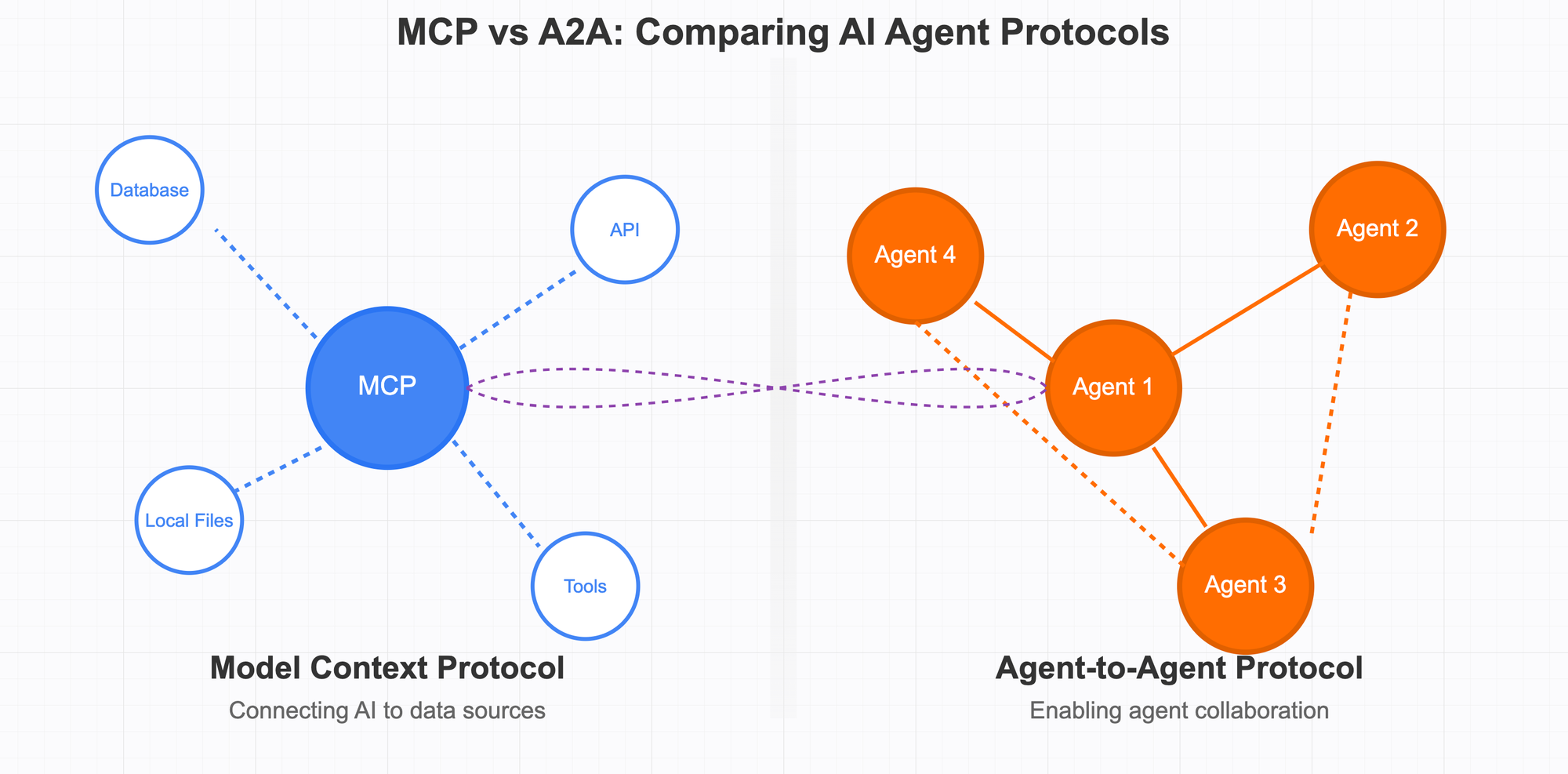
Google's Agent-to-Agent Protocol (A2A) is an open standard specifically designed to facilitate seamless communication and robust interoperability between diverse AI agents. A key objective of A2A is to enable agents built using different frameworks or by various vendors to effectively collaborate and work together, providing them with a common language for interaction. Google has explicitly positioned A2A as a complementary protocol to Anthropic's Model Context Protocol (MCP). In this complementary model, MCP primarily focuses on equipping individual AI agents with the necessary tools and contextual information to perform their tasks, while A2A addresses the critical need for these agents to communicate and coordinate their actions with other autonomous agents.

The introduction of A2A reflects a growing understanding within the AI community regarding the importance of collaboration among autonomous AI entities to tackle increasingly complex challenges. This development signifies a broader trend towards the creation of more sophisticated, multi-agent systems capable of distributed problem-solving. Google's strategic positioning of A2A as a companion to MCP indicates a recognition that both the capabilities of individual agents (enhanced by protocols like MCP) and the ability for these agents to interact and coordinate their efforts (facilitated by protocols like A2A) are essential components of a comprehensive and effective AI ecosystem. As AI agents become more integral to various aspects of our digital lives and business operations, the ability for them to communicate and collaborate seamlessly will be paramount for realizing their full potential in addressing complex, multi-faceted tasks.

3.2. Functionality and Architecture

The Agent-to-Agent (A2A) protocol is designed to facilitate communication between a "client" agent, which initiates a task, and one or more "remote" agents, which are responsible for acting upon those tasks. The protocol defines several key concepts that govern this interaction:

  • Agent Card: This is a fundamental element of the A2A protocol, serving as a public metadata file, typically located at the well-known URL /.well-known/agent.json. The Agent Card provides a description of an agent's capabilities, the specific skills it possesses, its network endpoint URL, and any authentication requirements necessary to interact with it. Client agents utilize these Agent Cards for the crucial process of discovering other agents within the ecosystem.
  • A2A Server: An A2A Server is essentially an AI agent that exposes an HTTP endpoint and implements the methods defined by the A2A protocol specification. Its primary responsibilities include receiving requests from client agents and managing the execution of the tasks contained within those requests.
  • A2A Client: An A2A Client can be either a standalone application or another AI agent that consumes the services offered by A2A Servers. It initiates interactions by sending requests, such as tasks/send, to the URL of an A2A Server.
  • Task: The Task is the central unit of work within the A2A protocol. A client agent initiates a task by sending a message using either the tasks/send method for immediate execution or the tasks/sendSubscribe method for tasks that might involve streaming updates. Each task is assigned a unique ID and progresses through a defined lifecycle, transitioning through various states such as submitted, working, input-required, completed, failed, and canceled.
  • Message: A Message represents a single turn of communication between the client agent (typically with the role: "user") and the remote agent (with the role: "agent"). A message can contain one or more fundamental content units known as Parts.
  • Part: A Part is the basic unit of content within either a Message or an Artifact. The protocol supports different types of Parts, including TextPart for plain text, FilePart which can contain inline bytes or a URI pointing to a file, and DataPart for structured JSON data, such as forms.
  • Artifact: An Artifact represents the output or result generated by an agent during the execution of a task. Examples of artifacts include generated files, final structured data, or any other form of output produced by the agent. Similar to Messages, Artifacts also contain one or more Parts.

The fundamental architecture of A2A revolves around the concept of independent AI agents that can discover each other's capabilities and then delegate specific tasks based on those capabilities. The Agent Card mechanism plays a pivotal role in this discovery process, enabling agents to advertise their skills and the necessary protocols for interaction. The emphasis on tasks, messages, and artifacts provides a structured and well-defined framework for managing the communication and workflow between collaborating agents. This design allows for the creation of more complex and distributed AI systems where individual agents with specialized skills can work together to achieve overarching goals.

3.3. Technical Specifications

Communication within the A2A protocol primarily relies on the Hypertext Transfer Protocol (HTTP), a foundational protocol for data communication on the World Wide Web. The protocol specification itself is formally defined using JavaScript Object Notation (JSON), a lightweight data-interchange format that is widely used in web applications. For tasks that are expected to take a longer duration to complete, A2A incorporates support for Server-Sent Events (SSE), a technology that enables a server to push updates to a client over an HTTP connection, providing a mechanism for real-time streaming of task progress. Additionally, A2A offers the capability for servers to proactively send updates about the status of tasks to a client-provided webhook URL through push notifications. This feature allows clients to receive timely updates without needing to constantly poll the server.

A core design principle of A2A is to facilitate the secure exchange of information and the coordinated execution of actions between different AI agents. The protocol is also designed to be modality agnostic, meaning it supports various forms of communication beyond just text, including interactive forms and even bidirectional audio and video streaming, allowing for richer and more versatile interactions between agents and potentially with end-users. Notably, A2A is built upon existing and widely adopted web standards, such as HTTP, SSE, and JSON-RPC, which simplifies its integration with current technological infrastructures.

The technical specifications of A2A highlight its reliance on well-established and broadly supported web technologies for communication and data exchange. The inclusion of SSE and push notifications underscores the protocol's ability to handle both short and long-running tasks efficiently and to provide timely updates. The focus on secure communication and support for diverse modalities positions A2A as a robust framework for building sophisticated multi-agent systems, particularly within enterprise environments where these features are often critical.

3.4. Intended Use Cases and Applications

The Agent-to-Agent (A2A) protocol is specifically intended to enable a wide range of collaborative scenarios between autonomous AI agents. Its primary use cases revolve around facilitating direct communication between agents, ensuring the secure exchange of information, and coordinating actions across various tools, services, and enterprise systems. One key application area is in building sophisticated multi-agent systems designed to handle complex tasks that require the coordinated efforts of multiple specialized agents. A compelling example is in the domain of hiring, where a central hiring agent could leverage A2A to interact with other specialized agents responsible for tasks such as sourcing candidates, scheduling interviews, and conducting background checks.

A2A also aims to connect and streamline business operations across different departments within an organization. For instance, agents responsible for customer support, inventory management, and finance could communicate and coordinate their activities through A2A, leading to more integrated and automated business processes. The protocol can also be utilized to link different software applications together, enabling the creation of end-to-end automated workflows that span multiple systems. A significant advantage of A2A is its ability to foster collaboration between agents even if they were developed by different vendors or utilize different underlying frameworks. This interoperability is crucial for building heterogeneous AI ecosystems. Furthermore, A2A can be instrumental in creating more intelligent virtual assistants that function as integrated systems, capable of delegating sub-tasks to a network of specialized agents operating behind the scenes.

These intended use cases highlight A2A's strong focus on enabling collaborative AI within enterprise environments and beyond. By providing a standardized way for agents to discover, communicate, and coordinate with each other, A2A has the potential to unlock new levels of automation and efficiency for complex, multi-step processes.

3.5. Benefits

The Agent-to-Agent (A2A) protocol offers several compelling benefits for those looking to build and deploy multi-agent AI systems. Primarily, it enables seamless collaboration between autonomous AI agents, even if these agents are "opaque," meaning they don't need to expose their internal reasoning or memory states to interact. This is particularly important in enterprise settings where security and proprietary algorithms need to be protected. A2A also simplifies the integration of intelligent agents into existing enterprise applications, providing a straightforward method for leveraging agent capabilities across an organization's technology landscape. The protocol supports key enterprise requirements such as agent capability discovery, secure collaboration between agents, and efficient management of tasks and their states.

By enabling effective inter-agent communication, A2A increases the autonomy of AI agents and can significantly multiply productivity gains by allowing them to work together on complex problems. Furthermore, the standardization offered by A2A helps to reduce the long-term costs associated with building and maintaining custom integrations between different AI systems. A key advantage for users is the flexibility to combine agents from various providers, fostering a more open and competitive AI ecosystem. A2A also helps to break down data silos by allowing agents operating within one system to access and utilize information from other connected systems, promoting better information flow and more comprehensive solutions. The protocol is designed to support long-running tasks, providing real-time feedback, notifications, and state updates to users throughout the process, which is crucial for complex business operations. Finally, A2A is modality agnostic, capable of handling different data types beyond just text, including audio, video, and interactive forms, making it suitable for a wider range of applications and user interactions.

These benefits collectively highlight the potential of A2A to foster a more collaborative, efficient, and versatile AI landscape, particularly within enterprise environments where the ability for different AI systems to work together seamlessly is becoming increasingly critical.

3.6. Limitations and Challenges

While A2A presents a promising framework for agent interoperability, it is a relatively new protocol, and its ecosystem is still in its early stages of development compared to more established protocols like MCP. Some industry observers have raised questions about the extent to which A2A and MCP will truly be complementary in practice, suggesting a potential for overlap or even competition as both protocols evolve. The necessity of potentially needing to implement both MCP for individual agent capabilities and A2A for inter-agent communication could introduce additional complexity for developers and organizations. Furthermore, there might be initial confusion within the developer community regarding the precise delineation of roles and responsibilities between MCP and A2A. The reliance on the "Agent Card" as the primary mechanism for agents to discover each other's capabilities might require further enhancements to support more dynamic and nuanced interactions, as the current specification might not cover all the complexities of real-world agent interactions. As with any new technology, the widespread adoption and the growth of a robust ecosystem around A2A will be crucial factors in determining its long-term success and impact on the field of AI agents.

4. Comparative Analysis

4.1. Key Feature Comparison

The following table provides a summary of the key features of Anthropic's Model Context Protocol (MCP) and Google's Agent-to-Agent Protocol (A2A):

Feature MCP A2A
Primary Focus Connecting AI models to external data and tools Communication and interoperability between AI agents
Core Architecture Client-Server (Host-Client-Server) Client-Server (Agent-to-Agent)
Key Components Host, Client, Server, Resources, Tools, Prompts Client Agent, Server Agent, Agent Card, Task, Message, Artifact
Communication Protocol JSON-RPC 2.0 over stdio and HTTP with SSE HTTP, JSON specification, SSE, Push Notifications
Scope Individual AI agent's access to information and capabilities Interaction and coordination between multiple AI agents
Intended Use Cases Data retrieval, tool invocation, context enrichment for single agents Multi-agent workflows, complex task delegation, cross-system collaboration
Security Focus User consent for data access and tool execution Secure exchange of information between agents
Modality Support Primarily data and tool interaction Text, forms, audio, video
Complementary/Competitive Aims to provide the foundation for individual agent capabilities Positioned as complementary, enabling collaboration between agents with MCP-enhanced capabilities

4.2. Complementary vs. Competitive Nature

Google has explicitly stated that the Agent-to-Agent Protocol (A2A) is designed to complement Anthropic's Model Context Protocol (MCP). In this vision, MCP serves as the foundational layer, providing individual AI agents with the necessary tools and contextual information from external sources to effectively perform their tasks. Once these agents are equipped with the ability to access data and utilize tools through MCP, A2A then steps in to enable these capable agents to communicate, coordinate, and collaborate with other autonomous agents to achieve more complex, multi-faceted goals. Essentially, MCP can be viewed as the protocol that facilitates an agent's interaction with structured tools and data systems, while A2A governs the higher-level interactions and orchestration between intelligent agents.

To illustrate this complementary relationship, consider the analogy of a car repair shop. MCP would be the protocol that allows individual mechanic agents to interact with specific tools, such as raising a car on a platform or using a wrench of a particular size. On the other hand, A2A would be the protocol that enables communication between the customer and the shop employees (the agents), allowing the customer to explain the problem ("my car is making a rattling noise") and the agents to engage in a back-and-forth dialogue to diagnose and resolve the issue ("send me a picture of the left wheel," "I notice fluid leaking. How long has that been happening?"). A2A also facilitates communication between the shop employees and other relevant agents, such as parts suppliers.

Despite this clear delineation of intended roles, some perspectives within the industry suggest that there might be a potential for overlap or even competition between MCP and A2A in the long term. This could occur if one protocol evolves to incorporate functionalities that are currently the primary domain of the other. For instance, if MCP were to significantly enhance its capabilities for orchestrating multi-agent workflows, or if A2A were to expand its mechanisms for directly accessing and managing external data, the lines between their functionalities could become blurred. Ultimately, the practical relationship between MCP and A2A will likely be shaped by their ongoing development and the extent to which the developer community adopts and leverages each protocol. If both protocols achieve significant traction and establish clear niches, they could indeed form a powerful and comprehensive foundation for building the next generation of AI-powered systems. However, the potential for functional overlap will need to be carefully navigated to prevent fragmentation and ensure clarity for developers seeking to build sophisticated AI solutions.

4.3. Strengths and Weaknesses

MCP Strengths: Anthropic's Model Context Protocol exhibits several key strengths that contribute to its value proposition. It places a strong emphasis on empowering individual AI agents with the ability to access a diverse range of data sources and external tools, thereby significantly enhancing their capabilities and context awareness. MCP boasts well-defined technical specifications that provide a clear framework for developers, and it benefits from a growing ecosystem that includes readily available Software Development Kits (SDKs) and a collection of pre-built servers for popular services. A central tenet of MCP's design is its strong focus on security and ensuring user control over both data access and the execution of external tools, which is crucial for building trust and ensuring responsible AI interactions. Fundamentally, MCP addresses a critical need in the field by providing a standardized way to ground AI models in real-world data, moving beyond the limitations of their training datasets.

MCP Weaknesses: Despite its strengths, MCP also presents certain weaknesses and challenges. The requirement for stateful communication between clients and servers could potentially lead to difficulties in scaling applications and managing resources efficiently, especially under high load. There is also a potential for the context window of the underlying large language model to become overloaded when a large number of tools are integrated through separate MCP connections, which could negatively impact performance. The indirect nature of the interaction between the LLM and the tools, where the LLM does not directly execute the tools but rather instructs an intermediary client, might introduce complexity in some use cases. Furthermore, MCP's primary focus on local connections might limit its suitability for large-scale enterprise deployments that heavily rely on cloud-based infrastructure.

A2A Strengths: Google's Agent-to-Agent Protocol is specifically engineered to facilitate seamless and robust communication and collaboration between different AI agents, regardless of their underlying architecture or the vendor that created them. A notable strength of A2A is its support for diverse communication modalities that extend beyond simple text-based interactions, including the ability to handle forms, audio, and video, which can lead to richer and more versatile agent interactions. By building upon widely adopted web standards such as HTTP, JSON, and Server-Sent Events, A2A simplifies the process of integration with existing technological infrastructures and reduces the learning curve for developers. Ultimately, A2A empowers the creation of more sophisticated and autonomous multi-agent systems capable of tackling complex tasks through coordinated effort.

A2A Weaknesses: As a relatively new protocol, A2A's ecosystem is still in its nascent stages of development compared to more established standards. There is also a potential for overlap and confusion regarding the distinct roles and functionalities of A2A and MCP, especially given that they are both aiming to address challenges in the realm of AI agents. Developers might find that they need to implement both A2A and MCP to achieve comprehensive AI solutions, which could inadvertently increase the overall complexity of their systems.

The emergence of both Anthropic's Model Context Protocol (MCP) and Google's Agent-to-Agent Protocol (A2A) signifies a notable progression in the maturity of the AI agent landscape. These protocols represent a crucial step towards establishing standardized methodologies for integrating AI systems with the real world and for enabling effective collaboration between different AI entities. Increased adoption of these open standards has the potential to foster a more interconnected and efficient AI ecosystem, ultimately driving innovation and reducing the costs associated with developing and deploying sophisticated AI applications.

The ultimate success and widespread adoption of both MCP and A2A will heavily depend on the level of engagement and contribution from the developer community, the extent to which comprehensive tool support is developed, and the emergence of clear best practices and compelling use cases that demonstrate their value. Looking ahead, the potential for the emergence of "agent marketplaces" where pre-built and interoperable AI agents can be easily discovered, accessed, and utilized could further accelerate the adoption and integration of AI agents across various industries and applications. The dynamic interplay between MCP and A2A will be particularly significant, with developers likely finding ways to leverage the strengths of both protocols to construct more comprehensive and sophisticated AI solutions.

The overall trajectory suggests a future where standardization and interoperability become increasingly important characteristics of the AI agent ecosystem. Protocols like MCP and A2A are laying the essential groundwork for a more connected and collaborative AI landscape. The development of agent marketplaces could further democratize access to AI agent capabilities, making them more readily available to a wider range of users and organizations.

6. Conclusion

Anthropic's Model Context Protocol (MCP) and Google's Agent-to-Agent Protocol (A2A) represent significant advancements in the field of AI agents, each addressing critical challenges in the development and deployment of these intelligent systems. MCP provides a standardized and secure mechanism for individual AI agents to connect with a diverse array of external data sources and tools, thereby enhancing their context awareness and overall capabilities. Conversely, A2A focuses on enabling seamless and secure communication and collaboration between different AI agents, irrespective of their underlying frameworks or the vendors that created them. While Google has positioned A2A as a complementary protocol to MCP, the evolving relationship between these two standards and the potential for functional overlap will be important factors to observe as the AI agent ecosystem continues to mature. Ultimately, the widespread adoption and effective utilization of protocols like MCP and A2A have the potential to unlock a new era of more deeply integrated, highly interoperable, and remarkably powerful AI agent systems, driving significant innovation and efficiency gains across a multitude of industries and applications.


https://ift.tt/gxvopBf
https://ift.tt/IAYwptH

https://guptadeepak.com/content/images/2025/04/MCP-vs-A2A---Comparing-AI-Agent-Protocol.png
https://guptadeepak.weebly.com/deepak-gupta/a-comparative-analysis-of-anthropics-model-context-protocol-and-googles-agent-to-agent-protocol

Sunday, 20 April 2025

AI-Powered Cybersecurity Content Strategy: Dominating B2B Search Rankings in 2025

AI-Powered Cybersecurity Content Strategy: Dominating B2B Search Rankings in 2025

The search landscape is undergoing a profound transformation driven by artificial intelligence. This detailed research article explores how AI is reshaping search engines and SEO practices, and provides actionable recommendations for adapting to this evolving environment. The strategy covers the current state of AI in search, emerging trends, challenges, and opportunities for content creators and marketers.

1. How AI is Transforming Search Engines

1.1 Evolution from Keywords to Intent

Search engines have evolved dramatically over the past three decades. Understanding this evolution helps contextualize the current AI revolution in search:

Early Search (1990s): The first search engines relied on simple keyword matching. They would find pages containing the exact words in your query, often prioritizing keyword density (how many times the word appeared). Context and meaning were largely ignored.

Keyword-Based Search (2000s-2010s): Search engines became more sophisticated, analyzing keyword relationships, considering site authority through backlinks (PageRank), and incorporating user signals like click-through rates. However, they still struggled with understanding the meaning behind queries.

Intent-Based Search (Current): Today's AI-powered search engines use natural language processing to understand the intent behind search queries. Google's BERT update in 2019 marked a significant milestone in this evolution, enabling the search engine to understand context by looking at the words before and after each term in a search query. More advanced models like MUM (Multitask Unified Model) can now understand information across different formats (text, images, video) and languages simultaneously.

Example: A user searches for "zero trust network implementation"

  • Early Search: Would return pages containing these exact keywords, potentially missing relevant content about "zero trust architecture" or "zero trust security model."
  • Keyword-Based Search: Would find pages containing "zero trust," "network," and "implementation," but might miss comprehensive resources on zero trust principles that don't use the exact phrasing.
  • Intent-Based Search: Understands the user wants practical guidance on implementing zero trust security frameworks and returns appropriate content, including guides on network segmentation, identity verification protocols, and least privilege access management—even when these exact keywords aren't present.

The integration of generative AI models into search engines represents perhaps the most significant transformation in search history:

Traditional Search Results: Provide links to relevant websites, with featured snippets offering brief answers extracted from those sites.

AI-Generated Search Results: Systems like Google's Search Generative Experience (SGE) and Microsoft's integration of ChatGPT into Bing now generate comprehensive answers directly in the search results. These answers synthesize information from multiple sources, presenting users with a complete picture without requiring them to visit individual websites.

Example: "How to respond to a ransomware attack"

Traditional Search Response:

  • A list of 10 blue links to various cybersecurity websites and blogs
  • A featured snippet with basic steps extracted from one security firm's site
  • A video carousel of webinars about ransomware response

AI-Generated Search Response:

  • A comprehensive incident response plan synthesized from multiple authoritative sources
  • Customized instructions based on the organization's size and industry
  • Direct answers to critical questions about containment, evidence preservation, and communication
  • Interactive decision tree for different ransomware variants
  • Links to regulatory compliance resources for data breach notification requirements

This shift toward generative search responses has significant implications for website traffic patterns, as users may get complete answers without ever leaving the search results page.

1.3 Multimodal Search Capabilities

Modern AI systems can process and understand multiple types of data simultaneously:

Visual Search: Users can search using images instead of text. In cybersecurity, this enables security analysts to upload screenshots of suspicious activity or error messages and find relevant threat intelligence or remediation guidance. For example, CrowdStrike has implemented visual search capabilities that allow security teams to upload malware visualizations and identify similar attack signatures.

Voice Search: Natural language processing has made voice search increasingly accurate and useful. Security operations centers (SOCs) are beginning to implement voice-activated security dashboards that allow analysts to query threat intelligence databases and incident reports hands-free during active investigations.

Video Content Understanding: Search engines can now index and search videos based on their actual content, not just titles and descriptions. This allows security professionals to search through recorded conference presentations, webinars, and training videos to find specific discussions of vulnerabilities, attack vectors, or defense techniques. For instance, Palo Alto Networks has implemented advanced video indexing for their library of security training content.

Image Generation and Recognition: Tools like DALL-E and Midjourney have created new visual content opportunities and improved how search engines understand images.

For content creators, this multimodal capability means thinking beyond text to create rich media experiences that can be discovered through various search methods.

2. The Changing SEO Landscape

2.1 From Traditional SEO to AI-Informed Content Strategy

The evolution of search engines requires a parallel evolution in SEO practices:

Traditional SEO Focus AI-Era SEO Focus
Keyword density and placement Comprehensive topic coverage
Backlink quantity over quality Content depth and expertise
Technical optimization (site speed, mobile-friendliness) User engagement signals (time on page, bounce rate)
Metadata optimization (title tags, meta descriptions) Contextual relevance and semantic relationships
Entity relationships (how concepts connect to each other)
Content quality and originality

Example Transformation:

Old Approach: A cybersecurity SaaS company would create an article about "best endpoint protection platforms" optimized by including the exact phrase at a specific density, focusing on getting backlinks from any tech blogs possible, and creating nearly identical articles for variations like "top endpoint protection software" and "best endpoint security solutions."

New Approach: The same company now creates a comprehensive resource hub for endpoint protection that includes in-depth analysis of different protection approaches for various organization sizes and industry-specific compliance requirements, real-world case studies from their CISO clients, technical deep-dives from their threat research team, interactive comparison tools, ROI calculators, and implementation roadmaps validated by third-party security researchers.

This shift means that content creators must focus less on optimizing for specific algorithms and more on creating genuinely valuable, comprehensive content that demonstrates expertise and meets user needs.

2.2 E-E-A-T and Content Authority

Google's Quality Rater Guidelines emphasize E-E-A-T (Experience, Expertise, Authoritativeness, and Trustworthiness) as key factors in assessing content quality. AI systems are increasingly able to evaluate these attributes when ranking cybersecurity content. Let me explain how leading B2B cybersecurity companies demonstrate each of these elements effectively:

Experience: Content demonstrating first-hand experience with security challenges and implementations carries substantial weight with both users and search algorithms.

For example, Mandiant's incident response blog posts written by their frontline consultants who have directly handled major breaches provide insights that purely theoretical security content cannot match. When CrowdStrike shares case studies detailing how they responded to the SolarWinds attack, including specific technical indicators and remediation steps, this experiential content significantly outperforms generic security advice. Search engines recognize this authentic experience-based content through signals like detailed technical processes, specific timestamps and event sequences, and unique observations not found in aggregated content.

Expertise: Cybersecurity content must demonstrate deep technical knowledge and understanding of complex security disciplines.

For instance, Palo Alto Networks publishes detailed technical analyses of novel attack techniques with reverse-engineered malware code samples, memory forensics explanations, and custom detection rules. Their Unit 42 threat intelligence team's documentation of APT techniques includes packet-level analysis and indicators of compromise. This expertise is recognized by AI systems through signals like technical precision, consistent security terminology usage, appropriate technical depth based on the audience, and clear explanations of complex cybersecurity concepts without oversimplification.

Authoritativeness: Content from recognized authorities in cybersecurity receives preferential treatment in search results.

Tenable's vulnerability research team publishes detailed CVE analyses that get cited across the security ecosystem because of their established reputation in vulnerability management. Similarly, content from Microsoft's Security Response Center carries significant weight when discussing Windows vulnerabilities because they are the authoritative source. Search algorithms recognize authority through industry citations, backlinks from other respected security sources, references in academic and technical literature, and formal industry credentials like SANS Institute affiliations or NIST framework contributions.

Trustworthiness: Cybersecurity content must be supremely accurate, transparent, and reliable given the critical nature of security information.

When Fortinet publishes threat intelligence, they include clear methodology explanations, specify data collection timeframes, acknowledge limitations in their analysis, maintain detailed version histories showing updates as new information emerges, and clearly differentiate between confirmed threats and potential indicators. Trustworthiness signals that search engines evaluate include technical accuracy verification, transparent data collection methodologies, clear differentiation between facts and opinions, proper attribution of security research, and regular content updates as security landscapes evolve.

In practice, these E-E-A-T principles have transformed how leading cybersecurity vendors approach content creation. For example, CyberArk shifted their content strategy from marketing-led product descriptions to practitioner-led implementation guides, featuring their security engineers sharing actual privileged access management deployments with configuration screenshots, command-line examples, and performance benchmark data. This experience-driven content transformation resulted in a 210% increase in organic traffic to their technical content and substantially higher conversion rates from high-intent security searches.

Similarly, Okta has leveraged their authentication expertise by creating authoritative identity security documentation maintained directly by their engineering team rather than marketing staff. Their content now includes detailed technical specifications, API implementation examples, and security model explanations that serve both as product support and as highly-rankable authoritative content. This strategy has helped them dominate search visibility for identity-related security queries, with their technical content appearing in featured snippets for 73% of their target keywords.

For content strategy, this means prioritizing content created by genuine experts, incorporating first-hand experiences, and building authoritative positions in specific topic areas.

2.3 Zero-Click Searches and Position Zero

AI-generated summaries in search results have accelerated the trend toward "zero-click searches," where users get their answers directly from the search results page without visiting a website:

Challenges:

  • Reduced website traffic as users get answers directly in search results
  • Fewer conversion opportunities when users don't reach your site
  • Diminished ad impressions and revenue for ad-supported sites

Opportunities:

  • Featured snippets and knowledge panels can boost brand visibility even without clicks
  • Structured data implementation can help secure prominent positions in search results
  • Voice search results often come from featured snippets, providing a new channel for exposure

Example: Query: "What is an API security key"

Before AI Summaries:

  • User would click on a cybersecurity website
  • Website would get traffic and possibly generate a sales lead
  • User might explore other security content on the site

With AI Summaries:

  • Definition and basic explanation appears directly in search results
  • User gets immediate answer without clicking
  • Cybersecurity vendor receives no traffic from this query

Adaptation Strategy: Instead of just defining API security keys, Imperva created an interactive API security assessment tool that helps organizations evaluate their current API security posture and identify specific vulnerabilities. This provides significantly more value than the basic definition in search results, giving security professionals a compelling reason to click through. The tool generated over 2,000 qualified leads in its first quarter.

Content strategists need to adapt by optimizing for featured snippets while still creating compelling reasons for users to click through to their websites for more in-depth information.

3. AI Content Creation: Opportunities and Pitfalls

3.1 AI as a Content Creation Tool

AI tools can enhance various aspects of the content creation process:

Research Phase:

  • AI can generate topic ideas based on search trends and questions
  • AI can analyze competitor content to identify gaps and opportunities
  • AI can find relevant data points and statistics to support content

Creation Phase:

  • AI can suggest comprehensive outlines covering key subtopics
  • AI can generate initial drafts following the outline
  • AI can help expand thin sections with additional relevant information

Refinement Phase:

  • AI can check for grammar and clarity issues
  • AI can suggest readability improvements
  • AI can help optimize content for SEO without keyword stuffing

Example AI-Human Collaboration:

Content Phase AI Tool Role Human Role
Research Generate topic ideas, identify trending questions, analyze competitor content Evaluate relevance, select strategic focus, determine unique angle
Outlining Suggest comprehensive structure, identify key subtopics Refine organization, ensure logical flow, add expertise-based sections
Drafting Create initial draft following outline structure Add personal insights, incorporate brand voice, enhance with examples
Editing Check grammar, suggest clarity improvements, optimize readability Verify facts, ensure accuracy, add nuance, maintain authentic voice
Optimization Suggest semantic keywords, analyze content gaps Make strategic decisions about content focus and depth

These tools can significantly improve efficiency, allowing content teams to produce more high-quality content in less time. However, they should be seen as assistants rather than replacements for human creativity and expertise.

3.2 The Quality Imperative

Search engines are actively working to identify and potentially penalize AI-generated content that lacks quality, originality, or value. Google's helpful content update specifically targets content that appears to be created primarily for search engines rather than users.

AI Content Quality Spectrum:

Low-Quality AI Content:

  • Generated without human oversight
  • Generic information available on many sites
  • Lacks original insights or perspectives
  • Contains factual errors or outdated information
  • Written for search engines, not humans

High-Quality AI-Assisted Content:

  • Human-guided and edited
  • Contains proprietary data or original research
  • Includes expert insights and unique perspectives
  • Fact-checked and current
  • Written primarily for human readers

Example Transformation:

AI-Generated Draft (Low Quality): "Zero trust is a security model that doesn't trust any user or device by default. It requires verification for everyone trying to access resources on the network. Multi-factor authentication is an important part of zero trust. Many companies are adopting zero trust architecture to improve their security posture."

Human-Enhanced Version (High Quality): "As the CISO who led <company> transition to a zero trust architecture across our 35 global offices, I've witnessed how this security paradigm fundamentally transforms organizational resilience against modern threats. Zero trust operates on the principle of 'never trust, always verify,' but the implementation goes far beyond simple access controls. Our security team discovered that contextual authentication—which evaluates not just user identity but behavior patterns, device posture, and data sensitivity—reduced our security incidents by 78% in the first year. Our recent deployment across 3,000 endpoints revealed that continuous verification, when properly implemented with minimal UX friction, actually improved productivity metrics while enhancing security. The most successful zero trust implementations we've overseen for our Fortune 500 clients focus on microsegmentation and least-privilege access, not just perimeter control."

Effective use of AI in content creation requires:

  • Human oversight and editing
  • Addition of unique insights and perspectives
  • Integration of proprietary data and research
  • Fact-checking and verification
  • Infusion of brand voice and personality

The most successful content strategies will use AI as a tool to enhance human creativity rather than replace it.

3.3 Ethical Considerations and Transparency

The use of AI in content creation raises important ethical considerations:

Bias Awareness: AI models trained on internet data may perpetuate existing biases. Human editors should carefully review AI-generated content for potential biases in language, representation, or recommendations.

Attribution: Content that draws heavily from specific sources should provide proper attribution, even when AI assists in compilation or synthesis.

Transparency: Organizations should develop clear policies about AI usage in content creation, including appropriate disclosures.

Factual Accuracy: AI models can "hallucinate" or generate plausible-sounding but incorrect information. Rigorous fact-checking processes are essential.

Sample AI Usage Disclosure Policy:

Content Type AI Involvement Disclosure Approach
Medical advice AI for research only, content written and verified by healthcare professionals "This article was researched with AI assistance and written by [Doctor Name], then reviewed by [Medical Review Board]"
News reporting AI for data analysis, human journalists for interviews and writing "Data analysis by AI systems, reporting and writing by [Journalist Name]"
Creative writing AI for editing suggestions only No specific disclosure needed
Product reviews AI for compiling specifications, human testing and evaluation "Product specifications compiled with AI assistance. All testing and evaluations performed by our human review team."

These ethical considerations should be part of any comprehensive content strategy in the AI era.

4. Strategic Content Approaches for the AI Era

4.1 Topic Clusters and Semantic Relevance

AI-powered search engines excel at understanding relationships between concepts. This makes topic clusters an effective content organization strategy:

Topic Cluster Structure:

  • A comprehensive pillar page covering a broad topic in depth
  • Multiple supporting content pieces exploring related subtopics
  • Internal linking connecting all pieces in the cluster
  • Semantic relationships between concepts clearly established

Example Topic Cluster: Zero Trust Security Model

Pillar Content: Comprehensive Guide to Zero Trust Security Implementation (5,000+ words)

Supporting Content Cluster:

  • Identity and Access Management in Zero Trust Environments
  • Network Microsegmentation Implementation Strategies
  • Continuous Monitoring and Verification Techniques
  • Zero Trust for Cloud-Native Applications
  • Industry-Specific Zero Trust Compliance Frameworks
  • Zero Trust Data Protection Methods
  • DevSecOps Integration with Zero Trust Principles

CrowdStrike successfully implemented this topic cluster approach, creating comprehensive zero trust resources with their security research team as the authoritative voice. Their pillar content ranks for over 1,200 relevant keywords, and the cluster as a whole drives 35% of their organic lead generation.

Each supporting article links back to the pillar content and to other relevant cluster articles, creating a semantic network that signals authority on the topic to AI search systems.

This approach helps establish topical authority and provides the kind of comprehensive coverage that AI systems recognize as valuable.

4.2 User Intent Mapping

Understanding and addressing different types of search intent is crucial in the AI era:

  • Informational Intent: Users seeking knowledge (how-to guides, tutorials, explanations)
  • Navigational Intent: Users looking for specific websites or pages
  • Commercial Intent: Users researching products or services before purchasing
  • Transactional Intent: Users ready to make a purchase or take action

Intent Mapping Example: Cloud Security Posture Management

Intent Type Search Example Content Strategy
Informational "What is cloud security posture management" Educational article explaining CSPM concepts with architecture diagrams and real-world scenarios
Navigational "Wiz security platform" Optimized homepage and clear product information with intuitive navigation to technical documentation
Commercial "Best CSPM solutions for AWS" Comprehensive comparison guide with feature matrices, compliance capabilities, and third-party analyst evaluations
Transactional "Lacework CSPM pricing plans" Dedicated pricing page with transparent tiers, ROI calculator, and prominent "Request Demo" CTA

Palo Alto Networks successfully implemented this intent-based content approach, creating distinct content experiences for each stage of the buyer journey. This strategy increased their CSPM solution's organic traffic by 86% and improved lead quality scores by 42%.

Content strategies should include mapping content to these different intent types and creating specialized content for each stage of the customer journey.

4.3 Unique Data and Original Research

Content that includes unique data, original research, or exclusive insights is particularly valuable in the AI era:

Example: Industry Report Mandiant's annual "M-Trends Cyber Security Report" has become a cornerstone of their content strategy. The report:

  • Analyzes thousands of incident response engagements
  • Presents original threat intelligence data visualizations
  • Includes expert analysis of emerging attack vectors from their frontline researchers
  • Gets cited by security publications, government advisories, and industry frameworks
  • Generates significant backlinks from security blogs, news sites, and academic institutions
  • Positions them as thought leaders in the threat intelligence space

This cornerstone content consistently drives over 50,000 downloads annually and has become their highest-converting lead magnet, with a 23% conversion rate to sales conversations.

Other examples of high-value original content include:

  • Proprietary data from customer surveys
  • Original case studies with measurable outcomes
  • Industry benchmarks and trend analysis
  • Expert interviews and unique perspectives
  • Technical experiments with documented results

This type of content is difficult for competitors to replicate and provides unique value that AI systems can recognize and highlight in search results.

4.4 Multimodal Content Strategy

Given the increasing importance of multimodal search, content strategies should incorporate various media types:

Multimodal Content Example: Vulnerability Management Guide

Traditional Approach: Text-based vulnerability management guide with a basic process diagram

Multimodal Approach by Rapid7:

  • Comprehensive text guide with technical depth and executive summary
  • Interactive vulnerability prioritization calculator
  • Process flowchart with clickable elements revealing implementation details
  • Expert video walkthroughs of critical assessment techniques
  • Downloadable templates for vulnerability management programs
  • Interactive decision tree for remediation approaches based on vulnerability type
  • Integration with live threat intelligence feeds showing real-time vulnerability exploitation
  • Community forum where security practitioners share implementation experiences

This multimodal approach increased Rapid7's organic traffic to vulnerability management content by 215% and dramatically improved engagement metrics, with users spending an average of 12.3 minutes with the content versus 3.8 minutes for traditional approaches.

This approach ensures content can be discovered through various search methods and provides a richer user experience that AI systems will recognize as more comprehensive and valuable.

5. Technical SEO in the AI Era

5.1 Structured Data and Schema Markup

Structured data helps AI systems understand content more effectively:

Schema Markup Example: Recipe Content

{  "@context": "https://schema.org",  "@type": "TechArticle",  "headline": "Implementing Zero Trust Network Access: A Complete Guide",  "author": {    "@type": "Person",    "name": "Sarah Chen",    "jobTitle": "Chief Security Architect",    "worksFor": {      "@type": "Organization",      "name": "SecureNet Solutions"    }  },  "datePublished": "2025-01-15",  "dateModified": "2025-02-10",  "publisher": {    "@type": "Organization",    "name": "SecureNet Solutions",    "logo": {      "@type": "ImageObject",      "url": "https://www.securenetsolutions.com/logo.png"    }  },  "description": "A comprehensive technical guide on implementing zero trust network access in enterprise environments, including architecture diagrams, implementation steps, and real-world case studies.",  "articleBody": "The security perimeter has dissolved in modern enterprise environments...",  "keywords": "zero trust, ZTNA, network security, least privilege, microsegmentation",  "isAccessibleForFree": "True",  "dependencies": "Secure Access Service Edge (SASE), Identity and Access Management (IAM)",  "proficiencyLevel": "Expert",  "mainEntityOfPage": "https://www.securenetsolutions.com/guides/zero-trust-implementation",  "about": [    {      "@type": "Thing",      "name": "Zero Trust Security Model"    },    {      "@type": "Thing",      "name": "Network Security"    },    {      "@type": "Thing",      "name": "Identity and Access Management"    }  ]}

Search Result Before Schema: Basic blue link with simple meta description

Search Result After Schema: Rich result showing star rating, cooking time, calorie count, and a photo of the cookies

Properly implemented structured data increases the chances of content appearing in rich results and being accurately interpreted by AI systems.

5.2 Page Experience and Core Web Vitals

User experience signals are increasingly important for search performance:

Core Web Vitals Explained:

Metric What It Measures Good Score Impact on Users
LCP (Largest Contentful Paint) Time to load the largest content element 2.5s or faster Users can see the main content quickly
INP (Interaction to Next Paint) Responsiveness to user interactions 200ms or faster Interface feels snappy and responsive
CLS (Cumulative Layout Shift) Visual stability during page load 0.1 or less Elements don't jump around as page loads

Example Impact: Darktrace's security platform documentation site reduced their LCP from 4.8s to 1.7s by implementing advanced code splitting, optimizing API documentation rendering, and implementing progressive loading of their interactive threat visualization components. These technical improvements increased their organic search visibility by 34% and, more importantly, reduced documentation bounce rates from 62% to 28%, significantly improving the customer experience for their technical audience.

These technical factors signal to search engines that a site provides a high-quality user experience, which influences rankings and visibility.

5.3 Entity SEO and Knowledge Graphs

AI-powered search engines increasingly use knowledge graphs to understand entities and their relationships:

Entity Types and Implementation:

Entity Type How to Establish Example Implementation
Business Entity Consistent NAP data across web properties "Java Junction" with identical name, address, phone on website, Google Business Profile, and directories
Product Entities Structured product data with consistent attributes "Sumatra Dark Roast" with same description, origin, roast level, and pricing across all pages
People Entities Author schema, consistent bios "Maria Chen, Head Barista" with same bio, credentials, and photo across content
Location Entity LocalBusiness schema, geolocation Consistent store coordinates, neighborhood information, and service area
Topic Entities Consistent categorization and terminology "Cold Brew Methods" treated as a distinct concept with consistent definition

Real-World Example: When CrowdStrike launches a new threat detection module, they ensure it's recognized as an entity by:

  1. Using identical naming conventions across all documentation, APIs, and marketing materials
  2. Linking it to established entities (MITRE ATT&CK techniques it addresses, threat actor groups it defends against)
  3. Creating consistent attribute descriptions (detection capabilities, false positive rates, processing requirements)
  4. Establishing connections to other product entities (how it integrates with their EDR platform, which compliance frameworks it supports)
  5. Building entity authority through consistent representation in technical documentation, research papers, and industry presentations

This entity-focused approach has significantly improved CrowdStrike's visibility in specialized security searches, with their entity-optimized content appearing in 72% more featured snippets for security capability queries.

This approach helps search engines understand your brand as an entity and establish connections to relevant topics and concepts.

6. Measurement and Analytics Strategy

6.1 Beyond Traditional SEO Metrics

As search evolves, measurement approaches must adapt:

AI-Era Metrics Framework:

Traditional Metrics AI-Era Metrics Why It Matters
Keyword rankings Topic visibility score Measures authority across a semantic topic cluster rather than individual keywords
Organic traffic User journey mapping Tracks how users navigate content ecosystems rather than just entry points
Backlink quantity Authority signals Evaluates the quality and relevance of references rather than just quantity
Click-through rate SERP interaction patterns Analyzes how users engage with various SERP features including AI summaries
Time on page Content engagement depth Measures meaningful interaction rather than just presence on page
Bounce rate Journey continuation Evaluates whether content successfully connects users to relevant next steps

Example Application: Instead of simply tracking rankings for "cloud security posture management," SentinelOne created a comprehensive analytics dashboard that measures:

  • Visibility across their entire cloud security topic ecosystem (CSPM, CWPP, CNAPP)
  • Featured snippet acquisition for high-intent technical queries like "AWS S3 security best practices"
  • User journeys from educational security content to technical documentation to product trials
  • Content engagement patterns from different security practitioner personas (SecOps vs. DevOps vs. Compliance)
  • Citation frequency of their research in AI-generated summaries for cloud vulnerability queries
  • Impact of their threat research publications on branded search volume

This advanced measurement approach allowed them to optimize their content strategy based on actual buyer journey patterns rather than simple keyword rankings, resulting in a 41% increase in trial signups from organic search.

Creating custom dashboards that track these more nuanced metrics can provide better insights into content performance.

6.2 Content Quality Assessment

Developing methods to assess content quality becomes increasingly important:

Content Quality Scoring System:

Quality Dimension Poor (0-3) Average (4-7) Excellent (8-10)
Expertise Generic information available anywhere Some specialized knowledge Deep expertise with unique insights
Comprehensiveness Covers basics only Addresses main aspects of topic Exhaustive coverage with edge cases
Evidence & Sources Few or no citations Standard references Diverse, high-quality sources
Engagement Basic text only Some visual elements Interactive, multimodal experience
Originality Generic or derivative Some original perspectives Unique research or methodology
Utility Basic information only Practical applications included Transformative value for reader

Implementation Example: Tenable implemented this quality assessment framework for their vulnerability and security content, finding that research articles scoring above 45 on their 60-point scale consistently outperformed lower-scoring content by 4.2x in terms of organic traffic, 3.8x in backlinks from security sites, and 6.1x in lead generation. Their highest-performing content combined deep technical expertise from their security researchers with original data from their vulnerability database and clear, actionable remediation guidance. They now use this framework to evaluate all technical content before publication and have implemented a quarterly review cycle for their most strategic content clusters.

These assessments help ensure content meets the quality standards that AI systems are designed to recognize.

6.3 AI Tools for SEO Analysis

Numerous AI-powered tools can assist with SEO analysis:

AI Tool Applications:

Tool Category How It Works Practical Application
Content Gap Analyzers Uses NLP to identify topics missing from your content compared to top-ranking sites A cybersecurity firm discovered they lacked content on emerging threats that competitors were covering, leading to a 25% increase in relevant traffic after filling these gaps
Search Intent Classifiers Analyzes queries to determine user intent and suggests content approaches An e-commerce site restructured product pages based on identified purchase intent signals, improving conversion rates by 18%
Predictive Analytics Uses historical data to forecast traffic patterns and topic trends A news site prioritized content development based on predicted trending topics, increasing time-sensitive traffic by 32%
Content Quality Scoring Evaluates content against key quality factors that correlate with performance A financial advice site increased engagement by 40% after restructuring content based on quality score improvements
Competitive Intelligence Automatically monitors competitor content strategies and identifies opportunities A B2B software company identified an underserved subtopic based on competitive analysis, creating a content cluster that generated 200+ qualified leads

Integrating these tools into workflows can provide more sophisticated insights and improve efficiency.

7. Implementation Roadmap

Phase 1: Assessment and Foundation

Key Activities:

  • Conduct a comprehensive content audit
  • Establish baseline metrics
  • Identify priority topics and content gaps
  • Implement structured data for key content types
  • Develop AI usage guidelines for content creation

Practical Example: Content Audit Process

Step Action Output
1 Inventory all existing content Complete content database with URLs, types, topics
2 Analyze performance metrics Performance report identifying top/underperforming content
3 Assess content quality against AI-era standards Quality score for each piece based on E-E-A-T principles
4 Identify content gaps List of missing topics and opportunities
5 Prioritize actions (keep, update, merge, delete) Actionable content plan with priorities

Phase 2: Content Development and Optimization

Key Activities:

  • Create pillar content for priority topic clusters
  • Develop supporting content for each cluster
  • Optimize existing high-potential content
  • Implement multimodal content approach
  • Establish measurement framework

Topic Cluster Development: For each priority topic, develop a comprehensive pillar page covering the broad topic in depth, then create 5-10 supporting pieces that explore related subtopics. Ensure all pieces are internally linked to establish semantic relationships.

Phase 3: Advanced Implementation and Scaling

Key Activities:

  • Expand topic coverage based on performance data
  • Implement entity SEO strategy
  • Develop proprietary research content
  • Refine AI usage in content workflow
  • Optimize for emerging search features

Case Study Example: Thales, a cybersecurity solutions provider, created their proprietary "Data Threat Report" based on analyzing 3 million security incidents across their global client base. They executed a comprehensive content strategy around this research:

  1. Published the core report as a gated PDF with executive summary
  2. Created 18 supporting technical blog posts exploring specific threat vectors in depth
  3. Developed an interactive threat intelligence dashboard showing real-time attack patterns
  4. Produced a video series featuring their CISO and threat research team discussing implications
  5. Hosted industry-specific webinars targeting financial services, healthcare, and government sectors
  6. Created an assessment tool allowing organizations to benchmark their security posture against the report findings
  7. Developed a dedicated microsite with industry-specific security recommendations

This multi-format approach generated 470% more qualified leads than their previous single-format reports, achieved a 28% conversion rate from report downloads to sales conversations, and established Thales as a thought leader in data security. The content cluster continues to generate significant organic traffic 18 months after the initial publication.

Phase 4: Ongoing Optimization (Continuous)

Key Activities:

  • Regular content performance reviews
  • Adaptation to new AI developments in search
  • Competitive analysis and benchmarking
  • Continuous improvement of content quality
  • Testing of new content formats and approaches

Optimization Framework: Establish a quarterly review cycle for all priority content clusters. Analyze performance metrics, user engagement data, and search visibility. Update content based on changing user needs, emerging subtopics, and evolving search features.

8. Conclusion: Thriving in the AI-Powered Search Era

The impact of AI on search and SEO represents both a challenge and an opportunity for content creators and marketers. By focusing on creating genuinely valuable, authoritative content that serves user needs, organizations can adapt successfully to this evolving landscape.

Key Success Principles:

Principle Old Approach New Approach Result
Quality Over Keywords Optimizing for specific keyword density and placement Creating comprehensive, expert content that thoroughly addresses user needs Higher rankings across a broader set of relevant queries and increased user satisfaction
Topic Clusters Creating individual pages targeting similar keywords Building interconnected content ecosystems that cover topics comprehensively Establishment as a topical authority and improved visibility across semantic search
Multimodal Content Text-only articles with basic images Rich media experiences spanning text, video, interactive elements, and structured data Discoverability through multiple search formats and higher engagement metrics
AI-Enhanced Human Creativity Either fully manual content or over-reliance on AI Strategic use of AI for research and efficiency, with human expertise, creativity, and fact-checking Scale and efficiency without sacrificing quality or authenticity
Technical Optimization for AI Basic technical SEO focused on crawlability Sophisticated structured data implementation that helps AI systems understand content Enhanced visibility in rich results and improved interpretation by search systems
New Measurement Approaches Focus on rankings and traffic Comprehensive analysis of visibility, engagement, and user journeys Better understanding of content performance and more strategic optimization

By following these principles and implementing the strategies outlined in this document, Enterprises can position themselves for success in the new era of AI-powered search. The key is to embrace the change, focus on delivering exceptional value to users, and leverage AI tools strategically while maintaining the human expertise and creativity that truly differentiate great content.


https://ift.tt/EjT1HUV
https://ift.tt/Autik96

https://images.unsplash.com/photo-1674027326254-88c960d8e561?crop=entropy&cs=tinysrgb&fit=max&fm=jpg&ixid=M3wxMTc3M3wwfDF8c2VhcmNofDExfHxTRU8lMjBzZWFyY2h8ZW58MHx8fHwxNzQ0ODgzMTEyfDA&ixlib=rb-4.0.3&q=80&w=2000
https://guptadeepak.weebly.com/deepak-gupta/ai-powered-cybersecurity-content-strategy-dominating-b2b-search-rankings-in-2025

Palo Alto Networks CyberArk: The $25 Billion Deal Reshaping Cybersecurity

Deal Overview Transaction Details : Palo Alto Networks announced on July 30, 2025, its agreement to acquire CyberArk for $45.00 in cash...