Wednesday, 5 March 2025

The Rise of Digital Passports: Navigating the Security Implications

The Rise of Digital Passports: Navigating the Security Implications

Traditional paper passport is gradually being replaced by its digital counterpart. While this shift promises greater convenience and efficiency for travelers, it also raises important questions about the security implications of entrusting sensitive personal information to digital platforms. Reports suggest this transition to digital passports is gaining momentum, with several countries already implementing or actively developing digital travel document systems.

This article delves into the security landscape of digital passports, exploring the measures in place to protect against potential risks and the challenges that lie ahead.

What is a Digital Passport?

A digital passport is an electronic version of a traditional passport. Instead of carrying a physical booklet, your passport information is securely stored on a mobile device or an online platform. It contains the same essential details, such as your name, nationality, and travel history, but in a more efficient and modern format.

Digital passports often incorporate biometric technology, such as facial recognition, fingerprints, or iris scans, to verify the identity of the passport holder. This integration of biometrics adds an extra layer of security, making it more difficult for unauthorized individuals to use a stolen or forged passport.

Benefits of Digital Passports

The adoption of digital passports offers several advantages for both travelers and governments:

  • Increased Efficiency and Convenience: Digital passports can expedite the process at security checkpoints, reducing wait times and making travel more efficient. Travelers can breeze through airports with greater ease, enjoying a smoother and faster travel experience.
  • Enhanced Security: Digital passports are more difficult to forge or steal than traditional passports. The use of encryption, digital signatures, and biometric technology makes it significantly harder for criminals to tamper with or replicate these documents.
  • Improved Identity Verification: Biometric technology and digital signatures make it more difficult for unauthorized individuals to use a stolen or forged passport. This enhances the accuracy and reliability of identity verification at border crossings.
  • Reduced Contact Points: Digital IDs can reduce contact points for passengers, minimizing the spread of germs and diseases. This is particularly relevant in today's health-conscious world.
  • Easier Updates: Renewing or updating passport information can be done online, eliminating the need to wait for a new physical document. This streamlines the process and saves travelers valuable time.
  • Environmentally Friendly: Digital passports reduce the need for paper-based travel documentation. This contributes to a more sustainable approach to travel.

Benefits for Governments and Authorities

Beyond the benefits for travelers, digital passports offer significant advantages for governments and authorities:

  • Enhanced Border Security: Digital passports provide a more secure and reliable way to verify the identity of travelers, strengthening border security and reducing the risk of fraudulent entries.
  • Improved Efficiency: The use of digital passports can streamline border control processes, reducing wait times and improving the efficiency of immigration procedures.
  • Cost Reduction: By reducing the need for manual processing and physical document handling, digital passports can lead to cost savings for governments.
  • Quicker Crisis Response: In emergency situations, digital passports can facilitate quicker identification and communication with citizens, enabling more efficient crisis response and support.

Security Measures in Digital Passports

Digital passports employ a multi-layered approach to security, incorporating various measures to protect against potential threats:

  • Biometric Verification: As mentioned earlier, digital passports are often linked to biometric data, such as facial recognition, fingerprints, or iris scans, to ensure that the person presenting the passport is the legitimate owner.
  • Encryption: Passport data is encrypted to protect it from unauthorized access. This ensures that even if a device is lost or stolen, the data remains secure.
  • Secure Digital Scans: Digital passports can be scanned at checkpoints using QR codes, NFC (near-field communication), or other secure methods to verify identity. These methods provide a quick and reliable way to authenticate the passport.
  • DTC Triad: The security architecture for Digital Travel Credentials (DTCs) is based on a "security triad" consisting of mobile, central, and border control components. The mobile component resides on the traveler's device, the central component is a secure cloud platform, and the border control component allows authorities to verify the traveler's identity. This triad ensures a secure and efficient process.
  • Chip Security Mechanisms: Digital passports utilize various chip security mechanisms to protect the data stored on the chip. These include:
    • Digital Signatures: Digital signatures are used to ensure the authenticity and integrity of the data stored on the passport chip.
    • Public Key Infrastructure (PKI): PKI technology is used to prevent the alteration of data on the chip.
    • Active Authentication (AA): This helps to prevent the cloning of biometric passports.
    • Passive Authentication (PA): This detects chip modifications.
    • Basic Access Control (BAC): This protects the communication channel between the passport chip and the reader.
    • Extended Access Control (EAC): This provides extra protection for iris scans and fingerprint data.
  • Protective Measures:
    • Metallic Mesh: RF blocking material embedded in the passport booklet prevents unauthorized reading or "skimming" of data.
    • Random UID (RUID) Feature: This issues a new random UID each time the chip is accessed, preventing tracking.

It is important to emphasize that security in digital passports requires a holistic approach. This involves not only implementing robust technological measures but also fostering user awareness, establishing strong data protection laws, and promoting international collaboration to ensure the integrity and security of digital travel document systems.

Potential Risks Associated with Digital Passports

While digital passports offer numerous benefits, it is crucial to acknowledge and address the potential risks:

  • Data Breaches and Hacking: As with any digital system, there is always a risk of data breaches and hacking. If passport data is compromised, it could be used for identity theft or other malicious purposes. Governments and technology providers must prioritize robust security measures and invest in continuous monitoring and improvement to mitigate these risks.
  • Loss or Theft of Device: If a device containing a digital passport is lost or stolen, the passport data could be accessed by unauthorized individuals. This highlights the importance of device security measures, such as strong passwords, biometric authentication, and remote data wiping capabilities.
  • Technical Issues: Digital passports rely on technology, which can malfunction or be unavailable. This could cause problems for travelers who are unable to access their passport information when needed. Contingency plans and offline backups should be in place to address such situations.
  • Privacy Concerns: There are concerns about the privacy implications of storing sensitive personal information on digital platforms and the potential for government surveillance. Clear regulations and safeguards are needed to ensure that digital passport systems prioritize data protection and individual privacy.
  • Discrimination: The use of facial recognition technology in digital passports raises concerns about potential bias and discrimination against certain groups. Thorough testing and ongoing evaluation are essential to ensure fairness and prevent discriminatory outcomes.
  • Unofficial Digital IDs and "Infostealers": Storing passport scans or other unofficial digital IDs on personal devices can pose significant security risks. These practices can make individuals vulnerable to "infostealers," a type of malware that targets sensitive information stored on devices. Infostealers can compromise personal data and lead to identity theft. It is crucial to avoid storing sensitive documents insecurely and to be cautious of potential phishing attempts or suspicious messages.

User Responsibility and Best Practices

While governments and technology providers have a responsibility to ensure the security of digital passport systems, users also play a crucial role in mitigating risks. Here are some best practices for travelers using digital passports:

  • Protect Your Device: Use strong passwords, biometric authentication, and keep your device software updated to prevent unauthorized access.
  • Be Mindful of Public Wi-Fi: Avoid using public Wi-Fi networks to access sensitive information, as these networks can be vulnerable to hacking.
  • Manage Location Services: Be aware of how you are using location services and adjust privacy settings to avoid unintentional data exposure.
  • Practice Social Media Savvy: Exercise caution when sharing travel updates on social media and avoid posting photos of your passport or other travel documents.
  • Be Wary of Phishing Attempts: Be skeptical of unsolicited communications and verify the source before sharing any information.

Current State of Adoption

Several countries are leading the way in the adoption of digital passports and travel documents:

  • Finland: Finland launched the world's first digital passport in 2023, allowing travelers on certain flights to use a mobile app instead of a physical passport. This pilot program is being closely monitored to assess its feasibility and user satisfaction.
  • Ukraine: In 2024, Ukraine granted digital passports the same legal status as physical ones. This demonstrates a commitment to digital transformation and the recognition of digital documents as valid proof of identity.
  • Singapore: Singapore introduced a digital health passport called HealthCerts in 2023 to store and present COVID-19 test results and vaccination records. This initiative facilitated safer travel during the pandemic and showcased the potential of digital health documents.
  • Estonia: Estonia has a long-established digital ID system that allows citizens to access various services online, including travel-related ones. This system has been highly successful and serves as a model for other countries.

The TSA's Role in the US

In the United States, the Transportation Security Administration (TSA) is actively exploring the use of digital IDs and facial recognition technology to enhance security and streamline travel. The TSA emphasizes that participation in facial recognition programs is voluntary and that all data and images are protected and not used for law enforcement or surveillance purposes.

Countries Planning to Use Digital Travel Documents

Many countries are actively working towards implementing digital travel document systems. These include:

This widespread adoption of digital travel documents indicates a global shift towards more efficient and secure border control processes.

The Future of Digital Passports

The future of digital passports is likely to be characterized by:

  • Wider Adoption: More countries are expected to adopt digital passport programs in the coming years. This will create a more interconnected and efficient global travel system.
  • Global Standardization: International collaboration on standards and compatibility will be crucial to ensure the seamless use of digital passports across borders. Organizations like ICAO will play a key role in establishing these standards.
  • Integration with Other Documents: Digital passports could be integrated with other travel documents, such as visas, vaccination records, and boarding passes, creating a single platform for all travel needs. This would further streamline the travel experience.
  • Quantum-Resistant Security: As quantum computing advances, digital passports will need to incorporate quantum-resistant algorithms to protect against new threats. This will ensure the long-term security of digital travel documents.
  • Increased Use of AI: Artificial intelligence will play a greater role in enhancing passport design, verification, and fraud detection. AI can help to improve the accuracy and efficiency of identity verification processes.

Expansion to Other Domains

The concept of digital identity is not limited to travel documents. The research also mentions the emergence of digital product passports. These digital passports provide detailed information about a product's origin, production process, and environmental impact. This technology has the potential to enhance supply chain security, combat counterfeiting, and increase consumer trust.

Conclusion

The transition to digital passports represents a significant step towards a more efficient and secure travel experience. While potential risks need to be addressed, the benefits of digital passports, such as increased convenience, enhanced security, and reduced environmental impact, are undeniable. As technology continues to evolve, digital passports will likely become the norm for international travel, paving the way for a more seamless and interconnected world.

This shift also has broader implications for global mobility, national security, and individual privacy. The increasing reliance on digital identity raises important questions about data protection, surveillance, and the balance between security and freedom. It is crucial to establish clear legal frameworks, robust security measures, and ethical guidelines to ensure that digital passport systems are used responsibly and protect individual rights.

Furthermore, the evolving nature of technology and the emergence of new threats, such as quantum computing and AI-generated fraud, necessitate ongoing evaluation and adaptation of security measures. Continuous research and development are essential to stay ahead of potential vulnerabilities and ensure the long-term integrity and security of digital passport systems.


https://bit.ly/3F7k94r
https://bit.ly/3XvPmVj

https://images.unsplash.com/photo-1594570322022-e7026b28a6c1?crop=entropy&cs=tinysrgb&fit=max&fm=jpg&ixid=M3wxMTc3M3wwfDF8c2VhcmNofDM0fHxwYXNzcG9ydCUyMFJJUHxlbnwwfHx8fDE3NDA1MTcxMzZ8MA&ixlib=rb-4.0.3&q=80&w=2000
https://guptadeepak.weebly.com/deepak-gupta/the-rise-of-digital-passports-navigating-the-security-implications

Monday, 3 March 2025

What is Identity Attack Surface Management (IASM)

What is Identity Attack Surface Management (IASM)

Organizations rely heavily on digital identities for access and authorization. This reliance has led to a significant increase in identity-based attacks, making it crucial for organizations to prioritize identity security.

Identity Attack Surface Management (IASM) is a critical security practice that addresses this growing concern by proactively identifying, assessing, and mitigating vulnerabilities and risks associated with an organization's identity attack surface. Before delving into the specifics of IASM, it's important to understand the broader context of attack surfaces.

There are several types of attack surfaces, including:

  • Digital: This encompasses all internet-connected assets, such as web applications, APIs, and cloud environments.
  • Physical: This includes physical devices and infrastructure, such as servers, laptops, and network devices.
  • Social Engineering: This involves exploiting human psychology to gain unauthorized access or information.
  • Human: This refers to vulnerabilities related to human behavior, errors, and social engineering tactics.

IASM specifically focuses on the digital and human aspects of the attack surface, particularly those related to identity and access management. This article provides a comprehensive overview of IASM, including its definition, benefits, challenges, best practices, and future trends.

What is Identity Attack Surface Management (IASM)?

IASM is a proactive security practice and technology solution that provides identity discovery, risk assessment, and mitigation workflows for an organization's identity assets and relationships. It involves graphing and analyzing these assets for exposures and risks, along with mitigation actions to infuse protection.

IASM aims to improve security programs by providing a unified and consistent approach to identity and access management. It is designed to secure access and transactions by using identity as the foundation for security policies, controls, and threat protection.

The identity attack surface encompasses all systems of a corporate network, both on-premises and in the cloud, that authenticate user or automated interactions and grant access to corporate systems based on that authentication. This includes directories, user accounts, authentication mechanisms, and privileged access and permissions management.

Unlike traditional security approaches that react to threats after they occur, IASM emphasizes proactive risk management. It encourages organizations to understand how an attacker might perceive their attack surface and prioritize vulnerabilities accordingly. By taking an attacker's perspective, organizations can identify and address weaknesses before they are exploited.

Understanding Attack Vectors in IASM

Attack vectors are the methods or pathways that attackers use to gain unauthorized access to systems or data. In the context of IASM, attack vectors often exploit vulnerabilities related to identity and access management. Some common examples of attack vectors include:

  • Phishing: Tricking users into revealing sensitive information through deceptive emails or websites.
  • Malware: Malicious software that can steal data, disrupt operations, or gain control of systems.
  • Social Engineering: Manipulating individuals to bypass security measures or divulge confidential information.
  • Web Application Vulnerabilities: Exploiting weaknesses in web applications to gain unauthorized access.
  • Network Attacks: Targeting network infrastructure to intercept data or disrupt services.
  • Zero-Day Exploits: Taking advantage of newly discovered vulnerabilities that have not yet been patched.
  • Cloud Misconfigurations: Exploiting misconfigured cloud services to gain unauthorized access.
  • Supply Chain Attacks: Compromising third-party vendors or suppliers to gain access to an organization's systems.
  • Insider Threats: Employees or other trusted individuals misusing their access privileges.
  • Physical Attacks: Gaining unauthorized physical access to systems or data centers.

Organizations needs to implement hygiene and posture management policies, monitoring configuration changes, and conducting regular identity audits and access reviews. The challenges of managing the identity attack surface in hybrid IT environments, where organizations must maintain consistency across on-premises and cloud identity providers. This challenge arises from the decentralized nature of identity data in such environments, making it difficult to gain a comprehensive view of the attack surface.

Vendors Offering IASM Solutions

Several vendors offer IASM solutions to help organizations manage and secure their identity attack surface. These solutions typically provide capabilities such as:

  • Identity discovery: Identifying and inventorying all identities, including human and non-human identities, across on-premises and cloud environments.
  • Risk assessment: Analyzing identity-related risks, such as weak passwords, excessive privileges, and misconfigurations.
  • Mitigation workflows: Providing automated workflows to remediate identified risks, such as enforcing password policies, managing access controls, and provisioning/deprovisioning identities.

Some notable vendors in the IASM space include:

IAM Solutions:

  • JumpCloud: An open directory platform that provides a comprehensive suite of IAM solutions, including Zero Trust security capabilities.
  • Rippling IT: Offers federated identity management, multi-factor authentication, and an enterprise password manager.
  • Okta Workforce Identity Cloud: A leading IAM provider with a focus on workforce identity and access management.
  • Microsoft Entra ID: Microsoft's cloud-based IAM solution that integrates with other Microsoft services.
  • IBM Security Verify: A comprehensive IAM platform with features like risk-based authentication and access management.

PAM Solutions:

  • CyberArk: Offers privileged access management (PAM) solutions that help secure privileged accounts, which are often targeted in identity-based attacks.
  • Thales SafeNet Trusted Access: A cloud-based PAM solution that combines single sign-on, risk-based policies, and universal authentication methods.

Security Ratings Tools:

  • SecurityScorecard: Provides security ratings and assessments to help organizations understand their security posture.

How IASM Has Been Used to Improve Security

Organization used an External Attack Surface Management (EASM) tool to continuously scan cloud assets for misconfigurations. This proactive approach helped them identify and secure a misconfigured cloud storage bucket that contained sensitive customer payment information, preventing a potential data breach. It's important to note that EASM is a specific type of Attack Surface Management that focuses on external-facing assets, while IASM specifically addresses identity-related risks.

In another case, an organization conducted regular access control audits as part of their attack surface management strategy. This allowed them to identify and revoke unnecessary access privileges for former employees, preventing potential insider threats and intellectual property theft.

Several other cases highlight the importance of IASM in mitigating identity-related attacks:

  • Snowflake Breach: Attackers exploited compromised credentials and lack of multi-factor authentication (MFA) to access Snowflake customer accounts, resulting in a significant data breach.
  • Microsoft Breach: APT29, a sophisticated threat actor, used password spraying and credential stuffing attacks to compromise test cloud identities lacking MFA.
  • Okta Breach: A threat actor gained access to Okta's customer support system by compromising a personal Google account linked to an Okta-managed device.
  • MGM Breach: Attackers exploited a vulnerability in MGM's identity infrastructure, leading to a significant outage of IT systems.
  • Retool Breach: A threat actor compromised third-party OAuth integrators to gain access to Retool customer accounts.
  • GitHub Breach: Attackers exploited vulnerabilities in third-party OAuth integrators to access GitHub customer accounts.

These studies demonstrate the various ways attackers can exploit vulnerabilities in identity and access management systems. They also highlight the importance of implementing IASM principles to proactively mitigate these risks.

Cost of IASM Solutions

The cost of IASM solutions can vary depending on several factors, such as the size of the organization, the complexity of the IT environment, and the specific features and capabilities required. Some vendors offer subscription-based pricing models, while others charge based on the number of identities or assets managed.

Basic security ratings tools and vulnerability scanning add-ons may cost in the $25,000-$50,000 range. However, these tools may not provide the comprehensive capabilities of modern EASM solutions, which are typically priced per asset under management. An average enterprise has over 50,000 assets, which can give you a better understanding of the potential cost. It's important to consider the cost-effectiveness of IASM solutions in light of the potential financial losses associated with data breaches. The average cost of a data breach is $13 million, making IASM a worthwhile investment for many organizations.

Benefits of IASM

Implementing IASM can provide several benefits to organizations, including:

  • Improved security posture: IASM helps organizations gain a comprehensive understanding of their identity attack surface, enabling them to proactively identify and mitigate vulnerabilities and risks.
  • Reduced risk: By proactively addressing identity-related risks, IASM helps reduce the likelihood of successful identity-based attacks.
  • Improved compliance: IASM can help organizations meet regulatory compliance requirements by providing documentation and reporting on their identity security practices.
  • Early threat detection: Continuous monitoring of the identity attack surface enables early detection of potential threats or changes in the environment. This continuous monitoring is crucial for maintaining a strong security posture as new vulnerabilities and threats emerge constantly.
  • Improved incident response: Understanding the identity attack surface in detail allows for a more robust incident response strategy.
  • Reduced operational costs: Proactively managing the attack surface reduces the likelihood of security incidents, minimizing potential financial losses associated with breaches, downtime, and remediation efforts.
  • Prioritization: IASM helps organizations prioritize risks based on their severity and potential impact, allowing them to focus their resources on addressing the most critical vulnerabilities first.

Challenges of Implementing IASM

While IASM offers significant security benefits, organizations may face several challenges when implementing it, including:

  • Lack of centralized view: As organizations adopt cloud services and hybrid IT environments, their identity data becomes decentralized, making it challenging to gain a comprehensive view of the identity attack surface.
  • Complexity of managing privileges: Matching users with the correct privileges can be complex, especially as organizations grow and evolve.
  • Scaling problems and performance drag: As the number of users and applications increases, IAM systems need to scale effectively to avoid performance issues.
  • Interoperability and app sprawl: IAM services must work seamlessly with various network assets, including on-premises legacy applications, SaaS tools, and third-party resources.
  • Integration with legacy systems: Integrating IASM with legacy systems can be challenging, requiring careful planning and consideration.
  • Human attack surface: The human element remains a significant challenge in IASM. Human error, negligence, and susceptibility to social engineering tactics can create vulnerabilities that attackers can exploit.
  • Identity provisioning: Managing and granting user access to various systems and resources becomes increasingly complex as organizations grow and adopt more applications and devices.
  • Non-human identities: Applications, APIs, and other non-human entities require different protocols and considerations for access management compared to human users.

Best Practices for Implementing IASM

To effectively implement IASM and overcome the associated challenges, organizations should consider the following best practices:

  • Establish a unified governance framework: This framework should encompass all identity and access management processes, including policies, standards, and procedures.
  • Implement multi-factor authentication (MFA): MFA adds an extra layer of security by requiring users to provide multiple forms of authentication.
  • Enforce strong password policies: This includes requiring complex passwords and frequent password rotations.
  • Deploy identity-specific security solutions: These solutions can help identify, manage, and remediate identity-related risks.
  • Conduct regular security assessments: This includes penetration testing and vulnerability scanning to identify weaknesses in the identity attack surface.
  • Develop and test incident response plans: These plans should outline procedures for responding to identity-related breaches.
  • Invest in employee training and awareness: Educating users on identity security best practices can help reduce the risk of human error and social engineering attacks.

Future of IASM

The future of IASM is likely to be shaped by several trends, including:

  • Increased automation: AI and machine learning will play a more significant role in automating identity discovery, risk assessment, and mitigation workflows.
  • Passwordless authentication: The adoption of passwordless authentication methods, such as biometrics and security keys, will continue to grow. This trend aligns with the increasing focus on IASM, as passwordless authentication can significantly reduce the risk of credential theft and account takeover attacks.
  • Zero Trust security: IASM will become an integral part of Zero Trust security frameworks, ensuring that only authorized users and devices have access to sensitive resources.
  • Cloud adoption: More organizations will move their IAM to the cloud, enabling greater scalability and flexibility.

Conclusion

IASM is a critical security practice for organizations of all sizes. By proactively managing their identity attack surface, organizations can significantly reduce the risk of identity-based attacks and improve their overall security posture. As the threat landscape continues to evolve, with attackers becoming more sophisticated and targeting vulnerabilities in identity and access management, IASM will play an increasingly important role in protecting organizations' valuable assets and data.

The increasing reliance on digital identities and the rise of hybrid IT environments have made IASM more critical than ever before. Organizations that fail to prioritize IASM risk significant financial losses, reputational damage, and disruption to their operations. By implementing IASM best practices and staying ahead of emerging trends, organizations can strengthen their defenses and ensure the security of their digital identities in an increasingly interconnected world.

The insights presented in this report highlight the importance of IASM in the broader cybersecurity landscape. IASM is not just a security practice but a strategic imperative for organizations seeking to thrive in the digital age. By embracing IASM, organizations can proactively manage their identity-related risks, protect their valuable assets, and build a more secure and resilient future.


https://bit.ly/3FeO6PZ
https://bit.ly/43jRnaI

https://images.unsplash.com/photo-1614064849348-46bfef75deb8?crop=entropy&cs=tinysrgb&fit=max&fm=jpg&ixid=M3wxMTc3M3wwfDF8c2VhcmNofDcxfHxjeWJlciUyMGF0dGFja3xlbnwwfHx8fDE3NDA1OTYzMjV8MA&ixlib=rb-4.0.3&q=80&w=2000
https://guptadeepak.weebly.com/deepak-gupta/what-is-identity-attack-surface-management-iasm

Saturday, 1 March 2025

When Your SaaS Vendor Goes Dark: A Guide to Protecting Your Business

When Your SaaS Vendor Goes Dark: A Guide to Protecting Your Business

The Software as a Service (SaaS) model has revolutionized how businesses operate, offering cost-effective, scalable solutions for various needs. However, this convenience comes with a critical dependency on the vendor's continued operation.

A couple months ago a Canadian SaaS company Bench shut down abruptly even after raised $100M in a few years, leaving thousands of businesses without access to accounting and tax docs. Now a couple days ago a security company Skybox Security short down abruptly even after raising more than $330M.

What happens when your SaaS vendor abruptly shuts down? This article explores the potential consequences and provides a comprehensive guide to safeguarding your business in such a scenario.

Understanding the Risks of SaaS Vendor Shutdown

While SaaS offers numerous benefits, relying on a third-party vendor introduces inherent risks. The failure rate for SaaS companies is now seven times higher than it was in pre-covid (2019). When a SaaS vendor shuts down, the consequences can range from minor inconveniences to significant business disruptions. These include:

  • Loss of access to critical data and applications: This can halt operations, interrupt workflows, and potentially lead to data loss if no proper backup or retrieval mechanisms are in place.
  • Interruption of end-user operations: Customers and employees relying on the SaaS application for daily tasks will face disruptions, potentially impacting productivity and customer satisfaction.
  • Disruption of website functionality: If your website relies on the SaaS vendor for functionalities like payment processing or customer support, their shutdown can severely impact your online presence.
  • Financial losses: Downtime can result in lost revenue, missed opportunities, and increased operational costs associated with finding and implementing alternative solutions.
  • Reputational damage: A SaaS vendor shutdown can damage your brand reputation, especially if it leads to prolonged service disruptions or data loss, eroding customer trust and potentially impacting future business.
  • Legal and compliance issues: Depending on the nature of your business and the data involved, a vendor shutdown can lead to non-compliance with regulations like GDPR or HIPAA, potentially resulting in fines and legal action.
  • Unexpected Costs: When a cloud provider like UKCloud experiences difficulties, it can lead to a significant increase in hosting bills for its customers, as seen in the case of some public sector cloud customers whose bills rose seven-fold.
  • Acquisition and Discontinuation: SaaS vendors can be acquired by other companies, which may lead to the discontinuation of the acquired product or service, as exemplified by CoStar's acquisition and subsequent closure of OnTheMarket Software's lettings software division.
  • Cybercrime: Cyberattacks can cripple SaaS vendors, forcing them to shut down operations, as seen in the case of CloudNordic, a Danish cloud computing company that closed after a ransomware attack.

Proactive Measures: Minimizing the Impact

The best way to deal with a SaaS vendor shutdown is to be prepared. Here are some proactive measures to minimize the impact:

Thorough Due Diligence in Vendor Selection

Before committing to a SaaS vendor, conduct thorough due diligence:

  • Assess the vendor's financial health: Look into their financial history, market position, and long-term viability. Consider factors like their customer base, funding sources, and growth trajectory.
  • Evaluate their Service Level Agreement (SLA): Scrutinize the SLA for provisions related to data security, disaster recovery, and service uptime. Pay close attention to their policies on data access, migration, and what happens in case of a shutdown or acquisition.
  • Consider software escrow services: These services act as a safety net, ensuring access to your software and its source code even if the vendor goes out of business.
  • Set Realistic Expectations: When negotiating contracts and SLAs, set realistic and achievable expectations. Overly ambitious targets can lead to frustration and disappointment for both parties. Ensure that the performance metrics and deliverables are aligned with what is realistically possible.
  • Understand Access-Related Parameters: Inquire about the vendor's hosting provider and their access-related parameters, such as preplanned technical maintenance periods, to anticipate potential downtime and plan accordingly.
  • Understand Policies on Litigation and Courts: Review the vendor's policies regarding litigation and the courts to understand how potential disputes will be handled and what legal recourse is available.
  • Minimize Risk of Loss: Evaluate the vendor's risk mitigation strategies and their policies on minimizing the risk of data loss, service disruptions, and other potential issues.
  • Understand RTO/RPO's: Inquire about the vendor's Recovery Time Objectives and Recovery Point Objectives (RTO/RPO's) to understand their ability to restore services and data in case of an outage or disaster.
  • Clarify Bankruptcy or Acquisition Terms: Ensure the vendor has specific terms outlining what happens to your data and access to services in the event of their bankruptcy or acquisition.
  • Understand License Scope: Clearly define the scope of the software license, including the number of authorized users, permitted usage, and any restrictions on modifications or distribution.
  • Understand Payment Terms: Negotiate favorable payment terms, including payment schedules, late payment penalties, and any potential discounts for early payment or multi-year contracts.
  • Understand Data Rights: Clarify data ownership and usage rights, including the vendor's access to and use of your data, especially for purposes like training AI models.
  • Understand Reps and Warranties: Review the representations and warranties provided by the vendor regarding the software's functionality, performance, and compliance with relevant laws and regulations.
  • Understand Indemnities: Negotiate indemnification clauses to protect your business from potential losses or damages arising from the vendor's breach of contract, negligence, or infringement of intellectual property rights.
  • Understand Limitation on Liability: Assess the limitation of liability clauses to understand the potential financial risks associated with service disruptions, data breaches, or other issues.
  • Understand Termination Rights: Clarify the conditions under which the contract can be terminated, including termination for convenience, breach, or insolvency, and understand the associated notice periods and procedures.
  • Understand Insurance: Inquire about the vendor's insurance coverage, including general liability, errors and omissions, cyber liability, and workers' compensation, to ensure they have adequate protection against potential risks.
  • Understand Notice Periods: Negotiate reasonable notice periods for various events, such as contract termination, price changes, or service updates, to allow sufficient time for adjustments and transitions.
  • Understand Force Majeure: Review the force majeure clause to understand the circumstances under which the vendor may be excused from performance due to events beyond their control, such as natural disasters or pandemics.
  • Understand Exclusions of Liability: Identify any exclusions of liability in the contract to understand the specific situations where the vendor may not be held responsible for damages or losses.
  • Understand Warranties: Review the warranties provided by the vendor regarding the software's functionality, performance, and compliance with relevant standards.
  • Understand Service Level Agreement: Scrutinize the Service Level Agreement (SLA) for performance guarantees, uptime commitments, and remedies for service disruptions.
  • Understand Indemnification: Negotiate indemnification clauses to protect your business from potential losses or damages arising from the vendor's breach of contract, negligence, or infringement of intellectual property rights.
  • Understand Provision: Review all provisions in the contract to ensure they are clear, concise, and protect your business interests.
  • Understand Limitation of Liability: Assess the limitation of liability clauses to understand the potential financial risks associated with service disruptions, data breaches, or other issues.
  • Understand Liability in SaaS Contracts: Understand the general principles of liability in SaaS contracts and how they apply to your specific agreement.

Data Protection and Backup Strategies

  • Ensure unconditional data access: Your contract should guarantee unconditional access to your data at all times, in a usable format.
  • Implement robust backup solutions: Regularly back up your critical data using a reliable third-party service or a local backup system. Consider a multi-cloud architecture or a recovery-as-a-service (RaaS) provider to mirror your data on a separate server.
  • Develop a comprehensive data migration plan: Outline the steps involved in migrating your data to a new platform, including data extraction, conversion, and transfer.
  • Consider Software Escrow Services and RaaS Providers: Explore options like software escrow services and recovery-as-a-service (RaaS) providers to further safeguard your data and ensure access to critical software even if the vendor becomes unavailable.
  • Plan the Migration Process: Thoroughly plan the data migration process, considering potential challenges, data compatibility issues, and the need for data conversion or transformation.

Contingency Planning

  • Identify alternative SaaS vendors: Research and shortlist potential alternatives to your current vendor, considering factors like functionality, cost, and compatibility with your existing systems.
  • Develop a communication plan: Prepare a communication strategy to inform employees, customers, and stakeholders about the vendor shutdown and the steps being taken to mitigate the impact.
  • Establish clear internal procedures: Define internal processes for data retrieval, migration, and system switchover in case of a vendor shutdown.
  • Utilize a Separate Cloud Provider: Consider using a separate cloud provider to store your mission-critical data and applications as a backup or as part of a multi-cloud strategy.
  • Consider Local Backups: Implement local backups of your most important information as an additional layer of protection and to ensure easy access in case of online disruptions.

Maintain Comprehensive Documentation

Maintain thorough documentation of all interactions, agreements, and performance reviews with your SaaS vendors. This includes contracts, meeting notes, performance reports, and other related correspondence. Having detailed records helps in resolving disputes and provides a clear historical record of the vendor relationship.

Establish Clear Communication Channels

Maintaining open and proper communication channels with your vendors is critical. This ensures that any issues or concerns are promptly addressed, and it facilitates a collaborative approach to problem-solving. Regular meetings, updates, and feedback sessions can help maintain a strong working relationship.

Plan for Exit Strategies

Develop a clear exit strategy for each SaaS vendor to ensure a smooth transition if the relationship ends. This includes understanding the process for data migration, service termination, and ensuring that all contractual obligations are met.

Maintain a Complete Vendor Inventory

Maintain a complete and up-to-date inventory of all SaaS vendors your business utilizes. This includes not only the major vendors but also any smaller or niche providers that may be used by specific departments or teams. Having a comprehensive view of your vendor landscape helps in managing risks, optimizing costs, and ensuring compliance.

Implement Monitoring

Website and application monitoring are extremely important for any business relying on SaaS solutions. Proper monitoring can help you quickly identify and address performance issues, outages, security threats, and other potential problems that could arise from a vendor shutdown or other disruptions.

SaaS contracts play a crucial role in protecting your business when a vendor shuts down. Pay close attention to the following legal aspects:

  • Termination clauses: Understand the conditions under which the contract can be terminated, including termination for convenience, breach, or insolvency.
  • Data ownership and access: Ensure the contract clearly defines data ownership and guarantees your right to access and retrieve your data in case of a shutdown.
  • Service Level Agreements (SLAs): Review the SLAs for performance guarantees, uptime commitments, and remedies for service disruptions.
  • Liability and indemnification: Understand the limitations of liability and indemnification clauses to assess the potential financial risks associated with a vendor shutdown.
  • Data security and privacy: Ensure the contract includes provisions for data security, privacy compliance, and breach notification protocols.
  • Types of SaaS Agreements: Familiarize yourself with the different types of SaaS agreements, such as Terms of Service (ToS), Service Level Agreements (SLAs), Master Services Agreements (MSAs), Subscription Agreements, Data Processing Agreements (DPAs), and End User License Agreements (EULAs). Each agreement addresses specific aspects of the vendor-customer relationship and outlines the rights and responsibilities of both parties.
  • Compliance Requirements: Ensure the contract addresses compliance with relevant industry regulations and data protection laws, such as GDPR, HIPAA, and SOX, especially if the SaaS application handles sensitive personal data.
  • Exit Strategies: Include a clear exit strategy in the contract to ensure a smooth transition if the vendor relationship ends. This should outline the procedures for data retrieval, service termination, and any associated fees or obligations.
  • Vendor Recourse: Understand the vendor's recourse in case of a customer breach, including their right to suspend services, terminate the agreement, or seek legal remedies.
  • Suspension Rights: Review the vendor's suspension rights, including the trigger events, notice requirements, duration of suspension, and the customer's opportunity to cure the issue.
  • Offline Agreements: If negotiating an "offline agreement" (a SaaS contract discussed with a vendor representative), ensure the terms are clearly defined and protect your business interests.
  • Auto-Renew Clauses: Pay close attention to auto-renew clauses and understand the procedures for canceling the contract to avoid being locked into another term.
  • Use of Third-Party Services: Understand the vendor's policies regarding the use of third-party services, including any limitations or restrictions on data sharing or integration with other platforms.
  • Intellectual Property Rights: Ensure the contract clearly defines intellectual property rights, including ownership of the software, its source code, and any modifications or derivative works.
  • Warranty and Disclaimer: Review the warranty and disclaimer clauses to understand the vendor's obligations regarding the software's functionality, performance, and limitations.

Negotiating Termination Clauses

While termination for convenience clauses can offer flexibility, they can also pose risks to your business. When negotiating these clauses, consider the following:

  • Understand the customer's perspective: Recognize the customer's need for flexibility and their concerns about vendor stability.
  • Identify your concerns: Clearly articulate your concerns about potential revenue loss and the impact on your business model.
  • Propose alternatives: Offer alternative solutions, such as minimum contract terms, notice periods, or termination fees, to mitigate the risks associated with termination for convenience.
  • Explain the benefits of your proposal: Clearly communicate the benefits of your proposed alternatives, emphasizing how they address both parties' needs and ensure a balanced agreement.
  • Be prepared to compromise: Approach the negotiation with a willingness to compromise and find a mutually beneficial solution that addresses both parties' concerns.
  • Document the negotiation and agreement: Maintain detailed records of the negotiation process and the final agreement to avoid future disputes.

Data Retrieval and Migration: A Step-by-Step Guide

In the event of a SaaS vendor shutdown, efficient data retrieval and migration are crucial. Here's a step-by-step guide:

1. Review Your Contract

Carefully review your contract with the vendor to understand their obligations regarding data retrieval, any timelines or procedures involved, and the format in which your data will be provided.

2. Contact the Vendor

Immediately contact the vendor to inform them of your need to retrieve your data and discuss the migration process. Inquire about their availability, support resources, and any potential assistance they can offer during the transition.

3. Assess Data Accessibility

Determine how you can access your data, whether through a web interface, API, or other means. If the vendor provides tools or APIs for data export, familiarize yourself with their functionalities and any limitations.

4. Choose a Migration Strategy

Select a suitable data migration strategy based on your data volume, complexity, and the new platform's requirements. Consider factors like data compatibility, the need for data transformation, and the desired downtime during the migration.

5. Execute the Migration

Carefully execute the data migration process, ensuring data integrity and minimizing downtime. If migrating to a new SaaS platform, coordinate with the new vendor to ensure a smooth transition and minimize disruptions to your operations.

6. Validate and Test

Thoroughly validate the migrated data to ensure completeness and accuracy. Test the functionality of the new platform or system to ensure it meets your business requirements and integrates seamlessly with your existing workflows.

Alternative SaaS Vendors: Exploring the Options

The SaaS market offers a wide range of alternative vendors. When choosing a replacement, consider the following:

  • Functionality: Ensure the new vendor offers the necessary features and functionalities to meet your business needs.
  • Cost: Evaluate the pricing structure and compare it with your previous vendor and other alternatives.
  • Integration: Assess the ease of integrating the new platform with your existing systems and workflows.
  • Security and compliance: Ensure the new vendor meets your security and compliance requirements.
  • Support and service: Evaluate the vendor's customer support and service level agreements.

To assemble the best SaaS stack for your business, consider these additional insights:

  • Make a list of what you need: Clearly define your requirements and prioritize the essential features and functionalities. This helps avoid being swayed by unnecessary features that may increase costs.
  • Ensure integration with existing tools: Choose vendors that offer seamless integration with your existing systems and workflows to avoid compatibility issues and data silos.
  • Ask your staff to recommend and test potential software: Involve your employees in the selection process by seeking their recommendations and allowing them to test potential solutions. This helps ensure the chosen software meets their needs and encourages adoption.
  • Look for external reviews: Consult external reviews and industry reports to gain an unbiased perspective on the vendor's performance, reliability, and customer satisfaction.

Alternative Open Source OR Single Tenant Hosting Solutions: Exploring the Options

When considering a shift from SaaS to open source or single-tenant hosting solutions, evaluate the following:

  • Control and ownership: Open source and single-tenant solutions provide greater control over your data, infrastructure, and upgrade schedules.
  • Customization capabilities: Assess the ability to modify the solution to meet your organization's specific needs and workflows.
  • Technical requirements: Evaluate the necessary infrastructure, maintenance, and technical expertise needed to self-host the solution.
  • Total cost of ownership (TCO): Calculate all costs including hosting, maintenance, support, and development resources compared to SaaS subscription fees.
  • Security management: Consider your team's ability to implement and maintain proper security practices for self-hosted solutions.

To implement the best self-hosted solution for your organization, consider these additional insights:

  • Evaluate your in-house capabilities: Honestly assess whether your team has the technical expertise to maintain and secure a self-hosted solution.
  • Consider hybrid approaches: Some vendors offer single-tenant deployments that they manage, providing a middle ground between full SaaS and complete self-hosting.
  • Plan for scaling requirements: Ensure the solution can grow with your organization and handle increased load without significant reconfiguration.
  • Calculate long-term maintenance costs: Factor in ongoing updates, security patches, and potential customization maintenance over the solution's lifecycle.
  • Test deployment in staging environments: Thoroughly test the solution in a non-production environment before full implementation to identify potential issues.
  • Develop a migration strategy: Create a detailed plan for transitioning data and workflows from your current solution to minimize disruption.
  • Establish monitoring and backup procedures: Implement robust monitoring and backup systems to ensure data integrity and system availability.

Conclusion: Preparedness is Key

While a SaaS vendor shutdown can be disruptive, proactive planning and a thorough understanding of the risks and legal considerations can significantly mitigate the impact. By conducting due diligence, implementing robust data protection strategies, and having a well-defined contingency plan, businesses can navigate this challenge effectively and ensure continuity.

Don't wait for the unexpected to happen. Take action now to protect your business from the potential fallout of a SaaS vendor shutdown. Evaluate your current vendors, review your contracts, and implement the strategies outlined in this article to ensure your business remains resilient and adaptable in the ever-evolving SaaS landscape.


https://bit.ly/43kKQgg
https://bit.ly/4ifqEkB

https://images.unsplash.com/photo-1603841537691-ce36284f2fec?crop=entropy&cs=tinysrgb&fit=max&fm=jpg&ixid=M3wxMTc3M3wwfDF8c2VhcmNofDF8fHNodXQlMjBkb3dufGVufDB8fHx8MTc0MDcwNjEzM3ww&ixlib=rb-4.0.3&q=80&w=2000
https://guptadeepak.weebly.com/deepak-gupta/when-your-saas-vendor-goes-dark-a-guide-to-protecting-your-business

Friday, 28 February 2025

Mozilla's Data Practices and Privacy Evolution: Recent Developments

Mozilla's Stance on User Data

Mozilla's Data Practices and Privacy Evolution: Recent Developments

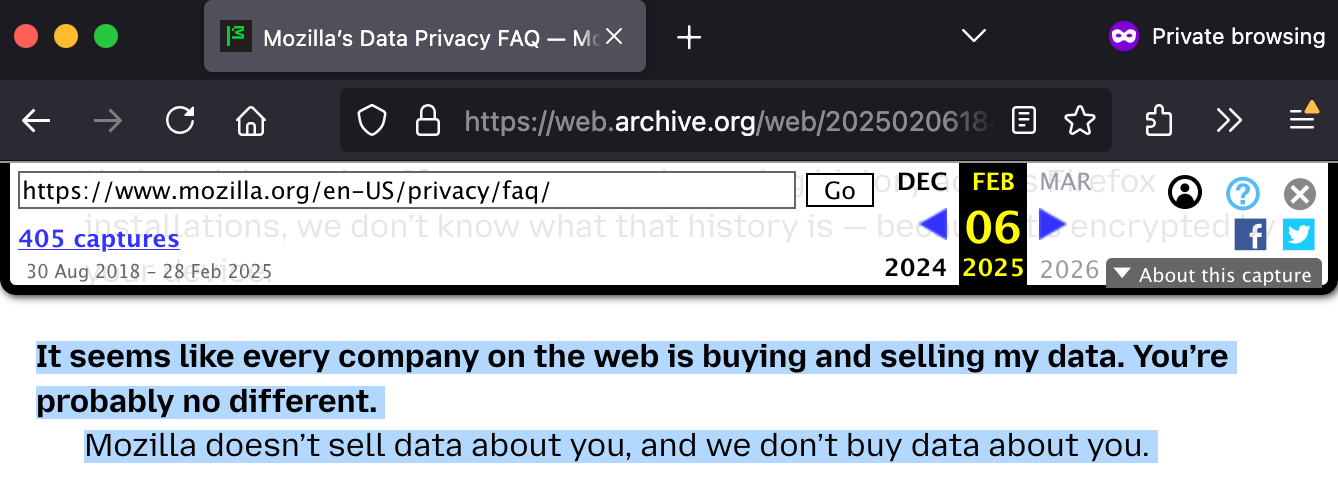
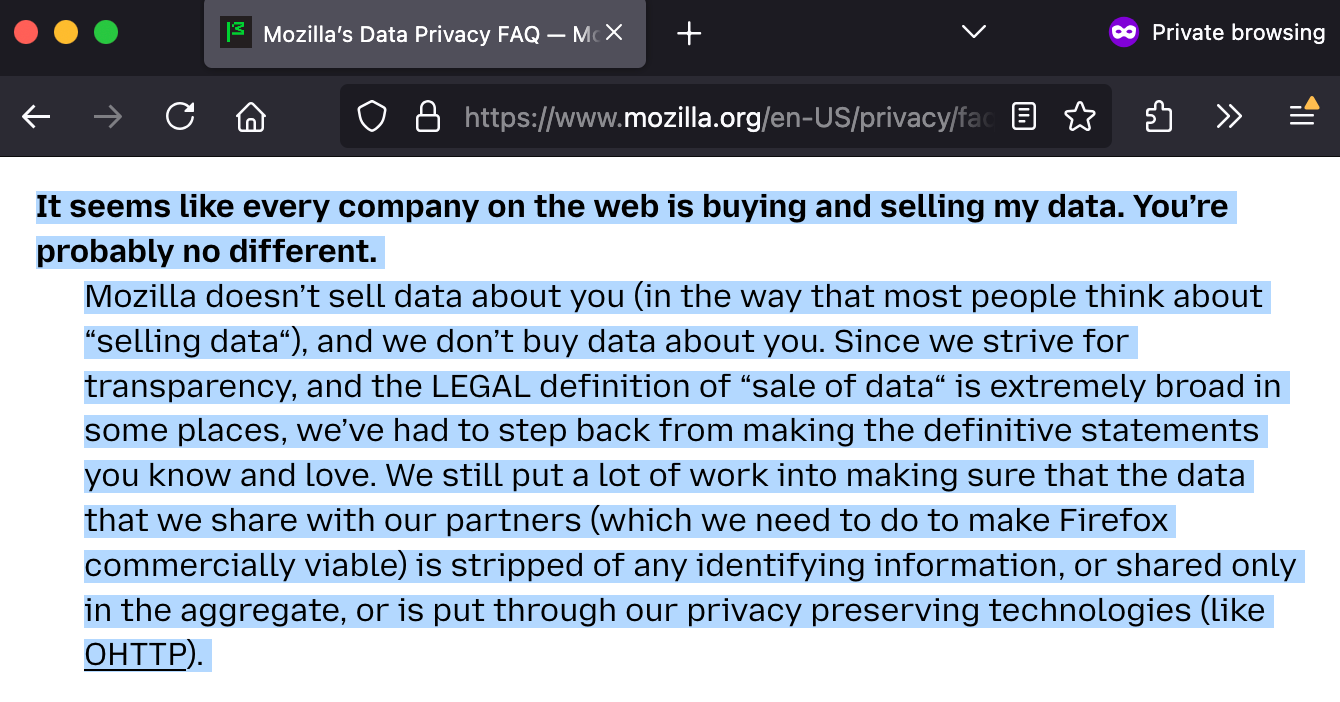
Mozilla has long built its reputation on privacy, positioning Firefox as an alternative to data-hungry tech giants. For years, Firefox's messaging included explicit assurances that "Mozilla doesn't sell data about you, and we don't buy data about you." However, Yesterday (Feb 27, 2025), Mozilla updated its Data Privacy FAQ with more nuanced language, now stating: "Mozilla doesn't sell data about you (in the way that most people think about 'selling data'), and we don't buy data about you."

Mozilla's Data Practices and Privacy Evolution: Recent Developments
Feb 06, 2025 - Snapshot of Mozilla Data Policy

This rewording acknowledges that while Mozilla shares some data with partners for Firefox's "commercial viability," such data is stripped of identifying information, shared in aggregate, or protected via privacy-preserving techniques. The change was prompted by increasingly broad legal definitions of "data sales" in certain jurisdictions, making Mozilla cautious about making absolute promises.

Mozilla's Data Practices and Privacy Evolution: Recent Developments
Feb 28, 2025 - Snapshot of Mozilla Data Policy

Mozilla maintains that its business model doesn't depend on selling personal data. The organization's primary revenue (over 90%) comes from search engine partnerships, particularly its agreement with Google to serve as Firefox's default search engine.

New Terms of Use and Privacy Policy Changes

27 February 2025, Mozilla introduced official Terms of Use for Firefox for the first time, along with an updated Privacy Notice. Previously, Firefox operated under an open-source license with informal privacy commitments. Mozilla explained this change as necessary to make its commitments "abundantly clear and accessible" in today's complex tech landscape.

The rollout sparked controversy among users when they noticed the removal of the explicit promise "Unlike other companies, we don't sell access to your data" from Mozilla's website and materials. This omission led to speculation that Mozilla might be preparing to sell user data, despite the organization's denials.

Another controversial point emerged from a clause in the new Terms of Use about user-submitted information. The terms asked users to "grant Mozilla a nonexclusive, royalty-free, worldwide license" to use information entered into Firefox. Taken at face value, this sounded as if Mozilla claimed rights over everything users type into the browser. Mozilla quickly clarified that this license only exists to make Firefox's basic functionality possible (processing URLs, performing searches, etc.) and that all data usage remains governed by the Privacy Notice's protections.

Community Reactions to Policy Changes

Many of these changes came to light before Mozilla's official announcements, thanks to its open development process. GitHub users spotted the changes in Mozilla's repositories, particularly the deletion of the line about not selling user data from the Firefox FAQ page.

Developers on GitHub expressed concern, with commenters urging that "the rationale for this ToS change is discussed in public," noting it seemed counter to Mozilla's principles of transparency and privacy.

On social media and forums, reactions ranged from disappointment to outrage. Some users accused Mozilla of betraying its privacy ethos, while others expressed skepticism about Mozilla's semantics—arguing there was little difference between "selling data" and "sharing it with partners" who provide revenue. Many long-time Firefox users discussed switching to alternative browsers like LibreWolf, Brave, or Safari.

Mozilla responded by publishing explanatory blog posts and engaging in forum discussions, but the initial lack of upfront communication allowed rumors to proliferate.

Privacy Incidents: Telemetry and Advertising Attribution

Beyond the Terms of Use controversy, Mozilla has faced other privacy-related challenges. In mid-2024, Mozilla implemented Privacy Preserving Attribution (PPA)—a system to help advertisers measure ad effectiveness without exposing individual user identities. However, it was enabled by default in Firefox 128, sending limited data about whether ads led to Firefox installations or website visits without explicit user opt-in.

This caught the attention of European privacy advocates. In September 2024, the Austrian digital rights group noyb filed a formal GDPR complaint, alleging that Mozilla had introduced tracking without users' consent. Mozilla defended PPA as privacy-preserving and less invasive than typical ad trackers, but admitted it "should have done more" to inform users and gather feedback.

A related issue involved Mozilla's use of Adjust, a third-party telemetry tool in mobile Firefox versions. In 2024, it came to light that Firefox for Android and iOS were sending data to Adjust to track how Mozilla's ads led to app installs, without prominent disclosure. Following community backlash, Mozilla removed the Adjust SDK from its mobile apps by August 2024.

Mozilla acknowledged regretting enabling such telemetry by default but explained the pressure it faced from advertisers who demand feedback on their campaigns. The compromise was to implement privacy-focused solutions and use aggregated metrics, though not everyone was convinced this was sufficiently transparent.

Product Updates Emphasizing Privacy

Despite these controversies, Mozilla continues to ship product updates aimed at enhancing user privacy. In Firefox version 135 (December 2024), Mozilla retired the old "Do Not Track" (DNT) setting in favor of the more robust Global Privacy Control (GPC) signal. Unlike DNT, which was widely ignored by websites, GPC has legal backing in regions like California, making it a more enforceable choice for users wanting to opt out of data collection.

Mozilla has also strengthened technological protections against tracking. In June 2022, Firefox rolled out Total Cookie Protection by default to all users, a milestone in browser privacy. This feature isolates cookies to the site where they were created, essentially giving each website its own "cookie jar" and preventing trackers from using third-party cookies to follow users across the web.

Additionally, Firefox's Enhanced Tracking Protection continues to block known trackers, fingerprinters, and cryptominers by default. Firefox's private browsing mode goes even further, blocking social media trackers and providing complete cookie isolation.

As Google Chrome moves to Manifest V3 (which limits the capabilities of ad-blockers), Mozilla has announced it will continue supporting the older Manifest V2 for Firefox add-ons alongside Manifest V3. This ensures users can keep using robust ad-blockers and privacy extensions without disruption, demonstrating Mozilla's willingness to diverge from Chrome in defense of user choice.

Organizational Decisions and Notable Developments

One significant controversy involved Mozilla's partnership with OneRep for its "Mozilla Monitor Plus" service, which helps users remove personal information from data broker websites. In March 2024, an investigative report revealed that OneRep's founder and CEO also owned numerous people-search and data broker sites—the very kind of privacy-invasive services OneRep claimed to protect users from.

Mozilla quickly announced it would terminate the partnership, stating that "the outside financial interests and activities of OneRep's CEO do not align with our values." However, as of early 2025, Mozilla was still in the process of disentangling from OneRep, explaining that finding a replacement service was taking longer than anticipated.

Beyond specific controversies, Mozilla has been diversifying its product portfolio to reduce reliance on the Firefox-Google search deal for revenue. New initiatives include Mozilla VPN and Mozilla.ai, a startup focused on ethical AI. The organization has also made difficult financial decisions, including layoffs in recent years, to maintain stability while continuing to advocate for an open, privacy-respecting web.

Conclusion and Implications

Claims that "Mozilla is selling user data" are not supported by evidence—Mozilla's policies emphasize that any data sharing happens in a privacy-conscious way. However, by removing its absolute "we never sell data" pledge and adding legal language about data licenses, Mozilla inadvertently created doubt among its loyal users.

The community reactions demonstrate that Mozilla's user base holds it to a higher standard than other browser makers. Every move that hints at dilution of privacy or transparency faces immediate scrutiny. This pressure keeps Mozilla aligned with its founding principles, as evidenced by its quick responses to clarify policies or reverse course on contentious features.

For users, two points are clear: Firefox remains one of the most privacy-friendly mainstream browsers, with features like Total Cookie Protection, tracker blocking, and powerful extension support. Unlike many tech companies, Mozilla does not monetize by profiling users or selling targeted ads based on browsing history. However, users must stay vigilant to ensure Mozilla maintains its privacy commitments.

From an industry perspective, Mozilla's handling of these issues could influence broader norms. When Firefox pushes privacy features like cookie isolation or GPC signals, it pressures competitors to offer similar protections. Mozilla is essentially testing whether a major software product can sustain itself without compromising user trust.

In summary, Mozilla is navigating complex legal, financial, and perceptual challenges regarding user data while striving to uphold its core ethos: "Internet for people, not profit." As long as Mozilla continues to engage with its community and prioritize privacy in tangible ways, Firefox will likely retain its position as the browser of choice for privacy-conscious users, and its developments will continue to influence the broader fight for online privacy.


https://ift.tt/YGe6pwi
https://ift.tt/i9dtMrF

https://images.unsplash.com/photo-1657885428171-0e164036a1f5?crop=entropy&cs=tinysrgb&fit=max&fm=jpg&ixid=M3wxMTc3M3wwfDF8c2VhcmNofDh8fGZpcmVmb3h8ZW58MHx8fHwxNzQwNzcxNDgyfDA&ixlib=rb-4.0.3&q=80&w=2000
https://guptadeepak.weebly.com/deepak-gupta/mozillas-data-practices-and-privacy-evolution-recent-developments

Single Sign-On (SSO) Differentiation Between Human and Autonomous Non-Human Identities

Single Sign-On (SSO) Differentiation Between Human and Autonomous Non-Human Identities

The evolution of digital ecosystems has necessitated distinct authentication frameworks for human users and autonomous non-human agents. Single sign-on (SSO) systems, originally designed for human workflows, now confront novel challenges in securing machine-driven operations.

This article analyzes the technical, procedural, and governance divergences in SSO implementation for these two identity classes, supported by behavioral, cryptographic, and lifecycle management evidence from contemporary identity frameworks.

SSO for Human Identities: Centralized Authentication and Session Management

Authentication Protocols and User-Centric Design

Human SSO relies on standards like OAuth 2.0 Authorization Code Flow and SAML 2.0, which prioritize user interaction. During authentication, humans submit credentials (username/password) and often complete multi-factor authentication (MFA) steps, such as biometric verification or one-time codes.

These protocols assume:

  1. Interactive sessions: Users manually authenticate via browsers or apps
  2. Persistent sessions: Tokens remain valid for hours/days (e.g., 8-hour OAuth access tokens)
  3. Role-based access: Permissions map to organizational roles (e.g., "HR Manager")

For example, a federated SSO flow across enterprises uses SAML assertions containing user attributes (department, job title) to grant access to third-party SaaS tools. The IdP (Identity Provider) enforces policies like password complexity and MFA enrollment while logging all authentication attempts for audit purposes.

Credential Lifecycle and Risk Mitigation

Human credential management follows HR-driven cycles:

  • Provisioning: Accounts created during employee onboarding
  • Rotation: Password changes mandated every 60-90 days
  • Revocation: Immediate deactivation upon termination

Security layers include anomaly detection (e.g., login attempts from unfamiliar locations) and step-up authentication for high-risk actions. However, human SSO remains vulnerable to phishing, credential reuse, and insider threats—factors requiring continuous behavioral monitoring.

Autonomous Agent SSO: Ephemeral Credentials and Contextual Authorization

Machine-Optimized Authentication Flows

Non-human identities (e.g., AI agents, IoT devices) authenticate via protocols stripping human-centric steps:

  1. OAuth 2.0 Device Flow: Agents receive scoped tokens (e.g., data:read) without direct user interaction.
  2. X.509 Certificate Handshakes: Hardware-backed keys replace passwords, binding identities to specific devices.
  3. Embedded Context: Tokens encode environmental parameters (allowed IP ranges, geolocation) to prevent misuse.

For instance, an AI agent optimizing cloud costs in Azure authenticates via a certificate, receives a token valid only from approved datacenter IPs, and auto-refreshes it every 5 minutes. This contrasts sharply with human SSO’s persistent sessions.

Dynamic Credential Lifecycle Management

Autonomous agents operate under zero-standing-privilege models:

Phase Implementation
Initiation Short-lived JWTs (15-30 minutes) issued per task
Active Session Automatic token rotation via HSMs (Hardware Security Modules)
Termination SCIM API revocation upon task completion or behavioral deviation

AI-driven systems exemplify this by rotating credentials upon detecting anomalous API call patterns, reducing exposure windows from days to minutes.

Unlike human credentials, agent keys never appear in configuration files—they’re injected at runtime via secure vaults.

Divergent Security Architectures

Human Identity Protections

  1. MFA Enforcement: Biometrics or authenticator apps guard against credential theft.
  2. Session Hijacking Prevention: Browser fingerprinting and token binding to client IPs.
  3. Compliance Audits: Manual reviews of user access logs for SOC2/GDPR.

Machine Identity Protections

  1. Mutual TLS (mTLS): All agent-server communication requires certificate validation.
  2. Behavioral AI Models: ML algorithms flag token usage anomalies (e.g., sudden privilege escalation).
  3. Cryptographic Isolation: Keys stored in HSMs, never exposed to host systems.

IAM solution conditionally granting access only if the requesting agent’s code signature matches a pre-approved hash. Such granular controls exceed human SSO’s role-based limitations.

Governance and Standards Landscape

Human SSO Standards

  • SAML 2.0: Exchanges user attributes between IdPs and service providers.
  • OpenID Connect (OIDC): Adds identity layer to OAuth 2.0 for userinfo endpoints.
  • NIST SP 800-63-3: Guides password policies and MFA implementation.

Non-Human SSO Standards

  • OAuth 2.0 Client Credentials Flow: Grants tokens to machines without user context.
  • X.509 PKI: Manages machine certificate issuance/revocation via CAs.
  • FIDO Device Onboard (FDO): Automates IoT device authentication in zero-touch deployments.

Gartner’s 2024 Magic Quadrant highlights the rise of "machine identity management" as a distinct PAM (Privileged Access Management) category, emphasizing certificate automation over password vaulting.

Operational Process Variations

Human Workforce Processes

  1. Access Requests: Employees submit tickets for role changes.
  2. Approval Workflows: Managers manually authorize access.
  3. Offboarding: HR triggers account deprovisioning.

Autonomous Agent Processes

  1. Policy-Driven Provisioning: Agents self-register via CI/CD pipelines with scoped permissions.
  2. AI Governance: Systems auto-revoke overprivileged identities.
  3. Task-Based Deprovisioning: Credentials expire automatically post-task.

For example, an AI agent deployed via Azure AI Foundry receives temporary compute:start privileges to optimize VM usage, which Azure AD revokes after 2 minutes of inactivity.

Conclusion: Toward Converged Identity Fabrics

Human and machine SSO diverge fundamentally in authentication mechanics, credential lifecycle, and governance models. While humans rely on interactive, role-based flows, autonomous agents demand ephemeral, context-aware tokens secured by cryptographic primitives.

Emerging frameworks like FIDO2 and OAuth 2.1 aim to bridge these paradigms, enabling hybrid systems where humans and agents coexist under unified zero-trust policies. Organizations must adopt IAM platforms that enforce machine-grade security without impeding human productivity—a balance requiring continuous adaptation to AI-driven identity sprawl.


https://ift.tt/t1gUfJB
https://ift.tt/iZ9CPcg

https://images.unsplash.com/photo-1611172061501-ee8ef02d49c5?crop=entropy&cs=tinysrgb&fit=max&fm=jpg&ixid=M3wxMTc3M3wwfDF8c2VhcmNofDMxfHxpZGVudGl0eXxlbnwwfHx8fDE3NDAxNjI0NTd8MA&ixlib=rb-4.0.3&q=80&w=2000
https://guptadeepak.weebly.com/deepak-gupta/single-sign-on-sso-differentiation-between-human-and-autonomous-non-human-identities

Wednesday, 26 February 2025

Understanding JWT: From Basics to Advanced Security

Introduction: The Evolution of Web Authentication

Understanding JWT: From Basics to Advanced Security

Early days of the web, authentication was relatively simple - users would log in, and servers would store their session information. However, as applications grew more complex and moved toward distributed systems and microservices, this traditional approach faced scalability challenges. JSON Web Tokens (JWTs), a revolutionary solution that changed how we handle authentication and authorization in modern web applications.

JWTs represent a paradigm shift in web security. Instead of the server keeping track of who's logged in, it issues a secure, self-contained token that holds all necessary information about the user. Think of it like a digital passport - once issued by a trusted authority, it can be verified anywhere without needing to check back with the issuing country. This approach has become increasingly important in our interconnected world of cloud services, mobile applications, and API-driven architectures.

Part 1: JWT Fundamentals

What is a JWT?

A JSON Web Token is a compact, self-contained way to securely transmit information between parties as a JSON object. Think of it as a digital passport that proves your identity and permissions in the web world. Each JWT contains three essential parts:

  1. Header: The metadata section that describes the token's type and the signing algorithm used
  2. Payload: The actual data (called "claims") about the user and additional metadata
  3. Signature: A verification seal that ensures the token hasn't been tampered with

When these three parts are combined, you get something that looks like this:

eyJhbGciOiJIUzI1NiIsInR5cCI6IkpXVCJ9.eyJzdWIiOiIxMjM0NTY3ODkwIiwibmFtZSI6IkpvaG4gRG9lIiwiaWF0IjoxNTE2MjM5MDIyfQ.SflKxwRJSMeKKF2QT4fwpMeJf36POk6yJV_adQssw5c

The Anatomy of a JWT: Understanding the Structure

Before diving into how JWTs work, let's examine their structure in detail. A JWT consists of three distinct parts, each encoded in Base64URL format and separated by dots:

eyJhbGciOiJIUzI1NiIsInR5cCI6IkpXVCJ9.eyJzdWIiOiIxMjM0NTY3ODkwIiwibmFtZSI6IkpvaG4gRG9lIiwiaWF0IjoxNTE2MjM5MDIyfQ.SflKxwRJSMeKKF2QT4fwpMeJf36POk6yJV_adQssw5c

1. Header (The Metadata)

The header contains information about how the token itself is constructed. It typically includes:

{  "alg": "HS256",    // The algorithm used for signing  "typ": "JWT"       // The type of token}

2. Payload (The Claims)

The payload carries the actual information about the user and token metadata. It contains claims, which are statements about an entity (typically the user) and additional metadata.

There are three types of claims:

  • Public Claims: Custom claims registered in the IANA JSON Web Token Registry
  • Private Claims: Custom claims created for sharing information between parties
  • Registered Claims: Predefined claims like:
{  "iss": "auth.service.com",  // Issuer  "sub": "user123",           // Subject  "exp": 1516239022,         // Expiration Time  "iat": 1516232822          // Issued At}

3. Signature (The Verification Seal)

The signature is created by taking the encoded header, encoded payload, and a secret key, then applying the algorithm specified in the header. For example, with HMAC SHA256:

HMACSHA256(  base64UrlEncode(header) + "." +  base64UrlEncode(payload),  secret)

This signature ensures that the token hasn't been modified in transit and verifies its authenticity.

How Does JWT Work in Practice?

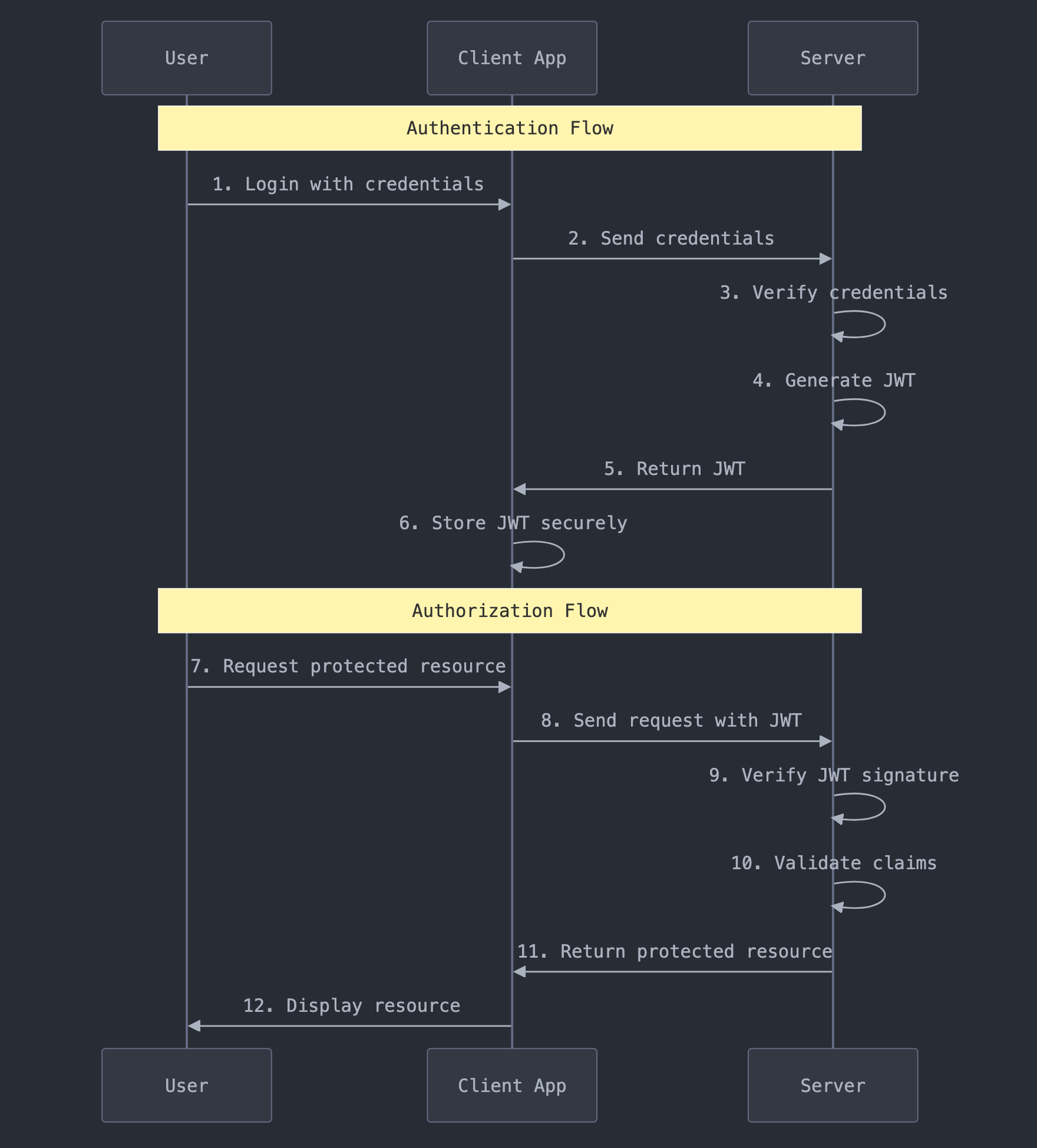
The journey of a JWT follows a simple flow:

  1. Authentication: When you log in successfully, the server creates a JWT containing information about your identity and permissions
  2. Token Storage: Your application receives and stores this token
  3. Authorization: For subsequent requests, your application includes this token in the header
  4. Verification: The server checks the token's signature and grants access if it's valid
Understanding JWT: From Basics to Advanced Security

This process eliminates the need for the server to store session information, making JWTs perfect for modern, scalable applications.

Part 2: The Security Challenge

Common JWT Vulnerabilities

While JWTs are powerful, they're not immune to security issues. Here are the key vulnerabilities to watch out for:

Signature Verification Flaws

The signature is like a tamper-evident seal on a package. If the verification process is flawed or the secret key is weak, attackers can modify the token's contents without detection. This is particularly dangerous because it could allow unauthorized access to protected resources.

Algorithm Confusion Attacks

JWTs support multiple signing algorithms, including a dangerous "none" algorithm. If your server isn't configured properly, an attacker might trick it into accepting an unsigned token, effectively bypassing security checks altogether.

Client-Side Storage Risks

Many applications store JWTs in browser storage (localStorage or sessionStorage), making them vulnerable to Cross-Site Scripting (XSS) attacks. Think of this like keeping your house key in an obvious place - if someone gains access to your browser's JavaScript environment, they could steal your token.

The Revocation Challenge

Unlike traditional session tokens, JWTs don't have a built-in way to be invalidated before they expire. This means if a token is compromised, it remains valid until its expiration time, potentially giving attackers a window of opportunity.

Part 3: Building a Secure JWT Implementation

Essential Security Practices

Let's explore how to implement JWTs securely:

1. Secure Communication

Always transmit JWTs over HTTPS. This encrypts the token during transmission, preventing eavesdropping attacks. It's like sending sensitive documents through a secure courier service instead of regular mail.

2. Smart Token Storage

Instead of using browser storage, use HttpOnly cookies with the Secure flag enabled. This approach prevents JavaScript access to the token while ensuring it's only transmitted over secure connections. The cookie settings might look like this:

Set-Cookie: access_token=<token>;            HttpOnly;            Secure;            SameSite=Strict;            Path=/api

3. Token Lifecycle Management

Implement a robust token lifecycle strategy:

  • Set short expiration times for access tokens (15-30 minutes)
  • Use refresh tokens for obtaining new access tokens
  • Maintain a token blacklist for revoked tokens
  • Implement token rotation to regularly replace active tokens

4. Payload Security

Be mindful of what you include in your token payload:

  • Never store sensitive data like passwords or credit card numbers
  • Minimize the payload size to reduce overhead
  • Consider encrypting certain claims if they contain sensitive information

Advanced Security Measures

Going beyond the basics:

1. Fingerprinting

Include device or context information in the token to detect potential token theft:

{  "sub": "1234567890",  "fingerprint": "device_id|user_agent|ip_hash",  "exp": 1516239022}

2. Audience Validation

Specify and validate the intended recipient of the token to prevent token reuse across different services:

{  "aud": "https://api.myservice.com",  "sub": "1234567890",  "exp": 1516239022}

Part 4: The Future of JWT Security

Emerging Security Enhancements

The security landscape is constantly evolving, and JWT security is no exception. Here are some promising developments:

1. Quantum-Resistant Algorithms

As quantum computing advances, new signing algorithms resistant to quantum attacks are being developed. These will ensure JWTs remain secure even in a post-quantum world.

2. Dynamic Validation

Future implementations might include real-time validation systems that can instantly revoke tokens based on security events or user behavior changes.

3. Enhanced Standards

The JWT standard continues to evolve with new security features and best practices. Stay updated with the latest JWT specifications and security recommendations from the IETF.

Conclusion

JWTs represent a powerful solution for modern web authentication and authorization, but their security requires careful consideration and implementation. By understanding both the fundamentals and security challenges, and by implementing robust security measures, you can harness the benefits of JWTs while maintaining strong security.

Learn on JWT, OAuth, OIDC, and SAML: https://guptadeepak.com/demystifying-jwt-oauth-oidc-and-saml-a-technical-guide/


Quick Reference: JWT Security Checklist

✓ Use strong, unique signing keys
✓ Implement proper algorithm validation
✓ Store tokens securely (HttpOnly cookies)
✓ Set appropriate token expiration
✓ Implement token rotation
✓ Validate token claims thoroughly
✓ Monitor for security updates
✓ Use HTTPS exclusively
✓ Implement proper error handling
✓ Regular security audits


https://ift.tt/wSY3My4
https://ift.tt/tcsQWi9

https://images.unsplash.com/photo-1666969295767-4db7ff1f8fec?crop=entropy&cs=tinysrgb&fit=max&fm=jpg&ixid=M3wxMTc3M3wwfDF8c2VhcmNofDYwfHxUb2tlbnxlbnwwfHx8fDE3NDAwODM4MDN8MA&ixlib=rb-4.0.3&q=80&w=2000
https://guptadeepak.weebly.com/deepak-gupta/understanding-jwt-from-basics-to-advanced-security

Palo Alto Networks CyberArk: The $25 Billion Deal Reshaping Cybersecurity

Deal Overview Transaction Details : Palo Alto Networks announced on July 30, 2025, its agreement to acquire CyberArk for $45.00 in cash...