Monday, 26 August 2024

Bootstrapping Growth: How B2B SaaS Startups Can Thrive on a Shoestring Budget

Bootstrapping Growth: How B2B SaaS Startups Can Thrive on a Shoestring Budget

Startups often face a critical challenge: how to achieve significant growth with limited financial resources. This is where the concept of "bootstrapping growth" comes into play. By leveraging creativity, hustle, and strategic thinking, startups can build a solid foundation for growth without relying on substantial outside investment. This article delves deep into the strategies and tactics that can help B2B SaaS startups bootstrap their way to success.

Understanding Bootstrapped Growth

Bootstrapped growth refers to the process of growing a business using minimal financial resources, often relying on the founder's personal savings, revenue generated from early customers, and creative, low-cost growth strategies. For B2B SaaS startups, this approach offers several advantages:

  1. Maintains equity and control for founders
  2. Forces a focus on profitability and sustainable growth
  3. Encourages creativity and resourcefulness in problem-solving
  4. Builds a lean, efficient company culture from the start

However, bootstrapping also presents unique challenges, particularly in the highly competitive SaaS space where well-funded competitors can outspend you on marketing and development. To overcome these challenges, startups need to be strategic, resourceful, and laser-focused on activities that drive real value.

Key Strategies for Bootstrapping B2B SaaS Growth

1. Leverage Free and Low-Cost Marketing Tools

In the early stages, every dollar counts. Fortunately, there's a wealth of free and low-cost tools available that can help startups punch above their weight class:

  • Content Marketing: Use tools like WordPress (free), Canva (freemium), and Unsplash (free) to create and distribute high-quality content.
  • Email Marketing: Leverage platforms like Mailchimp (free up to 2,000 contacts) or Brevo (free up to 300 emails per day) for email campaigns.
  • Social Media Management: Use Buffer (free plan available) or Adobe Express (limited free plan) to manage and schedule social media posts.
  • SEO: Utilize free tools like Google Search Console, Google Analytics, and Ubersuggest for keyword research and site optimization.
  • Customer Relationship Management (CRM): Start with HubSpot CRM (free) or Freshsales (free tier available) to manage customer relationships.

2. Focus on Organic Growth Channels

Paid advertising can quickly drain a startup's limited resources. Instead, focus on organic growth channels that require time and effort but minimal financial investment:

  • Content Marketing: Create in-depth, valuable content that addresses your target audience's pain points. This could include blog posts, whitepapers, eBooks, and case studies.
  • SEO: Optimize your website and content for search engines to drive organic traffic. Focus on long-tail keywords relevant to your niche.
  • Social Media: Build a presence on platforms where your target audience is active. Share valuable content, engage in conversations, and build relationships.
  • Community Building: Create or participate in online communities (e.g., Slack groups, LinkedIn groups, Reddit) where your target audience gathers.
  • Open-Source Strategy: If applicable, consider open-sourcing part of your product to build credibility and attract developers.

3. Implement Growth Hacking Techniques

Growth hacking involves using creative, low-cost strategies to acquire and retain customers. Some effective techniques for B2B SaaS startups include:

  • Product Hunt Launch: Orchestrate a well-planned launch on Product Hunt to gain initial traction and feedback.
  • Referral Programs: Implement a referral system that incentivizes current users to bring in new customers.
  • Strategic Partnerships: Partner with complementary businesses to cross-promote each other's products.
  • Freemium Model: Offer a free tier of your product to attract users and upsell them to paid plans.
  • Micro-Influencer Collaborations: Partner with niche influencers in your industry for product reviews or guest content.

4. Optimize for Customer Success and Retention

In B2B SaaS, retaining and expanding existing accounts is often more cost-effective than acquiring new customers. Focus on:

  • Onboarding: Create a frictionless onboarding process that quickly demonstrates value to new users.
  • Customer Education: Develop comprehensive documentation, tutorials, and webinars to help users get the most out of your product.
  • Proactive Support: Use tools like Freshdesk (freemium) to provide real-time chat support and proactively reach out to users who may need assistance.
  • Feature Adoption Campaigns: Use in-app messaging and email campaigns to drive adoption of key features that improve stickiness.

5. Leverage Data and Analytics

Data-driven decision-making is crucial for efficient growth. Use free or low-cost analytics tools to gain insights:

  • Google Analytics: Track website traffic and user behavior.
  • Mixpanel: Offers a free plan for basic product analytics.
  • Amplitude: Provides a generous free tier for event-based analytics.
  • Hotjar: Offers limited free heatmaps and session recordings.

Use these tools to identify which strategies are working, where users are dropping off, and what features are driving the most value.

6. Automate and Optimize Processes

Automation can help a small team punch above its weight. Look for opportunities to automate repetitive tasks:

  • Zapier: Automate workflows between different apps (free plan available).
  • IFTTT: Create simple automated actions (free).

7. Build in Public

"Building in public" involves sharing your startup journey openly, including successes, failures, and learnings. This approach can:

  • Generate interest and build an audience
  • Attract potential customers and partners
  • Provide valuable feedback on your product and direction

Use platforms like Twitter, LinkedIn, or a company blog to share regular updates, metrics, and behind-the-scenes insights.

8. Leverage Your Network

Your professional network can be a powerful asset for bootstrapped growth:

  • Reach out to former colleagues or classmates who might benefit from your product.
  • Ask for introductions to potential customers or partners.
  • Seek mentorship from experienced entrepreneurs in your network.

9. Focus on a Niche

Instead of trying to serve a broad market, focus on a specific niche where you can quickly establish authority and product-market fit. This allows you to:

  • Tailor your product more effectively to specific needs
  • Build a reputation as a specialist in your niche
  • Reduce marketing costs by targeting a more defined audience

10. Prioritize Revenue-Generating Activities

With limited resources, it's crucial to focus on activities that directly contribute to revenue growth:

  • Prioritize features that will help close deals with paying customers.
  • Focus on marketing activities with a clear ROI.
  • Consider offering services (consulting, implementation) alongside your product to generate additional revenue.

Case Study: Bootstrapping Success

To illustrate these principles in action, let's look at the example of Basecamp (37signals). The company bootstrapped its way to success by:

  1. Starting as a web design firm to generate revenue
  2. Building tools to solve their own problems, which became their products
  3. Focusing on a simple, opinionated product that solved a clear pain point
  4. Leveraging content marketing through their popular blog
  5. Maintaining a small, efficient team
  6. Prioritizing profitability over rapid growth

By following these principles, Basecamp grew to over $250 million in annual recurring revenue without ever taking significant outside investment.

Challenging, but Possible

Bootstrapping growth for a B2B SaaS startup is challenging but entirely possible with the right strategies and mindset. By focusing on low-cost, high-impact activities, leveraging available tools and resources, and prioritizing customer value and revenue generation, startups can build a solid foundation for growth without relying on external funding. Remember, the key is to stay lean, be creative, and always focus on providing value to your customers. With persistence and smart execution, bootstrapped startups can compete effectively in the B2B SaaS market and build sustainable, profitable businesses.


https://bit.ly/3AFQI7q
https://bit.ly/4e1T3rN

https://guptadeepak.com/content/images/2024/08/bootstrapping-growth.webp
https://guptadeepak.weebly.com/deepak-gupta/bootstrapping-growth-how-b2b-saas-startups-can-thrive-on-a-shoestring-budget

Thursday, 22 August 2024

Comprehensive Guide to API Error Code Management

Comprehensive Guide to API Error Code Management

Error handling is a critical aspect of API design and development. Well-designed error codes and messages can significantly improve the developer experience, reduce support overhead, and enhance the overall quality of your API. This guide will walk you through the best practices for creating and managing error codes in a developer-oriented API system.

Best Practices for API Error Codes

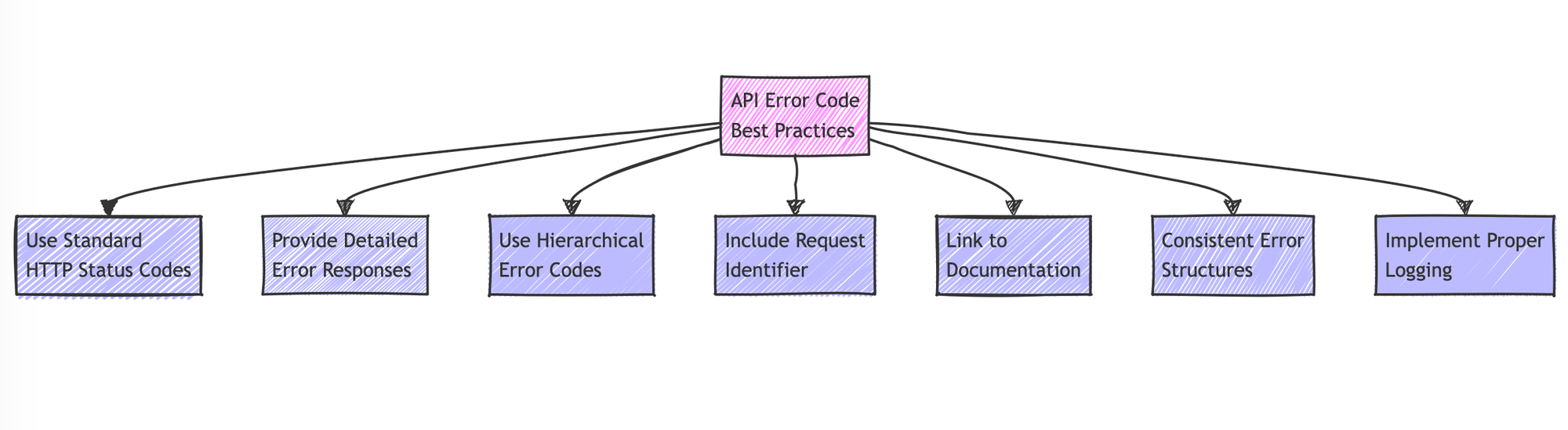
a. Use Standard HTTP Status Codes

Always use standard HTTP status codes as the first line of error reporting. These are widely understood and provide a broad categorization of the error.

HTTP/1.1 404 Not Found

b. Provide Detailed Error Responses

Include a detailed error response in the body of your HTTP response. This should be a structured object (typically JSON) containing more specific information about the error.

{  "error": {    "code": "RESOURCE_NOT_FOUND",    "message": "The requested resource could not be found.",    "details": "User with ID 12345 does not exist in the system.",    "timestamp": "2023-08-09T14:30:00Z",    "request_id": "f7a8b9c0-d1e2-3f4g-5h6i-7j8k9l0m1n2o"  }}

c. Use Hierarchical Error Codes

Implement a hierarchical error code system. This allows for both broad and specific error categorization.

Example:

  • AUTH_ERROR
    • AUTH_INVALID_CREDENTIALS
    • AUTH_EXPIRED_TOKEN
    • AUTH_INSUFFICIENT_PERMISSIONS

d. Include a Request Identifier

A Request Identifier, often called a Request ID, is a unique string or number assigned to each API request. Always include a unique identifier for each request. Its primary purpose is to provide a way to track and correlate requests across systems, which is incredibly useful for debugging, logging, and monitoring.

Example of Request Identifier in an API response:

{  "data": {    "user_id": 12345,    "username": "johndoe"  },  "meta": {    "request_id": "550e8400-e29b-41d4-a716-446655440000"  }}

Examples of Request Identifiers:

Hierarchical identifier (for microservices):

gateway-123:auth-456:user-789

Combination of service name and random number:

API-789456123

Base64-encoded random string:

dGhpc2lzYW5leGFtcGxl

Timestamp-based identifier:

20230809-154322-789

This combines a date (20230809), time (154322), and a random number (789).

UUID (Universally Unique Identifier):

550e8400-e29b-41d4-a716-446655440000

This is a common format due to its uniqueness and standardization.

Include links to relevant documentation in your error responses. This can help developers quickly find information on how to resolve the error.

{  "error": {    "code": "RATE_LIMIT_EXCEEDED",    "message": "You have exceeded your rate limit.",    "documentation_url": "https://api.example.com/docs/errors/rate-limiting"  }}

f. Use Consistent Error Structures

Maintain a consistent structure for all error responses across your API. This predictability helps developers in handling errors programmatically.

g. Implement Proper Logging

Ensure comprehensive logging on the server-side. While the client receives a sanitized error message, log detailed error information server-side for debugging and monitoring.

Things to Avoid

a. Exposing Sensitive Information

Never include sensitive information like stack traces, server paths, or database queries in error responses.

b. Using Ambiguous Error Codes

Avoid generic error codes like "ERROR_001". These provide no context and make debugging difficult.

c. Inconsistent Naming Conventions

Don't mix naming conventions. Stick to one style (e.g., UPPER_SNAKE_CASE) for all error codes.

d. Changing Error Codes Frequently

Changing error codes can break client integrations. Avoid changing existing error codes unless absolutely necessary.

Making It Developer-Friendly

a. Provide Clear and Actionable Error Messages

Error messages should clearly state what went wrong and, if possible, how to fix it.

{  "error": {    "code": "INVALID_PARAMETER",    "message": "The 'email' parameter is invalid.",    "details": "Please provide a valid email address in the format user@example.com."  }}

b. Offer Multiple Languages

Consider providing error messages in multiple languages. Use content negotiation to determine the appropriate language.

c. Implement Retry-After Headers

For rate limiting or temporary server issues, include a Retry-After header to indicate when the client should retry the request.

HTTP/1.1 429 Too Many RequestsRetry-After: 30

d. Provide SDK Support

Develop SDKs for popular programming languages that handle error parsing and provide language-specific exceptions.

Future-Proofing Your Error Codes

a. Use Versioning

Implement versioning in your API, including error responses. This allows you to evolve your error handling without breaking existing integrations.

b. Design for Extensibility

Structure your error responses to allow for easy addition of new fields in the future.

{  "error": {    "code": "PAYMENT_FAILED",    "message": "The payment could not be processed.",    "details": {      "reason": "Insufficient funds",      "transaction_id": "1234567890"    },    "additional_info": {}  // Placeholder for future extensions  }}

c. Implement Feature Flags

Use feature flags to gradually roll out changes to error handling, allowing for easy rollback if issues arise.

Examples from Industry Leaders

Stripe

Stripe's API is renowned for its developer-friendly error handling:

  • They use standard HTTP status codes.
  • Error types are clearly categorized (e.g., card_error, validation_error).
  • Detailed error messages and suggestions are provided.
  • They include a unique error ID for tracking.

Example Stripe error:

{  "error": {    "code": "resource_missing",    "doc_url": "https://stripe.com/docs/error-codes/resource-missing",    "message": "No such customer: cus_12345",    "param": "customer",    "type": "invalid_request_error"  }}

b. GitHub

GitHub's API error responses are clear and actionable:

  • They use a consistent error object structure.
  • Error messages are human-readable and often suggest a solution.
  • They provide links to relevant documentation.

Example GitHub error:

{  "message": "Validation Failed",  "errors": [    {      "resource": "Issue",      "field": "title",      "code": "missing_field"    }  ],  "documentation_url": "https://docs.github.com/rest/reference/issues#create-an-issue"}

Implementing Error Codes

a. Define an Error Code Enum

Create an enumeration of all possible error codes. This ensures consistency and makes it easier to manage codes.

from enum import Enumclass ErrorCode(Enum):    RESOURCE_NOT_FOUND = "RESOURCE_NOT_FOUND"    INVALID_REQUEST = "INVALID_REQUEST"    RATE_LIMIT_EXCEEDED = "RATE_LIMIT_EXCEEDED"    INTERNAL_SERVER_ERROR = "INTERNAL_SERVER_ERROR"    # ... more error codes ...

b. Create an Error Response Class

Implement a class to generate consistent error responses:

from dataclasses import dataclassfrom typing import Optional, Anyimport timeimport uuid@dataclassclass ErrorResponse:    code: ErrorCode    message: str    details: Optional[str] = None    timestamp: float = time.time()    request_id: str = str(uuid.uuid4())    additional_info: dict = field(default_factory=dict)    def to_dict(self) -> dict:        return {            "error": {                "code": self.code.value,                "message": self.message,                "details": self.details,                "timestamp": self.timestamp,                "request_id": self.request_id,                "additional_info": self.additional_info            }        }

c. Implement Error Handling in Your API

Use the ErrorResponse class in your API endpoints:

from fastapi import FastAPI, HTTPExceptionfrom fastapi.responses import JSONResponseapp = FastAPI()@app.exception_handler(HTTPException)async def http_exception_handler(request, exc):    error_response = ErrorResponse(        code=ErrorCode.RESOURCE_NOT_FOUND if exc.status_code == 404 else ErrorCode.INTERNAL_SERVER_ERROR,        message=str(exc.detail),        details=f"An error occurred while processing the request: {exc.detail}"    )    return JSONResponse(status_code=exc.status_code, content=error_response.to_dict())@app.get("/users/{user_id}")async def get_user(user_id: int):    # Simulating a user not found scenario    if user_id == 0:        raise HTTPException(status_code=404, detail="User not found")    # ... rest of the function ...

This setup ensures that all errors are consistently formatted and contain the necessary information for debugging and client-side error handling.

Conclusion

Implementing a robust error handling system is crucial for creating a developer-friendly API. By following these best practices, avoiding common pitfalls, and learning from industry leaders, you can create an API that is not only powerful but also a joy for developers to work with. Remember, good error handling is an ongoing process – continuously gather feedback from your API consumers and iterate on your error reporting to provide the best possible developer experience.


https://bit.ly/3SVDXfm
https://bit.ly/4dPekVk

https://guptadeepak.com/content/images/2024/08/Screenshot-2024-08-09-at-11.47.39-AM.png
https://guptadeepak.weebly.com/deepak-gupta/comprehensive-guide-to-api-error-code-management

Monday, 19 August 2024

Fuel Your B2B SaaS Startup's Growth: 6 Essential Channels

Fuel Your B2B SaaS Startup's Growth: 6 Essential Channels

In the competitive world of B2B SaaS, choosing the right growth channels can make or break a startup. Here are six effective channels that have propelled many tech startups to success:

  1. Product-Led Growth (PLG)
  2. Content Marketing
  3. Profitable Paid Advertising
  4. Affiliates and Partners
  5. Events and Trade Shows
  6. Account-Based Marketing (ABM)

1. Product-Led Growth (PLG)

PLG puts the product at the forefront of customer acquisition and retention. It allows users to experience value before committing to a purchase, often through freemium models or free trials.

How tech startups can use PLG:

  • Offer a free tier or trial of your product
  • Focus on user onboarding and activation
  • Use in-product messaging to guide users to value
  • Implement viral loops and referral programs
  • Analyze user behavior to identify conversion triggers

Example: Slack's freemium model allowed teams to try the product before purchasing, leading to rapid adoption and organic growth.

2. Content Marketing

Content marketing establishes thought leadership and builds trust with potential customers by providing valuable, relevant content.

How tech startups can use content marketing:

  • Create a blog with industry insights and best practices
  • Develop whitepapers, ebooks, and case studies
  • Leverage SEO to improve organic visibility
  • Use social media to distribute content and engage with audience
  • Host webinars and podcasts

Example: HubSpot's comprehensive inbound marketing resources attracted and educated prospects, establishing them as industry leaders.

3. Profitable Paid Advertising

Paid advertising can quickly drive targeted traffic and leads, but it's crucial to focus on profitability.

How tech startups can use paid advertising:

  • Start with small budgets and test different platforms (Google Ads, LinkedIn, Facebook)
  • Focus on high-intent keywords and audiences
  • Create compelling ad copy and landing pages
  • Implement retargeting campaigns
  • Continuously optimize for ROI

Example: Intercom used targeted LinkedIn ads to reach decision-makers in their ideal customer profile, driving qualified leads.

4. Account-Based Marketing (ABM)

ABM focuses on targeting and engaging specific high-value accounts with personalized marketing efforts.

How tech startups can use ABM:

  • Identify and prioritize target accounts
  • Create personalized content and campaigns for each account
  • Use intent data to time your outreach
  • Align sales and marketing efforts for coordinated engagement
  • Leverage tools like LinkedIn Sales Navigator for account-based advertising

Example: Snowflake used ABM to target enterprise accounts, creating tailored content and experiences for each prospect.

5. Affiliates and Partners

Leveraging affiliates and partners can extend your reach and credibility in the market.

How tech startups can use affiliates and partners:

  • Develop an affiliate program with attractive commissions
  • Form strategic partnerships with complementary businesses
  • Create co-marketing initiatives with partners
  • Offer integration capabilities to become part of larger ecosystems
  • Participate in partner marketplaces (e.g., Salesforce AppExchange)

Example: Shopify's partner program incentivizes web developers and agencies to recommend and build on their platform.

6. Events and Trade Shows

While often considered traditional, events and trade shows can be powerful for B2B networking and lead generation.

How tech startups can use events and trade shows:

  • Attend industry-specific conferences and exhibitions
  • Host your own user conferences or meetups
  • Sponsor relevant events to increase brand visibility
  • Deliver keynote speeches or participate in panel discussions
  • Use event networking apps to schedule meetings with potential clients

Example: Salesforce's Dreamforce conference has become a major industry event, showcasing their products and fostering community engagement.

The Power of PLG and Content Marketing in Early-Stage Startups

Product-Led Growth (PLG) and content marketing are particularly valuable for startups in their initial stages. Here's why:

Product-Led Growth

PLG puts the product at the forefront of customer acquisition and retention. It allows users to experience value before committing to a purchase, often through freemium models or free trials. This approach:

  • Reduces customer acquisition costs
  • Accelerates user adoption
  • Drives organic word-of-mouth growth

Content Marketing

Content marketing establishes thought leadership and builds trust with potential customers. It:

  • Attracts and educates prospects
  • Improves SEO, driving organic traffic
  • Provides value throughout the customer journey

Both PLG and content marketing create sustainable, scalable growth engines that can fuel a startup's journey to significant revenue milestones.

High-Growth Success Stories

Many SaaS companies have leveraged these growth channels to reach $100M+ ARR:

  1. Slack: Used PLG to grow from $0 to $100M ARR in just 3 years.
  2. HubSpot: Built a content marketing empire, becoming a go-to resource for inbound marketing.
  3. Dropbox: Combined PLG with a viral referral program to achieve rapid user acquisition.
  4. Zoom: Utilized a freemium model and word-of-mouth marketing to dominate the video conferencing market.

These success stories demonstrate how effective PLG and content marketing can be in creating a strong foundation for future growth, often complemented by other channels as the company scales.


https://bit.ly/46U1jHU
https://bit.ly/3yGDgj5

https://guptadeepak.com/content/images/2024/08/Screenshot-2024-08-15-at-2.04.23-PM.png
https://guptadeepak.weebly.com/deepak-gupta/fuel-your-b2b-saas-startups-growth-6-essential-channels

Wednesday, 14 August 2024

The Future of Search: AI-Powered Transformation

The Future of Search: AI-Powered Transformation

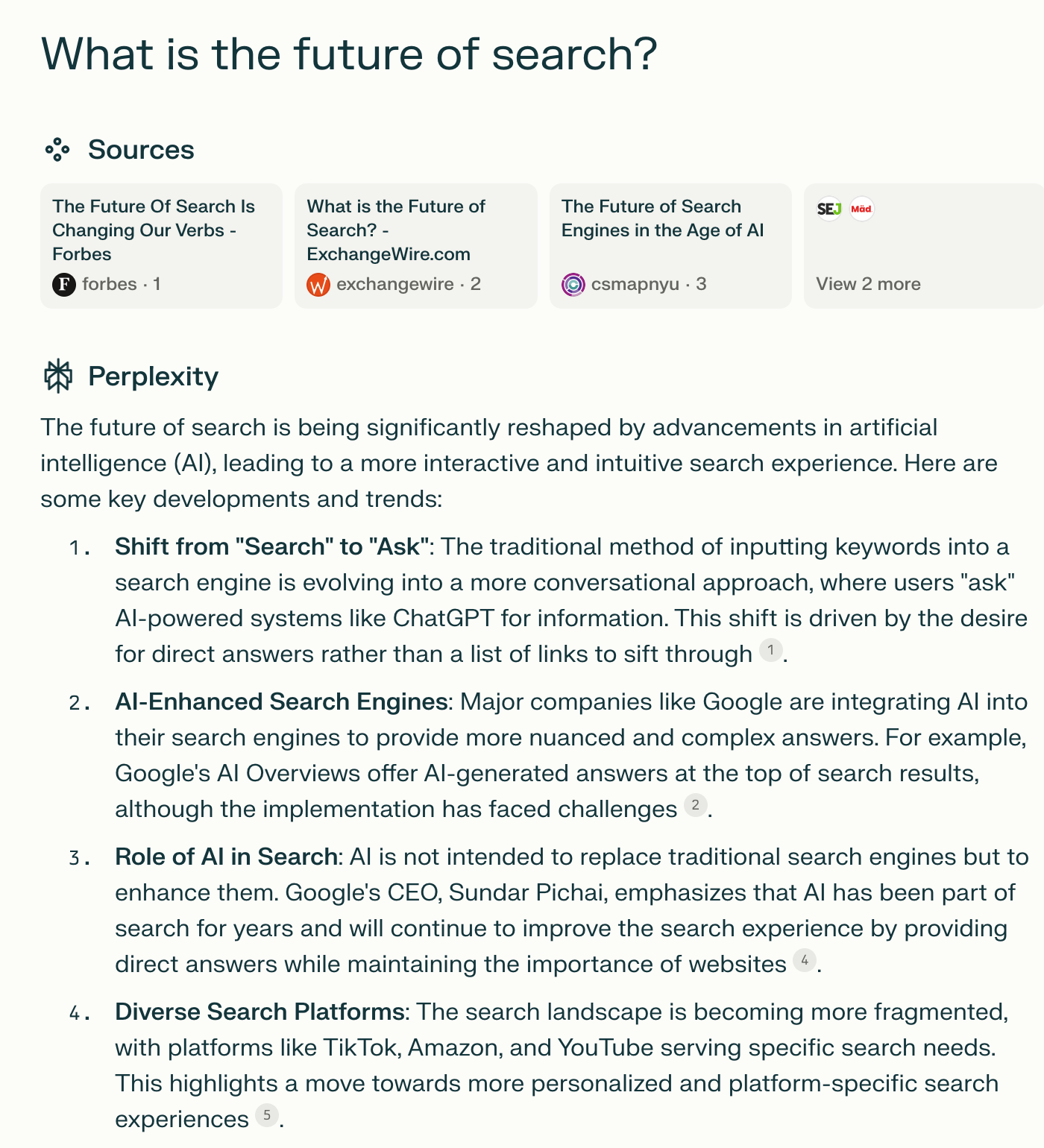
In the rapidly evolving landscape of artificial intelligence, traditional marketing playbooks are quickly becoming obsolete. As AI chatbots like ChatGPT, Perplexity and Exa reshape how consumers search for and interact with information, businesses must adapt their growth strategies to remain relevant and competitive.

The Shifting Search Paradigm

The rise of AI-powered search assistants marks a significant departure from conventional search engine optimization (SEO) tactics. Users are increasingly turning to conversational AI interfaces for quick, personalized answers, bypassing traditional search engine results pages. This shift necessitates a fundamental rethinking of how brands approach visibility and discoverability.

  1. Natural Language Queries: AI systems excel at understanding and responding to conversational, human-like questions, moving away from keyword-based searches.
  2. Intent Recognition: Advanced AI can better interpret the user's underlying intent, providing more accurate and relevant results.
  3. Personalized Results: AI-powered search takes into account user history, preferences, and context to deliver highly personalized results.
  4. Real-time Information Synthesis: Instead of simply returning links, AI can synthesize information from multiple sources to provide comprehensive answers.
  5. Multi-modal Search: AI is enabling more sophisticated image and voice searches, expanding beyond text-based queries.

AI Evaluation of Website Trustworthiness

AI systems are becoming increasingly sophisticated in evaluating the trustworthiness and relevance of websites, especially when it comes to specific products:

  1. Content Quality Assessment: AI analyzes the depth, accuracy, and uniqueness of content, favoring well-researched, original information.
  2. User Engagement Metrics: AI considers factors like time spent on site, bounce rates, and user interactions to gauge content value.
  3. Backlink Analysis: The quality and relevance of backlinks remain important, with AI better able to discern natural link patterns from artificial ones.
  4. Brand Authority: AI systems recognize established brands and authoritative voices in specific industries.
  5. Data Consistency: Consistent information across multiple trusted sources increases a website's credibility in AI evaluations.
  6. User Reviews and Sentiment: AI analyzes user reviews and overall sentiment across various platforms to assess product and brand reliability.
  7. Technical Performance: Website speed, mobile-friendliness, and overall user experience factor into AI trustworthiness assessments.

Reinventing Marketing for AI

To thrive in this new era, companies must:

  1. Optimize for Conversational AI: Develop content that aligns with the natural language processing capabilities of AI chatbots. This means focusing on clear, concise, and informative content that directly addresses user queries.
  2. Prioritize Brand Authority: As AI systems often prioritize reputable sources, establishing your brand as a thought leader in your industry becomes crucial. Invest in creating high-quality, authoritative content that AI is likely to reference.
  3. Embrace AI-Powered Analytics: Utilize AI tools to gain deeper insights into customer behavior and preferences, allowing for more targeted and effective marketing strategies.
  4. Personalization at Scale: Leverage AI to deliver hyper-personalized experiences to customers, enhancing engagement and loyalty.
  5. Ethical AI Integration: Incorporate AI into your marketing efforts responsibly, ensuring transparency and maintaining consumer trust.
  6. Structured Data Implementation: Use schema markup and other structured data formats to help AI systems better understand and categorize your content.
  7. Voice Search Optimization: Adapt content for voice search queries, which are often longer and more conversational than text-based searches.

Redefining Brand Value

In an AI-driven world, brand value extends beyond traditional metrics. Companies must now consider:

  • AI Compatibility: How easily can your brand be understood and recommended by AI systems?
  • Data Quality: The accuracy and relevance of your digital footprint will directly impact AI-driven recommendations.
  • User Experience: Seamless integration between AI interfaces and your brand's digital presence is crucial.
  • Trust Signals: Implement clear trust signals (certifications, transparent policies, expert endorsements) that AI can recognize and value.
  • Cross-platform Consistency: Maintain consistent brand messaging and information across all digital platforms to reinforce credibility to AI systems.

Conclusion

The AI revolution demands a radical reimagining of marketing and growth strategies. By embracing these changes and innovating accordingly, brands can not only survive but thrive in this new era. The key lies in adaptability, authenticity, and a willingness to explore the uncharted territories of AI-driven marketing. As AI continues to evolve, so too must our approaches to building and maintaining brand value in this dynamic digital landscape.


https://bit.ly/3SQRe8V
https://bit.ly/3M5WGkp

https://guptadeepak.com/content/images/2024/08/Screenshot-2024-08-14-at-12.02.22-PM.png
https://guptadeepak.weebly.com/deepak-gupta/the-future-of-search-ai-powered-transformation

Monday, 5 August 2024

Human vs AI Agents in Cybersecurity: Who Should Guard Your Data?

Human vs AI Agents in Cybersecurity: Who Should Guard Your Data?

In the ever-evolving landscape of cybersecurity, we face a pivotal question: Should we entrust the protection of our most valuable data to human experts or artificial intelligence (AI) agents? As cyber threats become increasingly sophisticated, this decision carries more weight than ever. Let's dive into this complex issue, exploring how AI agents might just be the guardians we need in the digital age.

The Human Touch: A Double-Edged Sword

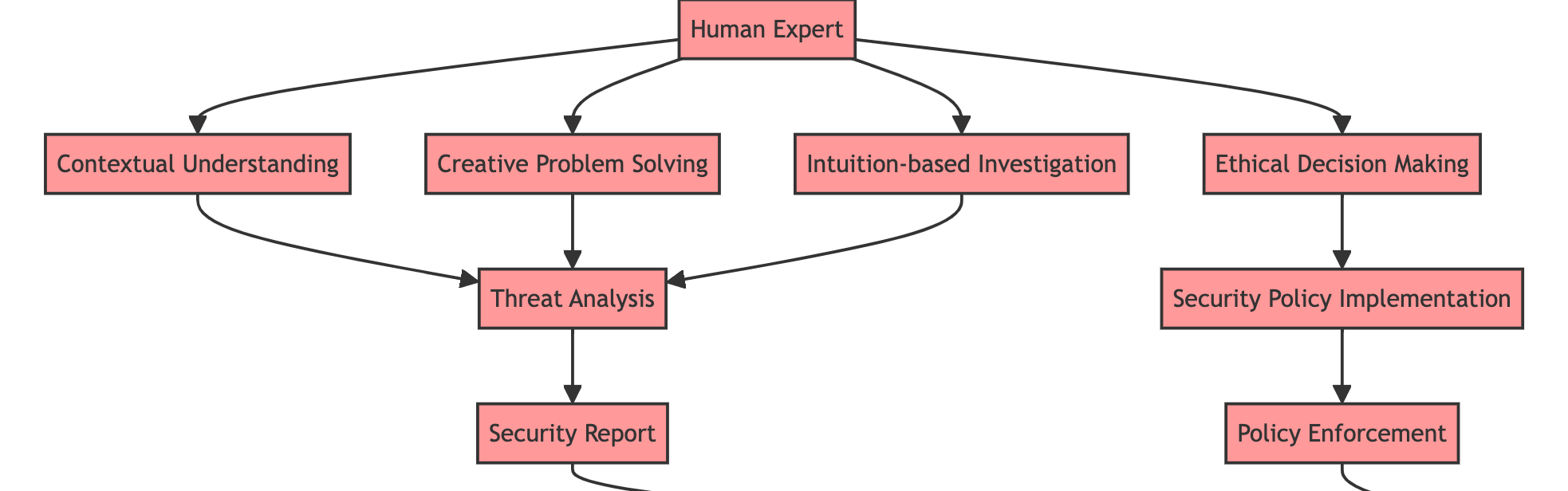
Humans have been at the forefront of cybersecurity since its inception. We've relied on the intuition, creativity, and adaptability of skilled professionals to defend against cyber threats. Human cybersecurity experts bring invaluable traits:

  1. Contextual understanding
  2. Ethical decision-making
  3. Creative problem-solving
  4. Emotional intelligence in crisis management

However, human involvement also introduces vulnerabilities:

  1. Fatigue and burnout
  2. Unconscious biases
  3. Limited processing speed
  4. Inconsistency in performance

As cyber attacks increase in frequency and complexity, these human limitations become more pronounced. This is where AI agents enter the picture, offering a compelling alternative.

AI Agents: The Tireless Guardians

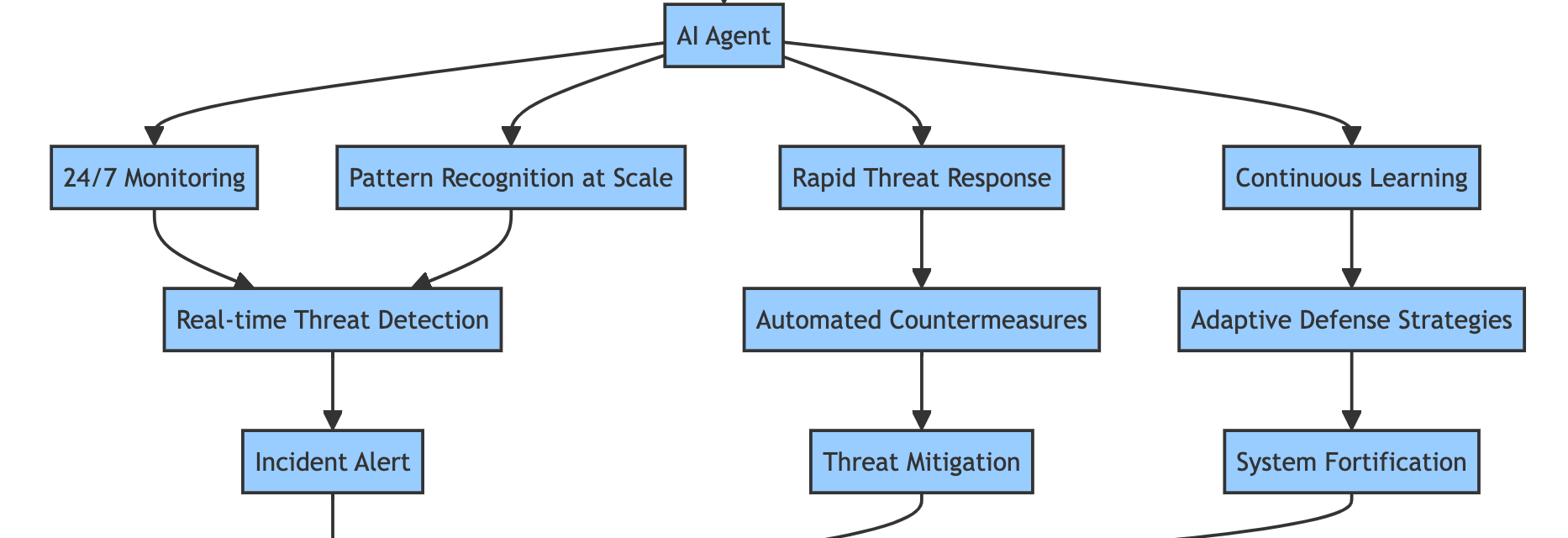
AI agents in cybersecurity are not just tools; they're evolving into autonomous defenders capable of learning, adapting, and making decisions at machine speed. Here's how they're changing the game:

1. Constant Vigilance

Unlike humans, AI agents don't need sleep. They can monitor networks 24/7, analyzing vast amounts of data in real-time. Imagine an AI agent "Argus":

Argus tirelessly scans millions of data points per second across your network. At 3:27 AM, it detects an unusual pattern of encrypted traffic from a database server. Within milliseconds, it correlates this with recent threat intelligence, identifies it as a potential data exfiltration attempt, and initiates countermeasures – all before a human analyst would have even logged in for their morning coffee.

2. Pattern Recognition at Scale

AI excels at identifying patterns in vast datasets, a crucial ability in detecting novel cyber threats. Consider an AI system "Sherlock":

Sherlock analyzes billions of network transactions across thousands of organizations. It notices a subtle commonality in seemingly unrelated phishing attempts targeting different industries. This pattern is so nuanced that it would have taken human analysts months to connect the dots. Sherlock immediately updates threat signatures across all protected networks, effectively inoculating them against this new attack vector.

3. Rapid Adaptation to New Threats

In the arms race of cybersecurity, speed is critical. AI agents can learn and adapt to new threats faster than any human team. Let's introduce "Phoenix":

Phoenix, an AI-driven intrusion prevention system, encounters a previously unseen type of malware. It quickly analyzes the malware's behavior, creates a signature, and deploys a countermeasure. Phoenix then simulates thousands of variations of this malware, predicting potential mutations. By the time the malware authors release their next version, Phoenix is already ten steps ahead, with defenses in place for hundreds of possible variants.

4. Unbiased Decision Making

AI agents make decisions based on data, free from human biases that can cloud judgment. Meet "Themis":

Themis, an AI security policy enforcer, notices that a C-level executive's account is exhibiting suspicious behavior indicative of a compromise. Unlike a human analyst who might hesitate due to the executive's status, Themis impartially applies security protocols, temporarily restricting the account's privileges and initiating a thorough investigation, potentially stopping a major breach in its tracks.

Learning from Experience: The AI Advantage

One of the most powerful aspects of AI in cybersecurity is its ability to learn from every interaction, attack, and defense. This continuous learning process creates a feedback loop that constantly improves the AI's capabilities.

Imagine an AI agent called "Hydra":

Hydra defends against a sophisticated attack on a financial institution. Although it successfully prevents data theft, the attackers manage to briefly disrupt services. Hydra analyzes every millisecond of the attack, identifying minute weaknesses in its response. It then runs millions of simulations, refining its strategies. The next time a similar attack occurs, Hydra's response is orders of magnitude more effective. Unlike a human team, which might take months to implement lessons learned, Hydra's improvements are immediate and continuously compounding.

The Symbiosis of Human and AI in Cybersecurity

While AI agents offer compelling advantages, the ideal scenario isn't an either/or choice between humans and AI. Instead, the future of cybersecurity lies in a symbiotic relationship between human experts and AI agents.

Humans provide the strategic oversight, ethical boundaries, and creative thinking that guide AI systems. They ask the right questions, set the priorities, and make the high-level decisions that shape cybersecurity policies.

Human vs AI Agents in Cybersecurity: Who Should Guard Your Data?

AI agents, in turn, handle the heavy lifting of data analysis, pattern recognition, and real-time threat response. They augment human capabilities, allowing cybersecurity teams to operate at unprecedented scales of speed and efficiency.

Together, they form a cybersecurity ecosystem that's greater than the sum of its parts. Humans and AI agents working in concert can create adaptive, intelligent defense systems capable of protecting our most valuable data in an increasingly complex digital world.

Embracing the AI Guardian

As we stand at this technological crossroads, the question isn't really whether we want humans or AI agents protecting our valuable data. The question is: How quickly can we integrate AI agents into our cybersecurity strategies to create more robust, responsive, and intelligent defense systems?

The cyber threats of tomorrow will be faster, more complex, and more devastating than ever before. To meet this challenge, we need guardians that can operate at the speed of data, learn from every encounter, and adapt in real-time. AI agents, working alongside human experts, offer our best hope for securing our digital future.

In the end, the choice to embrace AI in cybersecurity isn't just about protecting data – it's about staying one step ahead in a rapidly evolving digital landscape. As we entrust more of our lives and societies to digital systems, having AI guardians at the gate isn't just an option – it's becoming a necessity.


https://bit.ly/46xmQ9d
https://bit.ly/4fzpz5T

https://guptadeepak.com/content/images/2024/08/Screenshot-2024-08-05-at-1.34.35-PM.png
https://guptadeepak.weebly.com/deepak-gupta/human-vs-ai-agents-in-cybersecurity-who-should-guard-your-data

Monday, 29 July 2024

AI-Powered Cybersecurity: How Artificial Intelligence is Transforming the OSI Model

AI-Powered Cybersecurity: How Artificial Intelligence is Transforming the OSI Model

In today's interconnected digital landscape, businesses face an ever-evolving array of cybersecurity threats. To effectively protect their assets, data, and reputation, companies must implement robust security measures at every layer of their network infrastructure.

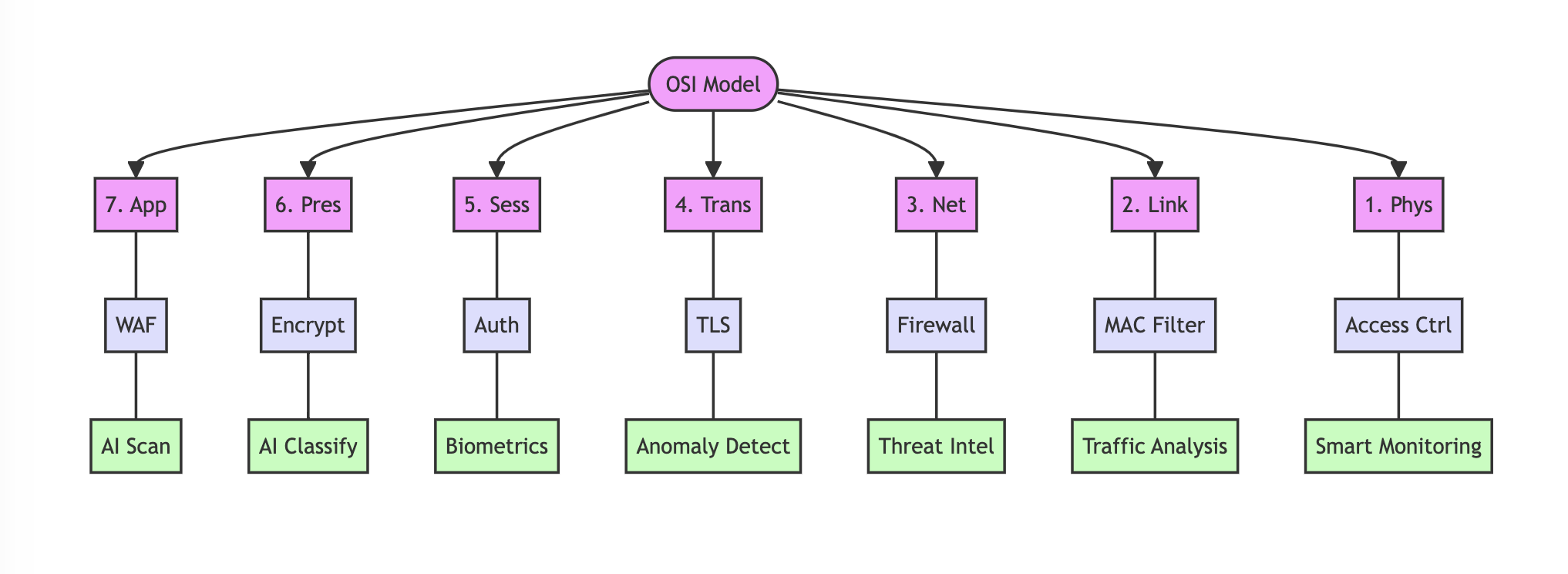
This article provides a deep dive into each layer of the OSI (Open Systems Interconnection) model, exploring the specific security challenges, protection strategies, key players in the security industry, and emerging innovations for each layer.

OSI Layer Layer Name Cybersecurity Measures
7 Application - Web Application Firewalls (WAF)
- Input validation
- Encryption (HTTPS, SSL/TLS)
- Authentication and authorization
- Regular security updates and patches
6 Presentation - Data encryption
- Digital signatures
- Format preserving encryption
5 Session - Session management
- Secure session handling
- Time-outs for inactive sessions
4 Transport - Transport Layer Security (TLS)
- Secure Socket Layer (SSL)
- Port security
3 Network - Firewalls
- Intrusion Detection/Prevention Systems (IDS/IPS)
- Virtual Private Networks (VPN)
- Access Control Lists (ACL)
2 Data Link - MAC address filtering
- Port security on switches
- IEEE 802.1X for port-based access control
1 Physical - Physical access controls
- Cable protection
- Biometric access systems
- Surveillance systems

1. Physical Layer Security

The Physical Layer is the foundation of network communication, dealing with the actual physical connections and hardware involved in network infrastructure.

Key Security Challenges

  • Unauthorized physical access to network devices
  • Cable tapping and signal interception
  • Hardware tampering and theft
  • Electromagnetic interference and jamming

Protection Strategies

  1. Access Control Systems: Implement biometric scanners, key card systems, and multi-factor authentication for server rooms and network closets.
  2. Surveillance: Deploy CCTV cameras and motion sensors to monitor sensitive areas.
  3. Cable Protection: Use armored fiber optic cables and secure cable trays to prevent tapping.
  4. Hardware Security: Employ tamper-evident seals and regularly inspect devices for signs of tampering.
  5. Environmental Controls: Implement proper HVAC systems to prevent overheating and moisture damage.

Key Security Companies

  • Honeywell (Access Control and Surveillance)
  • Cisco (Physical Network Infrastructure)
  • ADT (Physical Security Systems)
  • Axis Communications (Network Cameras and Access Control)

Future Innovations

  • AI-powered surveillance systems for anomaly detection
  • Quantum-based physical layer security for unbreakable communication
  • Self-healing materials for cable and hardware protection

The Data Link Layer manages communication between directly connected network nodes, handling data framing and error detection.

Key Security Challenges

  • MAC address spoofing
  • ARP poisoning attacks
  • Rogue access points
  • VLAN hopping

Protection Strategies

  1. Port Security: Configure switches to limit the number of MAC addresses per port.
  2. MAC Filtering: Implement whitelists of allowed MAC addresses on network switches.
  3. IEEE 802.1X: Deploy port-based Network Access Control (NAC) for authentication.
  4. DHCP Snooping: Prevent rogue DHCP servers from distributing malicious IP configurations.
  5. Private VLANs: Isolate hosts within the same VLAN to prevent lateral movement.

Key Security Companies

  • Cisco (Switches with advanced security features)
  • Juniper Networks (Network Access Control solutions)
  • Aruba Networks (Secure wireless solutions)
  • Extreme Networks (Fabric-based networking security)

Future Innovations

  • AI-driven anomaly detection in Layer 2 traffic patterns
  • Blockchain-based device authentication for IoT networks
  • Self-configuring and self-healing Layer 2 networks

3. Network Layer Security

The Network Layer handles routing and addressing, making it crucial for controlling traffic flow and preventing unauthorized access.

Key Security Challenges

  • IP spoofing
  • DDoS attacks
  • Routing table poisoning
  • Packet sniffing

Protection Strategies

  1. Firewalls: Deploy next-generation firewalls (NGFW) with deep packet inspection capabilities.
  2. Intrusion Detection/Prevention Systems (IDS/IPS): Implement real-time traffic analysis and threat mitigation.
  3. Virtual Private Networks (VPN): Secure remote access and site-to-site connections with strong encryption.
  4. Access Control Lists (ACL): Configure routers to filter traffic based on predefined rules.
  5. Segmentation: Implement network segmentation and micro-segmentation to limit the blast radius of potential breaches.

Key Security Companies

  • Palo Alto Networks (Next-generation firewalls)
  • Fortinet (Unified threat management solutions)
  • Check Point Software Technologies (Network security appliances)
  • Zscaler (Cloud-based security)

Future Innovations

  • AI-powered predictive threat intelligence
  • Software-defined perimeter (SDP) for dynamic access control
  • Quantum-resistant encryption for VPNs

4. Transport Layer Security

The Transport Layer ensures reliable data transfer between end systems, making it critical for securing communications.

Key Security Challenges

  • SSL/TLS vulnerabilities
  • TCP SYN flooding attacks
  • Session hijacking
  • Man-in-the-middle attacks

Protection Strategies

  1. Transport Layer Security (TLS): Implement the latest TLS protocols (TLS 1.3) for encrypted communications.
  2. Certificate Management: Use robust PKI systems and regularly rotate SSL/TLS certificates.
  3. TCP SYN Cookie: Enable SYN cookies on servers to mitigate SYN flood attacks.
  4. Connection Rate Limiting: Implement rate limiting to prevent connection exhaustion attacks.

Key Security Companies

  • DigiCert (SSL/TLS certificates and management)
  • Venafi (Machine identity protection)
  • F5 Networks (Application delivery and security)
  • Cloudflare (DDoS protection and SSL/TLS services)

Future Innovations

  • Post-quantum cryptography for transport layer security
  • AI-driven anomaly detection in encrypted traffic
  • Decentralized PKI systems using blockchain technology

5. Session Layer Security

The Session Layer establishes, manages, and terminates connections between applications, making session security crucial for preventing unauthorized access.

Key Security Challenges

  • Session hijacking
  • Cross-site scripting (XSS) attacks
  • Insufficient session timeout
  • Session fixation

Protection Strategies

  1. Secure Session Handling: Implement strong session ID generation and management.
  2. Session Timeouts: Configure appropriate idle and absolute session timeouts.
  3. Session Encryption: Encrypt session data in transit and at rest.
  4. Multi-factor Authentication (MFA): Require additional authentication for sensitive actions or after periods of inactivity.

Key Security Companies

  • Okta (Identity and access management)
  • Auth0 (Authentication and authorization as a service)
  • OneLogin (Unified access management)
  • Ping Identity (Identity security solutions)

Future Innovations

  • Continuous authentication using behavioral biometrics
  • Decentralized identity management using blockchain
  • Context-aware session management based on user behavior and environment

6. Presentation Layer Security

The Presentation Layer deals with data formatting and encryption, playing a crucial role in data privacy and integrity.

Key Security Challenges

  • Data format vulnerabilities
  • Insufficient encryption
  • Compression-based attacks
  • Encoding/decoding exploits

Protection Strategies

  1. Data Encryption: Implement strong encryption algorithms for data at rest and in transit.
  2. Input Validation: Rigorously validate and sanitize all input data to prevent injection attacks.
  3. Secure Data Serialization: Use secure methods for data serialization and deserialization.
  4. Format-Preserving Encryption: Employ FPE for sensitive data that needs to maintain its original format.

Key Security Companies

  • Voltage Security (Data-centric security solutions)
  • Thales (Encryption and key management)
  • IBM Security (Data security and encryption)
  • Microsoft (Azure Information Protection)

Future Innovations

  • Homomorphic encryption for processing encrypted data
  • AI-driven data classification and automatic encryption
  • Quantum-resistant encryption algorithms

7. Application Layer Security

The Application Layer is where end-user services operate, making it a primary target for cyberattacks and a critical focus for security efforts.

Key Security Challenges

  • SQL injection
  • Cross-site scripting (XSS)
  • Broken authentication
  • Sensitive data exposure
  • XML external entity (XXE) attacks

Protection Strategies

  1. Web Application Firewalls (WAF): Deploy WAFs to filter and monitor HTTP traffic.
  2. Secure Coding Practices: Implement and enforce secure coding guidelines and conduct regular code reviews.
  3. Regular Security Updates: Maintain a rigorous patching schedule for all applications and dependencies.
  4. API Security: Implement robust authentication, rate limiting, and input validation for APIs.
  5. Runtime Application Self-Protection (RASP): Deploy RASP solutions to detect and prevent attacks in real-time.

Key Security Companies

  • Akamai (Web application and API protection)
  • Imperva (Application security solutions)
  • Veracode (Application security testing)
  • Synopsys (Software composition analysis and security testing)

Future Innovations

  • AI-powered application security testing and vulnerability prediction
  • Serverless security solutions for cloud-native applications
  • Automated patch generation and deployment using machine learning

Conclusion

Securing each layer of the network is crucial for businesses to protect against the ever-evolving landscape of cyber threats. By implementing a comprehensive, multi-layered security approach, organizations can significantly reduce their risk exposure and build resilience against potential attacks.

As we look to the future, emerging technologies like AI, machine learning, blockchain, and quantum computing are set to revolutionize network security. However, these same technologies may also be leveraged by malicious actors, creating new challenges and attack vectors.

To stay ahead in this constant arms race, businesses must remain vigilant, continuously updating their security strategies, and investing in the latest security innovations. By doing so, they can not only protect their assets and data but also gain a competitive advantage in an increasingly digital world.


https://ift.tt/64gK51w
https://ift.tt/dkFaw20

https://guptadeepak.com/content/images/2024/07/Screenshot-2024-07-27-at-2.12.01-PM.png
https://guptadeepak.weebly.com/deepak-gupta/ai-powered-cybersecurity-how-artificial-intelligence-is-transforming-the-osi-model

Thursday, 25 July 2024

Comparative Analysis of Password Hashing Algorithms: Argon2 bcrypt scrypt and PBKDF2

Comparative Analysis of Password Hashing Algorithms: Argon2, bcrypt, scrypt, and PBKDF2

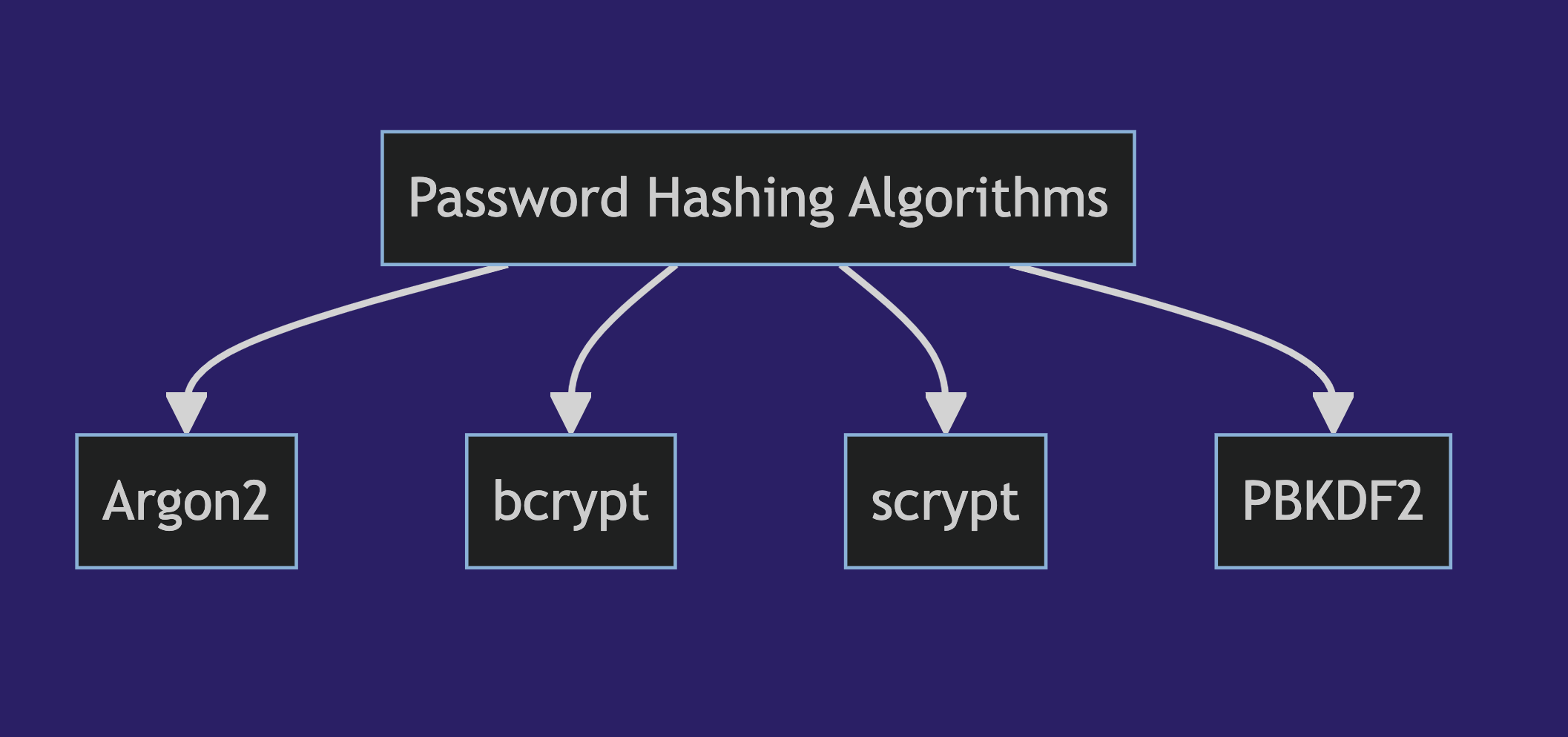
In cryptography and cybersecurity, choosing a password hashing algorithm is crucial for protecting user credentials and sensitive data. This article compares four prominent password hashing algorithms: Argon2, bcrypt, scrypt, and PBKDF2. We'll explore their strengths, weaknesses, use cases, and prospects to help inform decisions on which algorithm to use in various scenarios.

Password Hashing Algorithms

Comparative Analysis of Password Hashing Algorithms: Argon2, bcrypt, scrypt, and PBKDF2

Argon2

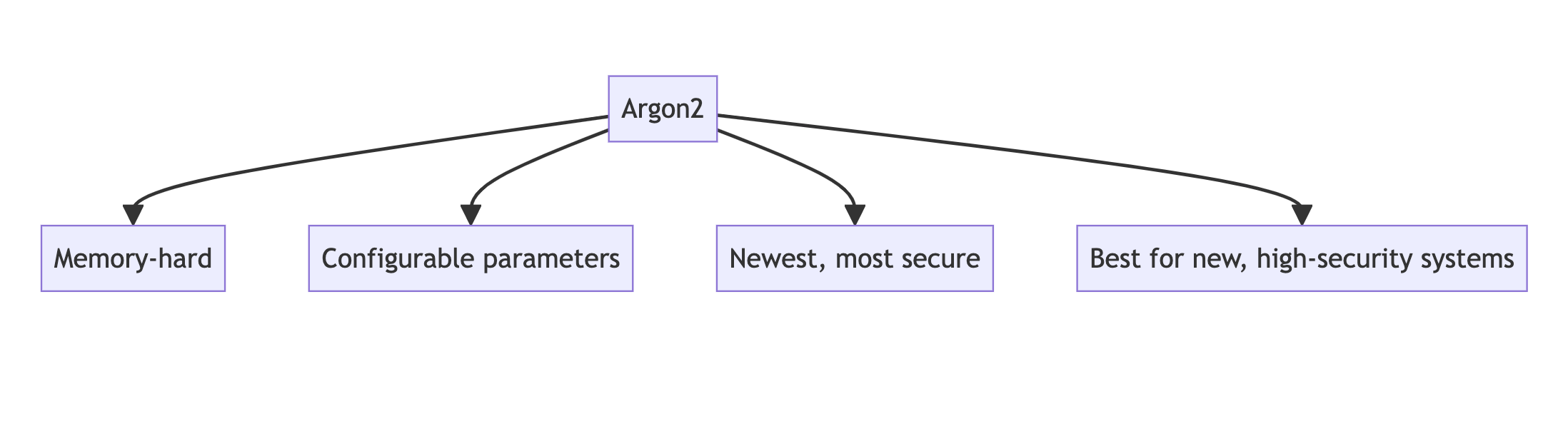
Argon2 is the winner of the Password Hashing Competition held between 2013 and 2015. It was designed to be a state-of-the-art memory-hard function, resistant to various types of attacks.

Key Features:

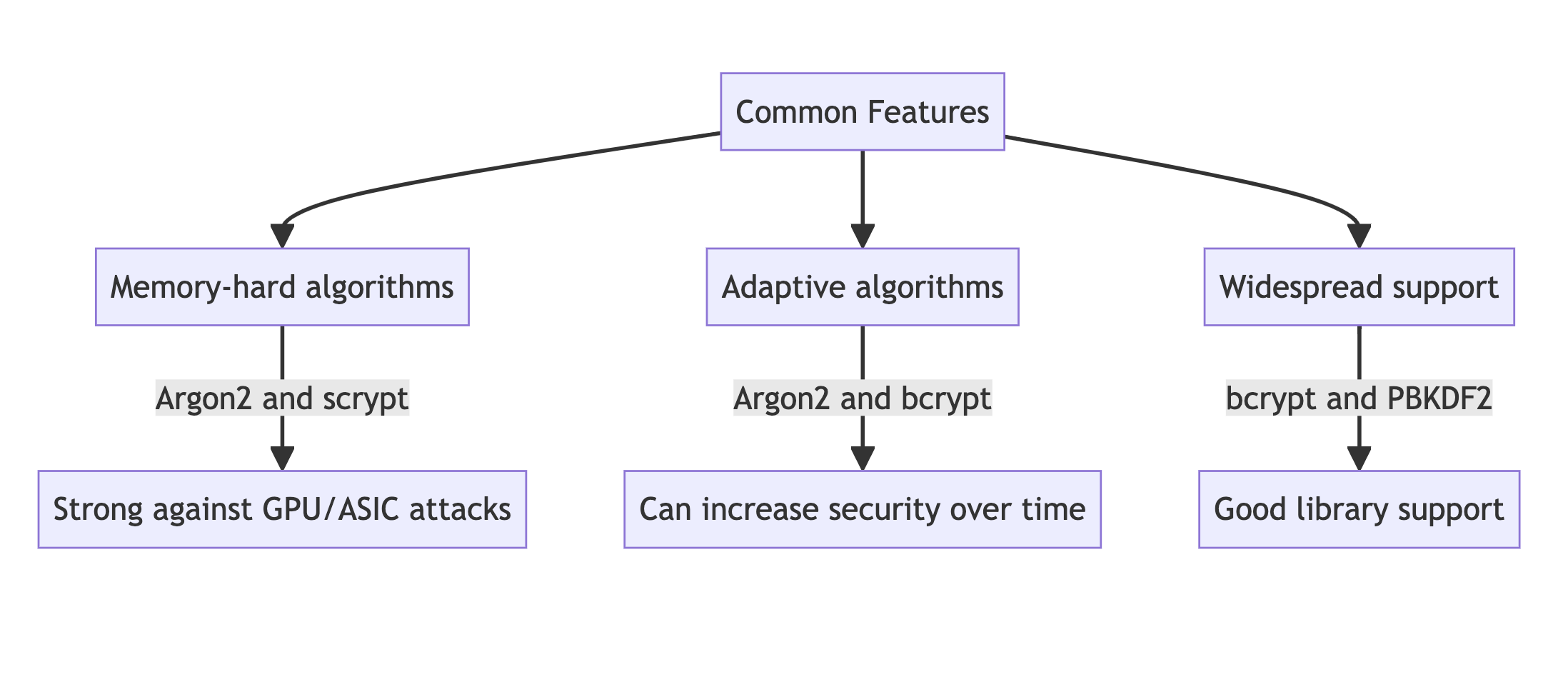
  • Memory-hard, making it resistant to GPU and ASIC attacks
  • Configurable memory, time, and parallelism parameters
  • Three variants: Argon2d, Argon2i, and Argon2id
Comparative Analysis of Password Hashing Algorithms: Argon2, bcrypt, scrypt, and PBKDF2

bcrypt

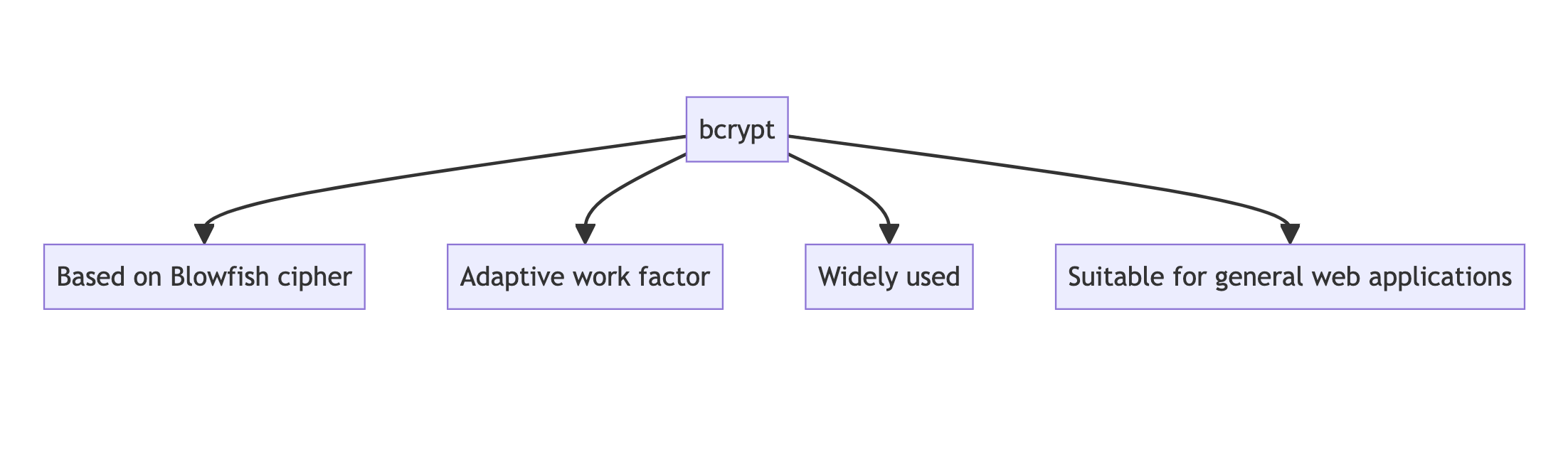
Developed in 1999 by Niels Provos and David Mazières, bcrypt is based on the Blowfish cipher and is widely used for password hashing.

Key Features:

  • Adaptive function with a work factor that can be increased over time
  • Built-in salt to protect against rainbow table attacks
  • Relatively slow, which is beneficial for password-hashing
Comparative Analysis of Password Hashing Algorithms: Argon2, bcrypt, scrypt, and PBKDF2

scrypt

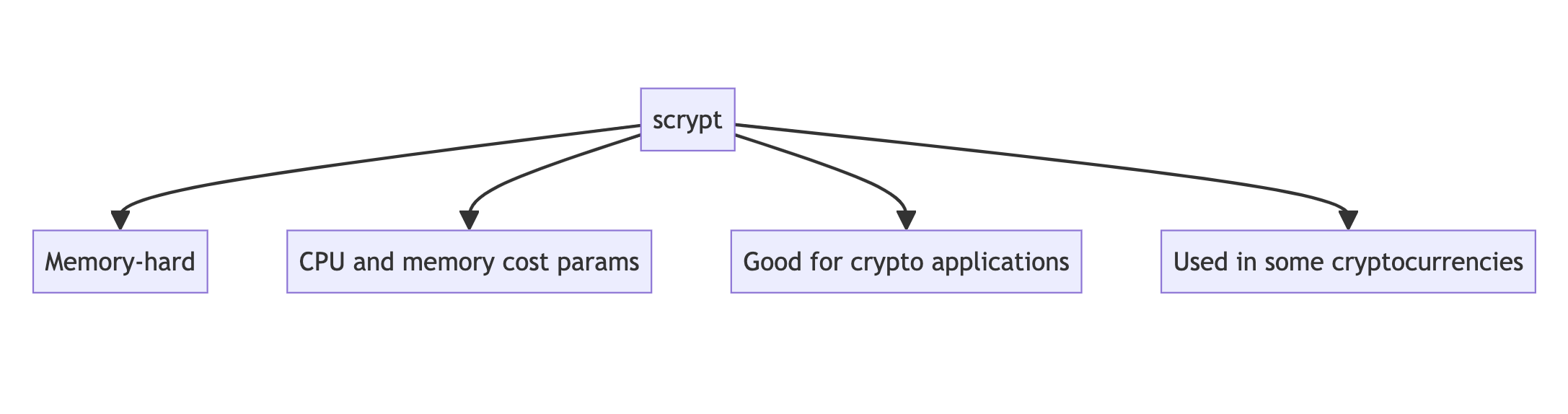
Created by Colin Percival in 2009, scrypt was designed to be memory-hard and resistant to large-scale custom hardware attacks.

Key Features:

  • Memory-hard, requiring significant amounts of RAM
  • Configurable CPU and memory cost parameters
  • Designed to be more secure against hardware brute-force attacks than PBKDF2
Comparative Analysis of Password Hashing Algorithms: Argon2, bcrypt, scrypt, and PBKDF2

PBKDF2

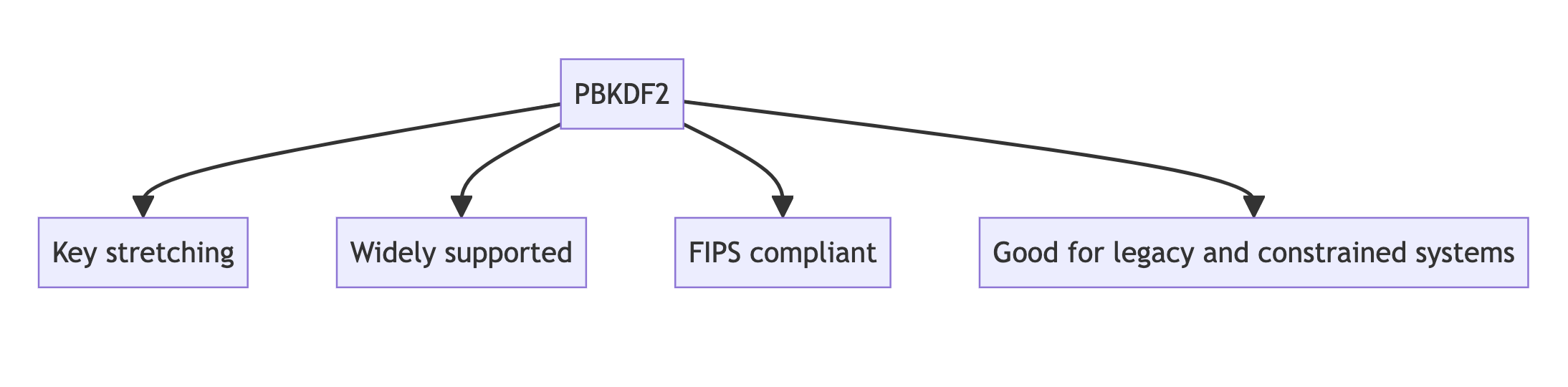
Password-Based Key Derivation Function 2 (PBKDF2) is part of RSA Laboratories' Public-Key Cryptography Standards (PKCS) series. It's widely used and considered a standard in many applications.

Key Features:

  • Applies a pseudorandom function to the input password along with a salt
  • Uses key stretching through iteration count
  • It can be used with various underlying cryptographic hash functions (e.g., SHA-256)
Comparative Analysis of Password Hashing Algorithms: Argon2, bcrypt, scrypt, and PBKDF2

Comparative Analysis

Security

  1. Argon2: Considered the most secure among the four, especially against GPU and ASIC attacks. Its memory hardness and configurability make it highly resistant to various attack vectors.
  2. bcrypt: Still considered secure, but potentially vulnerable to FPGA attacks. Its fixed memory usage (4KB) is a limitation compared to more modern algorithms.
  3. scrypt: Very secure due to its memory-hardness, but slightly less so than Argon2. It's particularly strong against hardware-based attacks.
  4. PBKDF2: The least secure of the four, especially against GPU and ASIC attacks. However, it's still considered safe when used with a high iteration count.

Performance and Resource Usage

  1. Argon2: Highly configurable, allowing for balanced CPU and memory usage. Can be optimized for different hardware environments.
  2. bcrypt: Consistent performance across different hardware due to fixed memory usage. Generally slower than PBKDF2 but faster than scrypt.
  3. scrypt: High memory usage, which can be a limitation in resource-constrained environments. Slower than bcrypt and PBKDF2.
  4. PBKDF2: Fastest of the four, but this is a drawback for password hashing. Low memory usage makes it vulnerable to parallel attacks.

Flexibility and Implementation

  1. Argon2: Highly flexible with three variants and configurable parameters. However, being newer, it may have less widespread library support.
  2. bcrypt: Simple to implement and widely supported in various programming languages and frameworks.
  3. scrypt: Moderately complex to implement correctly. Has good library support but not as ubiquitous as bcrypt or PBKDF2.
  4. PBKDF2: Very flexible and widely supported. Can be used with different underlying hash functions.

Use Cases

Argon2

  • Best for high-security applications where memory-hardness is crucial
  • Ideal for password hashing in new systems with modern hardware
  • Recommended for cryptocurrency systems due to its resistance to GPU attacks

bcrypt

  • Suitable for general-purpose password hashing in web applications
  • Good choice for systems that need a battle-tested, widely supported algorithm
  • Appropriate for legacy systems that can't easily migrate to newer algorithms

scrypt

  • Excellent for systems requiring strong protection against hardware-based attacks
  • Suitable for cryptocurrency applications (e.g., used in Litecoin)
  • Good for high-security systems with sufficient memory resources

PBKDF2

  • Still suitable for key derivation functions in various cryptographic protocols
  • Useful in resource-constrained environments where memory-hardness isn't critical
  • Appropriate for systems requiring FIPS compliance

Future Prospects

  1. Argon2: Likely to see increased adoption as the new standard for password hashing. Its flexibility and security make it well-positioned for future cryptographic needs.
  2. bcrypt: Will continue to be widely used due to its established presence and simplicity. However, it may gradually be replaced by Argon2 in high-security applications.
  3. scrypt: Will remain relevant, especially in cryptocurrency and other memory-hard applications. However, it may lose ground to Argon2 in general use cases.
  4. PBKDF2: Due to its widespread implementation and FIPS compliance, PBKDF2 will continue to be used, but it's likely to be phased out in favor of more secure alternatives for password hashing.

Conclusion

While all four algorithms are currently considered secure when properly implemented, Argon2 stands out as the most future-proof and safe option, especially for new systems. bcrypt remains a solid choice for general-purpose use, particularly in established systems. scrypt offers strong security against hardware attacks but at the cost of higher resource usage. PBKDF2, while still widely used, is generally considered the least secure option for password hashing among these four.

Comparative Analysis of Password Hashing Algorithms: Argon2, bcrypt, scrypt, and PBKDF2

The choice of algorithm should be based on specific security requirements, available resources, and the nature of potential threats. In most cases, migrating to or implementing Argon2 is recommended for optimal security. However, proper implementation and parameter selection are crucial regardless of the chosen algorithm.

As the field of cryptography evolves, it's essential to stay informed about new developments and potential vulnerabilities in these algorithms. Regular security audits and updates to cryptographic practices remain vital for maintaining robust security in any system.


https://ift.tt/kp8GsNU
https://ift.tt/HIzBuSj

https://guptadeepak.com/content/images/2024/07/hashing-algorithms-use-cases.webp
https://guptadeepak.weebly.com/deepak-gupta/comparative-analysis-of-password-hashing-algorithms-argon2-bcrypt-scrypt-and-pbkdf2

Palo Alto Networks CyberArk: The $25 Billion Deal Reshaping Cybersecurity

Deal Overview Transaction Details : Palo Alto Networks announced on July 30, 2025, its agreement to acquire CyberArk for $45.00 in cash...