Thursday, 24 October 2024

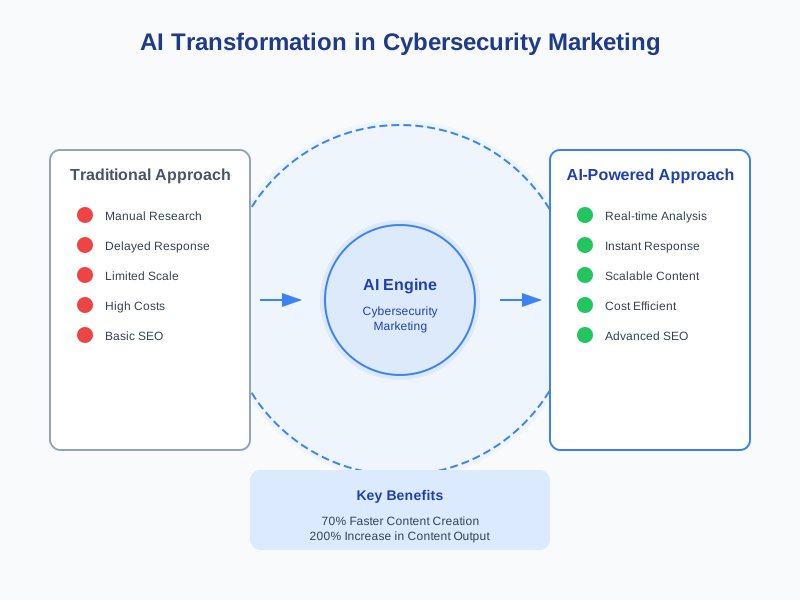
The Evolution of Cybersecurity Marketing: Traditional vs. AI-Powered Approaches

The Evolution of Cybersecurity Marketing: Traditional vs. AI-Powered Approaches

The cybersecurity marketing landscape has undergone a dramatic transformation in recent years. With the increasing sophistication of cyber threats and the growing complexity of security solutions, marketing teams face unique challenges in communicating value propositions, maintaining technical accuracy, and staying current with rapidly evolving threats. This analysis explores how artificial intelligence is revolutionizing cybersecurity marketing, comparing traditional methodologies with modern AI-powered approaches.

1. Content Creation and Management

Content creation in cybersecurity marketing presents unique challenges due to the technical nature of the subject matter, the rapid evolution of threats, and the need to maintain credibility while making complex concepts accessible. Traditional approaches have struggled to keep pace with the volume and velocity of changes in the cybersecurity landscape.

The cybersecurity industry generates an enormous amount of technical information daily:

  • 450,000+ new malware variants detected daily
  • 30+ major CVEs (Common Vulnerabilities and Exposures) published weekly
  • Hundreds of security research papers published monthly
  • Constant updates to compliance regulations and security standards

Traditional Approach

  • Research Process:
    • Manual monitoring of security news and threat intelligence portals
    • Security researchers spending 15-20 hours/week keeping up with latest threats
    • Technical writers needing 5-10 hours to understand and contextualize each new threat
    • 2-3 day delay in responding to emerging vulnerabilities
    • Heavy reliance on subject matter experts (SMEs) causing bottlenecks
    • Limited coverage of global security trends
  • Content Development:
    • Small team of specialized writers (typically 2-3) with cybersecurity knowledge
    • Average turnaround time of 1-2 weeks per technical piece
    • Content capacity limited to 2-4 major pieces per month
    • Cost per piece ranging from $500-$2000
    • Multiple revision cycles with technical teams
    • Difficulty maintaining consistent technical accuracy
    • Limited ability to create content variants for different platforms

AI-Powered Approach

  • Research Process:
    • Real-time monitoring of global threat intelligence feeds
    • Automated analysis of security research papers and technical documentation
    • Integration with threat databases and vulnerability scanners
    • Instant correlation of related threats and vulnerabilities
    • Automated technical validation with configurable accuracy thresholds
    • Global coverage of security trends and regional variations
  • Content Development:
    • AI systems trained on vast cybersecurity datasets and technical documentation
    • Content generation in hours rather than weeks
    • Scalable production of 20+ pieces per month
    • Cost reduction to $50-$200 per piece
    • Automated technical accuracy verification
    • Consistent terminology and technical definitions
    • Automatic content variants for different channels and audiences

2. Technical to Non-Technical Translation

The cybersecurity industry faces a unique challenge in communicating complex technical concepts to various stakeholders, from technical practitioners to C-level executives. This translation challenge has historically been a major bottleneck in marketing effectiveness.

Cybersecurity content must serve multiple audiences:

  • Technical professionals (CISOs, Security Engineers)
  • Business decision-makers (CEOs, CFOs)
  • IT professionals
  • Compliance officers
  • End users
  • Industry regulators

Traditional Approach

  • Communication Challenges:
    • Requiring writers with both deep technical knowledge and marketing skills
    • Average recruitment time of 3-6 months for qualified technical writers
    • 60% of content requiring multiple revisions for clarity
    • High risk of technical inaccuracies in simplified content
    • Limited ability to maintain technical depth while achieving accessibility
  • Content Adaptation:
    • Manual rewrites taking 4-8 hours per piece for each audience level
    • Extensive review cycles involving both technical and marketing teams
    • Inconsistent messaging across different audience versions
    • Limited ability to customize content for different industry verticals
    • High resource requirements for multi-audience content strategies

AI-Powered Approach

  • Communication Solutions:
    • Automated translation of technical concepts using industry-specific algorithms
    • Dynamic adjustment of technical depth based on audience profiles
    • Maintenance of technical accuracy through AI validation
    • Consistent terminology use across all content versions
    • Real-time adaptation to audience engagement metrics
  • Content Adaptation:
    • Simultaneous generation of multiple audience versions
    • Automated technical accuracy verification
    • Integration of industry-specific examples and use cases
    • Dynamic content adjustment based on reader behavior
    • Scalable multi-audience content strategy

3. SEO and Content Distribution

Cybersecurity SEO presents unique challenges due to rapidly changing terminology, emerging threats, and the need to maintain technical accuracy while optimizing for search visibility.

The cybersecurity SEO landscape includes:

  • Rapidly evolving technical terms
  • New threat names and categories
  • Changing compliance requirements
  • Complex product categories
  • Technical and non-technical search intent

Traditional Approach

  • SEO Strategy:
    • Manual keyword research taking 10-15 hours per month
    • Limited coverage of technical terms and emerging threats
    • Static optimization based on historical data
    • Delayed response to new security trends
    • Basic keyword mapping and content planning
    • Limited ability to target technical and non-technical searches simultaneously
  • Content Distribution:
    • Manual content scheduling and posting
    • Basic platform-specific optimization
    • Limited A/B testing capabilities
    • Standard analytics tracking
    • Fixed content formats and structures
    • Limited ability to respond to trending topics

AI-Powered Approach

  • SEO Strategy:
    • Real-time keyword discovery and trend analysis
    • Comprehensive technical term coverage
    • Dynamic content optimization based on search patterns
    • Automated identification of emerging security topics
    • Advanced keyword clustering and topic modeling
    • Multi-intent content optimization
  • Content Distribution:
    • Automated cross-platform distribution
    • AI-optimized posting schedules
    • Continuous performance optimization
    • Advanced analytics and predictive modeling
    • Dynamic content reformatting
    • Real-time trend response capabilities

4. Lead Generation and Nurturing

Cybersecurity solutions often have complex sales cycles involving multiple stakeholders and requiring significant education and trust-building. Traditional lead generation and nurturing approaches often struggle to address the unique needs of cybersecurity buyers.

Cybersecurity lead generation involves:

  • Complex buyer journeys (6-18 months)
  • Multiple decision-makers
  • High technical knowledge requirements
  • Significant trust and credibility requirements
  • Compliance and regulatory considerations

Traditional Approach

  • Lead Capture:
    • Standard form-based lead capture
    • Basic lead scoring based on form fields
    • Manual lead qualification processes
    • Generic nurture sequences
    • Limited ability to segment technical vs. non-technical leads
    • Static qualification criteria
  • Content Personalization:
    • Basic persona-based segmentation
    • Limited personalization capabilities
    • Static content journeys
    • Manual content recommendations
    • Fixed nurture paths
    • Limited ability to adapt to buyer behavior

AI-Powered Approach

  • Lead Capture:
    • Intelligent content gating based on visitor behavior
    • Advanced behavioral scoring algorithms
    • Automated technical vs. non-technical lead classification
    • Dynamic qualification criteria
    • Real-time lead prioritization
    • Adaptive nurture sequences
  • Content Personalization:
    • Dynamic persona development
    • Real-time content personalization
    • Adaptive content journeys
    • AI-driven content recommendations
    • Behavioral-based nurture paths
    • Continuous optimization based on engagement

5. Thought Leadership and Brand Building

In the cybersecurity industry, thought leadership is crucial for establishing credibility and trust. Companies must demonstrate deep technical expertise while maintaining accessibility to different audience segments.

Cybersecurity thought leadership requires:

  • Deep technical expertise
  • Current threat intelligence
  • Industry trend awareness
  • Regulatory compliance knowledge
  • Strategic security insights

Traditional Approach

  • Thought Leadership:
    • Reactive content strategy based on news cycles
    • Heavy reliance on individual experts
    • Limited perspective on emerging trends
    • Inconsistent publishing schedule
    • Difficulty maintaining technical depth
    • Limited ability to cover multiple security domains
  • Brand Building:
    • Manual brand monitoring
    • Delayed response to market changes
    • Basic competitive analysis
    • Traditional PR approaches
    • Limited market intelligence
    • Static brand positioning

AI-Powered Approach

  • Thought Leadership:
    • Proactive identification of emerging trends
    • AI-assisted expert insights
    • Predictive trend analysis
    • Consistent content cadence
    • Automated technical validation
    • Comprehensive security domain coverage
  • Brand Building:
    • Real-time brand sentiment analysis
    • Rapid market adaptation
    • Comprehensive competitive intelligence
    • Automated PR monitoring and response
    • Advanced market trend analysis
    • Dynamic brand positioning

6. Resource Allocation and ROI

Cybersecurity marketing requires significant resources to maintain technical accuracy, currency, and relevance while achieving marketing objectives. Traditional approaches often struggle with resource allocation and ROI measurement.

Resource challenges include:

  • High cost of technical expertise
  • Rapid pace of industry change
  • Complex content requirements
  • Multiple audience needs
  • Extensive review processes

Traditional Approach

  • Resource Requirements:
    • Large in-house marketing team (10+ people)
    • High personnel costs ($500K+ annually)
    • Significant time investment in technical validation
    • Limited scalability
    • Heavy reliance on external experts
    • Complex approval processes
  • ROI Measurement:
    • Basic analytics tracking
    • Delayed reporting cycles
    • Limited attribution modeling
    • Manual ROI calculations
    • Difficulty tracking technical content impact
    • Limited ability to measure multi-channel effectiveness

AI-Powered Approach

  • Resource Requirements:
    • Streamlined team structure (3-5 people)
    • Reduced personnel costs (40-60% savings)
    • Efficient resource utilization
    • Scalable operations
    • Automated technical validation
    • Streamlined approval workflows
  • ROI Measurement:
    • Advanced analytics integration
    • Real-time performance tracking
    • Multi-touch attribution modeling
    • Automated ROI calculation
    • Technical content impact analysis
    • Cross-channel effectiveness measurement

The cybersecurity marketing landscape continues to evolve with new technologies, threats, and buyer behaviors. Understanding future trends is crucial for maintaining competitive advantage.

Key drivers of change:

  • Advancing AI capabilities
  • Evolving threat landscape
  • Changing buyer behaviors
  • New security technologies
  • Regulatory changes

Emerging Technologies

  • Advanced AI Capabilities:
    • Natural language understanding improvements
    • Enhanced personalization algorithms
    • Predictive analytics advancement
    • Automated content optimization
    • Real-time threat analysis integration
    • Advanced technical validation capabilities
  • Integration Possibilities:
    • Seamless workflow automation
    • Enhanced cross-platform capabilities
    • Improved data analytics
    • Advanced threat intelligence integration
    • Automated compliance checking
    • Real-time market analysis

Market Impact

  • Competitive Advantages:
    • 70% reduction in time-to-market
    • 40% improvement in content quality
    • 200% increase in content production
    • 50% reduction in resource requirements
    • Enhanced market positioning
    • Improved technical accuracy
  • Industry Transformation:
    • Evolution of marketing roles
    • New skill requirements
    • Changed success metrics
    • Automated workflow adoption
    • Enhanced technical integration
    • Improved market responsiveness

Conclusion

The transformation from traditional to AI-powered cybersecurity marketing represents a fundamental shift in how companies approach their marketing efforts. This evolution offers significant advantages in terms of efficiency, scalability, and effectiveness, while also presenting new challenges and opportunities for marketing teams.

Key Recommendations:

  1. Invest in AI-powered tools specifically designed for cybersecurity marketing
  2. Develop hybrid teams combining technical expertise with AI capabilities
  3. Implement automated technical validation processes
  4. Focus on scalable, multi-audience content strategies
  5. Maintain balance between automation and human oversight
  6. Regularly evaluate and adapt to new AI capabilities
  7. Invest in continuous learning and skill development
  8. Develop integrated measurement frameworks
  9. Build flexible, adaptable marketing processes
  10. Focus on maintaining technical accuracy while increasing accessibility

Implementation Strategy:

  1. Assess current marketing capabilities and gaps
  2. Identify priority areas for AI implementation
  3. Develop phased adoption plan
  4. Train teams on new tools and processes
  5. Monitor and measure impact
  6. Continuously optimize and adapt
  7. Maintain focus on technical accuracy and credibility
  8. Build scalable, repeatable processes
  9. Establish clear governance frameworks
  10. Regular review and adjustment of strategies

https://ift.tt/5rUn2jM
https://ift.tt/BlHJ5Yy

https://guptadeepak.com/content/images/2024/10/cybersecurity-marketing-transformation.svg
https://guptadeepak.weebly.com/deepak-gupta/the-evolution-of-cybersecurity-marketing-traditional-vs-ai-powered-approaches


Tuesday, 22 October 2024

Non-Human Identity in the AI Age: A Technical Deep Dive

Non-Human Identity in the AI Age: A Technical Deep Dive

The concept of identity has expanded far beyond human users. Non-human identity (HNI) refers to the digital identities assigned to entities that are not individual persons, such as software applications, IoT devices, AI agents, and more. As our digital ecosystems grow increasingly complex, understanding and managing these non-human identities has become crucial for security, access control, and accountability.

1. History

The history of non-human identity can be traced back to the early days of computing, with concepts like service accounts and daemon processes. However, the explosion of cloud computing, IoT, and AI has dramatically increased both the importance and complexity of non-human identity management.

2. Types of Non-Human Identities

2.1 Software Applications and APIs

Software applications and APIs are often assigned their own identities to interact with other systems securely. These identities typically use API keys or OAuth tokens for authentication.

2.2 Internet of Things (IoT) Devices

IoT devices, from smart home appliances to industrial sensors, require unique identities to securely communicate and be managed within networks.

2.3 Artificial Intelligence (AI) Agents and Machine Learning Models

As AI systems become more autonomous, they need their own identities to interact with other systems, access data, and be held accountable for their actions.

2.4 Robotic Process Automation (RPA) Bots

RPA bots automate repetitive tasks and often require their own identities to access various systems and applications securely.

2.5 Service Accounts and Daemon Processes

These are background processes or accounts used by operating systems and applications to perform specific functions, often with elevated privileges.

2.6 Virtual and Augmented Reality Avatars

In VR and AR environments, avatars represent users or AI entities and require identities to interact within these digital spaces.

2.7 Blockchain Smart Contracts

Smart contracts on blockchain platforms have their own identities, typically represented by their address on the blockchain.

3. Technical Foundations of Non-Human Identity

3.1 Identity Data Models for Non-Human Entities

Non-human identity data models often extend traditional Identity and Access Management (IAM) schemas. They may include attributes such as:

  • Unique Identifier
  • Type of Entity
  • Owner or Responsible Party
  • Creation and Expiration Dates
  • Associated Permissions and Roles
  • Cryptographic Keys or Certificates

The NIST Special Publication 800-63 provides guidelines for digital identity models that can be adapted for non-human entities.

3.2 Authentication Mechanisms

API Keys

API keys are simple, long-lived tokens used to authenticate API requests. While easy to implement, they lack granular control and can be security risks if not managed properly.

X.509 Certificates

X.509 certificates, based on public key infrastructure (PKI), provide strong authentication and are widely used for machine-to-machine communication. They're particularly useful for IoT devices and service-to-service authentication.

OAuth 2.0 for Machine-to-Machine (M2M) Communication

OAuth 2.0, particularly the Client Credentials grant type, is well-suited for M2M authentication. It provides secure, token-based access with fine-grained control and the ability to revoke access.

3.3 Authorization and Access Control

Role-Based Access Control (RBAC) for Non-Human Identities

RBAC assigns permissions to roles, which are then assigned to identities. This model can be extended to non-human identities, allowing for consistent access control across human and non-human entities.

Attribute-Based Access Control (ABAC)

ABAC uses attributes of the identity, resource, and environment to make access decisions. This flexibility makes it well-suited for complex non-human identity scenarios.

Policy-Based Access Control

Policy-based access control uses centrally managed policies to determine access rights. This approach can provide fine-grained control over non-human identity access.

3.4 Identity Lifecycle Management for Non-Human Entities

Managing the lifecycle of non-human identities involves:

  1. Creation: Establishing the identity with necessary attributes and credentials.
  2. Provisioning: Granting initial access and permissions.
  3. Monitoring: Tracking usage and detecting anomalies.
  4. Rotation: Regularly updating credentials to maintain security.
  5. Deprovisioning: Removing access when the identity is no longer needed.

Automated lifecycle management is crucial for maintaining security and compliance, especially in environments with large numbers of non-human identities.

4. Non-Human Identity in Cloud and Distributed Systems

4.1 Cloud Service Provider Identity Solutions

Major cloud providers offer specialized solutions for managing non-human identities:

AWS IAM Roles for EC2

AWS Identity and Access Management (IAM) roles can be assigned to EC2 instances, allowing applications running on these instances to securely access other AWS services without managing explicit credentials.

Azure Managed Identities

Azure Managed Identities provide an automatically managed identity in Azure Active Directory for applications, simplifying secret management.

Google Cloud Service Accounts

Google Cloud uses service accounts as identities for non-human entities, allowing fine-grained access control to Google Cloud resources.

4.2 Kubernetes Service Accounts and Workload Identity

Kubernetes uses Service Accounts to provide identities for pods. Workload Identity extends this concept to allow Kubernetes applications to securely access cloud services.

4.3 Serverless Function Identities

Serverless platforms like AWS Lambda, Azure Functions, and Google Cloud Functions provide managed identities for individual functions, allowing secure access to other services without explicit credential management.

4.4 Microservices and Service Mesh Identity Management

Service meshes like Istio provide identity and access management for microservices architectures. They offer features like mutual TLS authentication and fine-grained access policies between services.

5. Security Challenges and Best Practices

5.1 Threat Modeling for Non-Human Identities

Threat modeling for non-human identities should consider:

  • Unauthorized access or impersonation
  • Privilege escalation
  • Data exfiltration
  • Denial of service
  • Supply chain attacks

The STRIDE model can be adapted for non-human identity threat modeling.

5.2 Secure Secret Management

Hardware Security Modules (HSMs)

HSMs provide a physical computing device that safeguards and manages digital keys for strong authentication. They are particularly useful for high-security non-human identity scenarios.

Vault Systems (e.g., HashiCorp Vault)

Vault systems provide a centralized solution for managing secrets, including those used by non-human identities. They offer features like dynamic secret generation, leasing, and revocation.

5.3 Rotation and Revocation Strategies

Regular rotation of credentials (e.g., API keys, certificates) is crucial for maintaining security. Automated rotation processes should be implemented to ensure consistency and reduce human error.

Immediate revocation capabilities are necessary for responding to security incidents. This often requires a centralized identity management system with real-time revocation features.

5.4 Monitoring and Auditing Non-Human Identity Activities

Continuous monitoring of non-human identity activities is essential for detecting anomalies and potential security breaches. This includes:

  • Logging all authentication and authorization attempts
  • Monitoring for unusual access patterns or privileges
  • Regular review of active identities and their permissions
  • Automated alerts for suspicious activities

Tools like Elastic Stack (ELK) or cloud-native solutions like AWS CloudTrail can be used for comprehensive logging and monitoring.

5.5 Zero Trust Architecture for Non-Human Identities

Zero Trust principles should be applied to non-human identities:

  • Verify explicitly: Authenticate and authorize based on all available data points
  • Use least privilege access: Provide just-in-time and just-enough-access
  • Assume breach: Minimize blast radius and segment access

The NIST SP 800-207 provides a comprehensive framework for implementing Zero Trust Architecture.

6.1 Decentralized Identifiers (DIDs) for Non-Human Entities

DIDs, as specified by the W3C, provide a decentralized approach to identity management that can be applied to non-human entities. This allows for more autonomous and self-sovereign non-human identities.

6.2 Self-Sovereign Identity (SSI) Concepts Applied to Non-Human Identities

SSI principles, when applied to non-human identities, can provide greater autonomy and control. This is particularly relevant for AI agents and IoT devices that may need to operate independently.

6.3 AI-Driven Identity Governance for Non-Human Entities

AI and machine learning are being leveraged to enhance identity governance for non-human entities. This includes anomaly detection, automated access reviews, and predictive access modeling.

6.4 Quantum-Safe Cryptography for Non-Human Identity Protection

As quantum computing advances threaten current cryptographic methods, quantum-safe algorithms are being developed to secure non-human identities in the post-quantum era.

7. Regulatory and Compliance Considerations

7.1 GDPR and Non-Human Data Processors

The General Data Protection Regulation (GDPR) has significant implications for non-human identities, particularly when they act as data processors. Key considerations include:

  • Accountability: Organizations must ensure non-human entities processing personal data comply with GDPR principles.
  • Data minimization: Non-human identities should only have access to the minimum data necessary for their function.
  • Audit trails: Comprehensive logging of non-human identity activities is crucial for demonstrating compliance.

7.2 NIST Guidelines for Non-Human Identity Management

The National Institute of Standards and Technology (NIST) provides several guidelines relevant to non-human identity management:

  • NIST SP 800-63: Digital Identity Guidelines
  • NIST SP 800-145: The NIST Definition of Cloud Computing
  • NIST SP 800-190: Application Container Security Guide

These guidelines offer frameworks for secure identity management that can be adapted for non-human entities.

7.3 Industry-Specific Regulations

Various industries have specific regulations that impact non-human identity management:

  • Healthcare: HIPAA requires strict access controls and audit trails for all entities accessing protected health information, including non-human identities.
  • Finance: PCI DSS mandates strict controls on identities accessing cardholder data, applying to both human and non-human entities.
  • Critical Infrastructure: NERC CIP standards in the energy sector include requirements for managing identities of cyber assets.

7.4 Liability and Accountability for Non-Human Entity Actions

As non-human entities become more autonomous, questions of liability and accountability become more complex:

  • Legal frameworks may need to evolve to address actions taken by AI agents or autonomous systems.
  • Clear chains of responsibility must be established for actions taken by non-human identities.
  • Logging and auditing become crucial for attributing actions to specific non-human identities and their responsible parties.

Conclusion

Non-human identity management is a critical component of modern digital ecosystems. As we continue to develop more complex, autonomous systems, the importance of securely managing these identities will only grow.

Key takeaways:

  1. Non-human identities encompass a wide range of entities, from IoT devices to AI agents.
  2. Robust technical foundations, including strong authentication and authorization mechanisms, are crucial.
  3. Cloud and distributed systems present both challenges and opportunities for non-human identity management.
  4. Security best practices, including threat modeling and zero-trust architectures, should be applied to non-human identities.
  5. Emerging technologies like DIDs and quantum-safe cryptography are shaping the future of non-human identity.
  6. Regulatory compliance and accountability are key considerations in non-human identity management.
  7. Successful implementation requires careful planning, integration with existing systems, and consideration of scalability and continuity.

As organizations increasingly rely on non-human entities to drive innovation and efficiency, investing in robust non-human identity management will be key to maintaining security, compliance, and operational effectiveness.

The field of non-human identity is rapidly evolving. Staying informed about new technologies, best practices, and regulatory changes will be crucial for organizations looking to leverage the full potential of non-human entities while managing associated risks.


https://ift.tt/iu8zEDb
https://ift.tt/ftBTLkN

https://guptadeepak.com/content/images/2024/10/non-human-identity-in-AI-age.webp
https://guptadeepak.weebly.com/deepak-gupta/non-human-identity-in-the-ai-age-a-technical-deep-dive

Thursday, 17 October 2024

Mastering Product-led Onboarding in B2B SaaS: A Comprehensive Guide

Mastering Product-led Onboarding in B2B SaaS: A Comprehensive Guide

In the high-stakes world of B2B SaaS, where traditional growth tactics are losing their edge and customer acquisition costs are spiraling out of control, growth hackers are unearthing a game-changing strategy: product-led onboarding. This isn't just another marketing tactic—it's a full-scale revolution in how we think about user acquisition, activation, and retention. By weaponizing your product's core value proposition, product-led onboarding slashes time-to-value, ignites viral loops, and turns your users into your most potent growth engine.

Imagine a world where your product sells itself, where every new user becomes a potential evangelist, and where your growth curve defies gravity. This is the promise of product-led onboarding. It's growth hacking in its purest form—leveraging your product's inherent strengths to create a self-perpetuating cycle of adoption and advocacy. In an era where users are bombarded with options and their attention is a precious commodity, product-led onboarding cuts through the noise, delivering value from the first click and transforming curious tire-kickers into power users at unprecedented rates.

But make no mistake—this isn't about flashy gimmicks or short-term gains. Product-led onboarding is a sophisticated growth hack that requires a deep understanding of user psychology, data-driven optimization, and relentless focus on delivering value. It's about crafting such an irresistible first experience that users can't help but invite their entire team to the party.

In this comprehensive guide, we're pulling back the curtain on one of the most potent weapons in the modern growth marketer's arsenal. We'll dissect the strategies that have propelled B2B SaaS juggernauts to stratospheric growth, and arm you with the tools to turn your product into a user-acquisition juggernaut:

  • What is Product-led Onboarding?
  • Why Importance of First Impression Matters in B2B SaaS?
  • Let's Map User Journey
  • Designing Your Onboarding Flow
  • Identifying and Optimizing Activation Points
  • Reducing Time-to-Value
  • Personalizing the Onboarding Experience
  • Measuring Onboarding Success
  • Case Study: Ahrefs' Interactive Product Tour
  • Tips for Continual Onboarding Improvement

What is Product-led Onboarding?

Product-led onboarding is a user-centric approach that puts your product at the forefront of the user acquisition and activation process. Unlike traditional sales-led or marketing-led approaches, product-led onboarding allows users to experience the value of your product firsthand, as quickly as possible.

Key principles of product-led onboarding include:

  • Self-service: Users can explore and start using the product without extensive hand-holding.
  • Value-first: The onboarding process is designed to showcase the product's core value propositions immediately.
  • Contextual guidance: Instructions and tips are provided within the product interface, right when users need them.
  • Progressive complexity: Features are introduced gradually, preventing overwhelm and encouraging exploration.

By embracing these principles, B2B SaaS companies can create an onboarding experience that not only educates users but also inspires them to integrate the product into their daily workflows.

Why Importance of First Impression Matters in B2B SaaS?

In the B2B SaaS, first impressions can make or break your relationship with a potential customer. A well-crafted onboarding experience serves several critical functions:

  1. Validates the User's Decision: It reassures users that they've made the right choice in trying your product.
  2. Sets Expectations: It gives users a clear idea of what they can achieve with your product and how it fits into their workflow.
  3. Reduces Churn: A smooth onboarding process can significantly decrease early-stage churn by helping users overcome initial hurdles.
  4. Accelerates Adoption: By quickly demonstrating value, you can speed up the process of users integrating your product into their daily routines.
  5. Builds Trust: A thoughtful, user-centric onboarding process builds credibility and trust in your brand.

Remember, in B2B SaaS, you're not just onboarding an individual—you're often onboarding an entire team or organization. Your first impression needs to resonate with various stakeholders, from end-users to decision-makers.

Let's Map User Journey

Before diving into the specifics of onboarding design, it's crucial to map out the user journey. This process involves understanding the steps a user takes from their first interaction with your product to achieving their desired outcome.

Steps to effectively map the user journey:

  1. Identify User Personas: Create detailed profiles of your typical users, including their goals, pain points, and technical proficiency.
  2. Define Key Milestones: Determine the critical steps users need to take to derive value from your product. These might include:
    • Creating an account
    • Setting up integrations
    • Completing a core task
    • Inviting team members
    • Achieving a specific goal (e.g., sending their first email campaign)
  3. Map Touchpoints: Identify all the points where users interact with your product during their journey.
  4. Anticipate Pain Points: Predict where users might struggle or lose interest during the journey.
  5. Outline Desired Actions: For each stage of the journey, define the actions you want users to take.
  6. Consider Emotional States: Think about how users might feel at different points in their journey and how you can address these emotions.

By thoroughly mapping the user journey, you create a blueprint for an onboarding process that aligns with user needs and expectations at every step.

Designing Your Onboarding Flow

With a clear understanding of the user journey, you can now design an onboarding flow that guides users effectively towards their goals. Let's break down the key components:

Welcome Screens

Welcome screens serve as the gateway to your product experience. They should:

  • Greet the user warmly and personalize the message if possible
  • Briefly reiterate the core value proposition of your product
  • Set clear expectations for the onboarding process
  • Provide a clear call-to-action to begin the journey

Example: "Welcome to ProjectPro, [User Name]! Let's set up your first project in just 2 minutes and boost your team's productivity by 30%. Ready to get started?"

Product Tours

Product tours provide an overview of your interface and key features. Best practices include:

  • Keep it concise: Highlight only the most crucial features initially
  • Use visual cues: Employ arrows, highlights, or overlays to draw attention
  • Make it skippable: Allow power users to bypass the tour if they prefer
  • Provide context: Explain not just what features do, but why they're valuable

Consider implementing an interactive product tour that allows users to click through different features at their own pace.

Interactive Walkthroughs

Interactive walkthroughs guide users through completing key actions within your product. To create effective walkthroughs:

  • Focus on core value actions: Guide users to complete tasks that demonstrate your product's primary benefits
  • Use progressive disclosure: Reveal information and features gradually to avoid overwhelm
  • Provide immediate feedback: Celebrate small wins to keep users motivated
  • Offer help: Provide easy access to additional resources or support if users get stuck

Identifying and Optimizing Activation Points

Activation points are key moments in the user journey where individuals experience the core value of your product—their "aha moment." Identifying and optimizing these points is crucial for successful onboarding.

Steps to identify and optimize activation points:

  1. Analyze User Behavior: Use analytics to identify actions that correlate with long-term user retention and engagement.
  2. Define Clear Activation Metrics: Establish quantifiable goals for user activation (e.g., creating 3 projects in the first week).
  3. Streamline the Path to Activation: Remove any unnecessary steps or friction that might prevent users from reaching activation points.
  4. Provide Clear Guidance: Use in-app messaging, tooltips, or guided tours to direct users towards key activation actions.
  5. Incentivize Key Actions: Consider offering rewards or unlocking features when users complete important steps.
  6. A/B Test Different Approaches: Continuously experiment with different methods of guiding users to activation points to find the most effective approach.

Remember, activation points may differ based on user personas or use cases. Tailor your approach to guide different user segments towards their specific "aha moments."

Reducing Time-to-Value

In B2B SaaS, quickly demonstrating tangible value is crucial for user retention and conversion. Here are strategies to reduce time-to-value:

  1. Implement Quick Wins: Design early interactions that provide immediate, tangible benefits to users.
  2. Pre-populate Data: Where possible, pre-fill information or provide templates to help users get started faster.
  3. Offer Import Tools: Provide easy ways for users to import existing data from other tools or spreadsheets.
  4. Implement Intelligent Defaults: Set smart default options based on user characteristics or common use cases.
  5. Provide Sample Data: Offer the option to explore the product with sample data, allowing users to understand functionality before inputting their own information.
  6. Modularize Onboarding: Allow users to access core features quickly, while gradually introducing more advanced functionality.
  7. Leverage Integrations: Offer quick integrations with popular tools to enhance your product's value within existing workflows.

By focusing on rapid value delivery, you not only improve user satisfaction but also increase the likelihood of conversion and long-term retention.

Personalizing the Onboarding Experience

One-size-fits-all onboarding is a relic of the past. In B2B SaaS landscape, personalization is key to engaging users effectively.

Here's how to create a personalized onboarding experience:

  1. Gather Relevant Information: Use sign-up forms or welcome surveys to collect key information about users' roles, goals, and preferences.
  2. Segment Users: Create distinct onboarding paths based on user characteristics, such as job role, company size, or primary use case.
  3. Adapt Content Dynamically: Adjust the onboarding content, feature highlights, and suggested next steps based on user behavior and preferences.
  4. Personalize Communication: Use the user's name and company information in onboarding messages to create a more engaging experience.
  5. Offer Role-Based Guidance: Provide specific tips and tutorials relevant to different user roles (e.g., admin vs. regular user).
  6. Allow Customization: Give users the option to choose which features or use cases they want to explore first.
  7. Use AI and Machine Learning: Implement intelligent systems that learn from user behavior to provide increasingly personalized guidance over time.

Remember, the goal of personalization is to make each user feel that your product is tailored specifically to their needs and use case.

Measuring Onboarding Success

To continuously improve your onboarding process, it's essential to measure its effectiveness. Key metrics to track include:

  1. Time to First Key Action: How long it takes users to complete their first meaningful action in your product.
  2. Activation Rate: The percentage of new users who reach predefined activation points.
  3. Time to Value: How quickly users achieve their first "aha moment" or realize tangible benefits from your product.
  4. Onboarding Completion Rate: The percentage of users who complete the entire onboarding process.
  5. Feature Adoption Rate: How many users are utilizing key features of your product post-onboarding.
  6. User Engagement: Metrics like daily active users (DAU) or weekly active users (WAU) in the period following onboarding.
  7. Retention Rate: The percentage of users who continue to use your product after specific time intervals (e.g., 7 days, 30 days).
  8. Net Promoter Score (NPS): Measure user satisfaction and likelihood to recommend your product immediately after onboarding.
  9. Time to Second Login: How quickly users return to your product after their initial session.
  10. Support Ticket Volume: The number of support requests during the onboarding phase, which can indicate areas of confusion or friction.

Regularly analyze these metrics to identify areas for improvement in your onboarding process.

Case Study: Dropbox's B2B Conquest Through Seamless Product-Led Onboarding

Dropbox, which began as a consumer-focused file synchronization service, has successfully leveraged its product-led approach to capture a significant share of the B2B market. Their journey from a consumer app to a robust B2B solution showcases the power of intuitive onboarding and viral growth mechanics.

The Onboarding Excellence

  1. Minimalist Sign-Up:
    Dropbox's sign-up process is remarkably simple, requiring just an email and password. This low-friction entry point is crucial for quick adoption in business settings.
  2. Immediate Value Delivery:
    Upon sign-up, users can immediately start using the core feature - file storage and sharing. This instant gratification showcases the product's value proposition within seconds.
  3. Desktop Integration:
    Dropbox prompts users to install the desktop app, which creates a Dropbox folder on their computer. This seamless integration into the user's workflow is a key factor in driving habitual use.
  4. Guided Feature Discovery:
    Through a series of small, manageable tasks (like uploading a file or sharing a folder), Dropbox guides users to discover key features organically.
  5. Incentivized Referrals:
    Dropbox's referral program, which offers additional storage for both the referrer and the new user, has been a cornerstone of its viral growth in both B2C and B2B sectors.
  6. Team Collaboration Emphasis:
    For business users, Dropbox highlights team folders and collaborative features, encouraging users to invite colleagues and thereby driving organic growth within organizations.
  7. Progressive Security Features:
    As users engage more with the product, Dropbox introduces advanced security features relevant to business users, such as two-factor authentication and admin controls.

Growth Metrics and Impact

  • Explosive User Growth: Dropbox grew from 100,000 users in 2008 to 500 million by 2016, with a significant portion being business users.
  • Viral Coefficient: At its peak, Dropbox's viral coefficient was 0.5, meaning for every 2 users who joined, 1 additional user was added through referrals.
  • Freemium to Paid Conversion: Dropbox has maintained a healthy conversion rate of free to paid users, reportedly around 4% overall, with higher rates for business accounts.
  • B2B Market Penetration: By 2017, Dropbox reported over 300,000 business teams using their platform.
  • Revenue Growth: Dropbox's revenue grew from $603.8 million in 2015 to $1.91 billion in 2020, significantly driven by their B2B offerings.

Key Takeaways

  1. Simplicity is Key: Dropbox's success stems from its incredibly simple and intuitive user interface, making it easy for both individuals and teams to adopt.
  2. Seamless Integration: By integrating directly into users' file systems, Dropbox became a natural part of the workflow, increasing stickiness.
  3. Viral Loop Creation: The referral program and easy sharing features created natural viral loops, driving growth organically.
  4. Freemium Model Optimization: Dropbox's free tier provided enough value to showcase the product while encouraging upgrades for power users and teams.
  5. Cross-Pollination from B2C to B2B: Many users who loved Dropbox for personal use became advocates for its adoption in their workplaces.
  6. Progressive Feature Rollout: By gradually introducing more advanced features, Dropbox was able to cater to growing business needs without overwhelming new users.

Dropbox's approach to product-led growth and onboarding demonstrates how a simple, user-friendly product can penetrate the B2B market effectively. By focusing on core value, easy adoption, and viral sharing mechanics, Dropbox transformed file storage and sharing in both personal and professional contexts. Their success in transitioning from a primarily B2C to a strong B2B player underscores the power of product-led strategies in driving cross-market growth.

Tips for Continual Onboarding Improvement

Onboarding is not a "set it and forget it" process. To maintain its effectiveness, consider these tips for ongoing improvement:

  1. Gather User Feedback: Regularly survey users about their onboarding experience and act on their suggestions.
  2. Analyze Drop-off Points: Identify where users commonly abandon the onboarding process and work to improve these areas.
  3. Stay Updated with Product Changes: Ensure your onboarding process reflects new features or UI changes in your product.
  4. A/B Test Regularly: Continuously test different onboarding flows, messaging, and design elements to optimize performance.
  5. Monitor Industry Trends: Stay informed about evolving best practices in UX design and user onboarding.
  6. Cross-functional Collaboration: Involve teams from product, marketing, sales, and customer success in onboarding optimization discussions.
  7. Implement Progressive Onboarding: Consider extending the onboarding experience beyond the initial session, gradually introducing advanced features over time.
  8. Leverage User Behavior Data: Use analytics to understand how successful users navigate your product and align your onboarding with these patterns.
  9. Maintain Simplicity: As you iterate, be cautious about adding complexity. Always strive to simplify the user's path to value.
  10. Consider Multichannel Onboarding: Integrate your in-app onboarding with other channels like email, webinars, or video tutorials for a comprehensive experience.

By continuously refining your onboarding process, you ensure that it remains effective as your product evolves and user expectations change.

In conclusion, product-led onboarding is a powerful strategy for B2B SaaS companies looking to accelerate user adoption, reduce churn, and drive growth. By focusing on quickly demonstrating value, personalizing the user experience, and continuously optimizing based on data and feedback, you can create an onboarding process that not only educates users but also turns them into loyal advocates for your product. Remember, in the world of B2B SaaS, a great product is just the beginning—it's an exceptional onboarding experience that truly sets the stage for long-term success.


https://bit.ly/3NsoZdB
https://bit.ly/3UfOTF1

https://guptadeepak.com/content/images/2024/10/mastering-product-led-growth-with-b2b-saas.webp
https://guptadeepak.weebly.com/deepak-gupta/mastering-product-led-onboarding-in-b2b-saas-a-comprehensive-guide

Friday, 11 October 2024

The Ripple Effect: .io Domain Disappearance and Its Impact on the Tech Industry

The Ripple Effect: .io Domain Disappearance and Its Impact on the Tech Industry

The .io TLD, originally assigned to the British Indian Ocean Territory, has become a favorite among tech startups and AI companies due to its association with "input/output" in computer science. Its popularity grew organically, with notable adopters like GitHub (github.io) and Google's developer conference (Google I/O) cementing its status in the tech lexicon.

Root Cause: Geopolitical Shift

The potential disappearance of the .io top-level domain (TLD) is rooted in a significant geopolitical development:

  1. Chagos Islands Sovereignty: The British government has decided to transfer sovereignty of the Chagos Islands (officially known as the British Indian Ocean Territory) to Mauritius.
  2. Historical Dispute: Mauritius has long claimed that the UK illegally retained control of these islands when Mauritius gained independence in 1968.
  3. Resolution: After more than 50 years of dispute, the UK has agreed to hand over the islands to Mauritius in exchange for a 99-year lease for a military base.

Key Facts and Timeline

  1. Announcement Date: The British government announced this decision on October 3, 2024.
  2. Domain Origin: The .io TLD was assigned to the British Indian Ocean Territory in 1997.
  3. Transition Period: Thetreaty has been signed, there will likely be a 3-5 year transition period before the .io domain is potentially retired.
  4. Domain Popularity: As of 2024, there were over millions of registered .io domains, showing significant adoption in the tech industry.
  5. Economic Impact: The .io domain generates millions in revenue annually, with domain registrations costing around $90 per year.

Technical and Administrative Process

  1. ISO Code Removal: The International Organization for Standardization (ISO) will remove the country code "IO" from its specification.
  2. IANA Action: The Internet Assigned Numbers Authority (IANA), which manages top-level domains, uses the ISO specification to determine valid country code top-level domains (ccTLDs).
  3. Domain Freeze: Once "IO" is removed from the ISO list, IANA will likely freeze new .io domain registrations.
  4. Retirement Process: IANA will initiate the process of retiring existing .io domains, following established procedures for ccTLD retirement.

Historical Precedents

  1. Yugoslavia (.yu): After the breakup of Yugoslavia, the .yu domain faced similar challenges. It took until 2010 for the domain to be fully phased out.
  2. Soviet Union (.su): Despite the dissolution of the Soviet Union in 1991, the .su domain still exists today, showcasing the complex nature of retiring ccTLDs.

Potential Consequences

  1. Branding Disruption: Many AI and tech startups have built their brand identity around .io domains. A forced transition could lead to significant marketing and branding challenges.
  2. SEO Setbacks: Companies may face temporary drops in search engine rankings as they transition to new domains, potentially impacting visibility and user acquisition.
  3. Infrastructure Overhaul: Businesses relying on .io domains for internal tools or APIs may need to undertake extensive infrastructure updates.
  4. Trust and Security Concerns: The transition period could be exploited by bad actors, potentially leading to phishing attempts or domain squatting issues.

Broader Implications for the Tech Industry

  1. Reassessment of TLD Strategies: This event may prompt companies to diversify their domain portfolios or lean towards more established TLDs like .com or .ai.
  2. Increased Due Diligence: Startups and investors may place greater emphasis on the geopolitical stability of TLDs when making domain choices.
  3. Rise of Alternative Tech Domains: We might see increased adoption of other tech-oriented TLDs like .dev, .tech, or .ai as companies seek new digital homes.
  4. Policy Discussions: This situation could spark debates about the governance of the global domain name system and the role of national interests in digital infrastructure.

Looking Ahead

While the fate of .io remains uncertain, this situation underscores the complex interplay between digital assets and real-world geopolitics. As the tech industry navigates this potential transition, it may lead to innovations in domain management, digital branding strategies, and perhaps even new approaches to online identity that are less reliant on traditional domain structures.

The tech community's response to this challenge will likely shape future discussions on digital sovereignty, the resilience of online ecosystems, and the need for more stable, globally-oriented naming conventions in our increasingly interconnected digital world.

Potential Mitigating Factors

  1. Economic Considerations: Given the significant economic value of .io domains, there may be efforts to preserve the TLD despite the geopolitical changes.
  2. Precedent Setting: How this situation is handled could set important precedents for the management of ccTLDs in an increasingly complex geopolitical landscape.
  3. Tech Industry Advocacy: Given the popularity of .io among tech companies, there might be industry-led initiatives to lobby for the preservation of the domain.

This situation underscores the intricate relationship between digital infrastructure and real-world geopolitics, highlighting the need for the tech industry to remain adaptable and resilient in the face of unexpected changes to the digital landscape.


https://bit.ly/4h3awSJ
https://bit.ly/4eWLC5u

https://guptadeepak.com/content/images/2024/10/io-domain-disappear.jpeg
https://guptadeepak.weebly.com/deepak-gupta/the-ripple-effect-io-domain-disappearance-and-its-impact-on-the-tech-industry

Monday, 7 October 2024

Apple Intelligence: Pioneering AI Privacy in the Tech Industry

Apple Intelligence: Pioneering AI Privacy in the Tech Industry

Apple has long been a champion of user privacy, and with the introduction of Apple Intelligence, they're taking their commitment to the next level. This new AI system, set to roll out in beta this fall, promises to deliver powerful AI capabilities while maintaining stringent privacy protections. Let's delve into how Apple Intelligence works and why it's being hailed as a game-changer in the world of AI privacy.

The Foundation: On-Device Processing

At the heart of Apple Intelligence lies a commitment to on-device processing. This fundamental approach allows users to harness the power of AI without the need for their personal data to leave their devices. By leveraging the advanced Neural Engine found in newer Apple devices, a wide array of AI tasks can be performed locally, ensuring that sensitive information remains firmly under the user's control.

The advantages of on-device processing are:

  1. Enhanced privacy: Personal data never leaves the device, minimizing exposure to potential breaches.
  2. Reduced latency: Processing locally often results in faster response times.
  3. Offline functionality: Many AI features can work without an internet connection.
  4. Lower energy consumption: On-device processing can be more energy-efficient than constant cloud communication.

Private Cloud Compute: Extending Privacy to the Cloud

For more complex tasks that require greater computational power, Apple has introduced Private Cloud Compute (PCC). This groundbreaking system extends the security and privacy protections of Apple devices into the cloud.

How PCC Works

  1. Selective Data Transmission: When a task is too complex for on-device processing, only the data pertinent to the specific task is transmitted to PCC. This minimizes the amount of personal information leaving the device.
  2. Secure Processing Infrastructure: The data is processed on custom-designed Apple silicon servers. These servers run a hardened operating system specifically engineered to prioritize privacy and security.
  3. Ephemeral Data Handling: User data is not stored or made accessible to Apple beyond the duration of the specific request. Once the task is completed, the data is immediately purged from the system.
  4. Secure Enclave and Attestation: PCC employs Apple's Secure Enclave technology to protect critical encryption keys. Additionally, an attestation process enables a user's device to securely verify the identity and configuration of a PCC cluster before sending a request, ensuring the integrity of the system.

Transparency and Verification: A New Standard

In a move unprecedented in the tech industry, Apple is making the code that runs on their PCC servers available for inspection by independent experts. This bold step towards transparency allows for continuous verification of Apple's privacy claims, setting a new benchmark for accountability in AI development.

The benefits of this approach include:

  • Building trust with users and privacy advocates
  • Encouraging ongoing improvement through external scrutiny
  • Setting a precedent for transparency in the AI industry

Additional Privacy Features

Apple Intelligence goes beyond cloud computing to introduce several new privacy-focused features:

  1. Locked and Hidden Apps: Users can now lock or hide specific apps, adding an extra layer of privacy when sharing devices with family members or colleagues.
  2. Secure ChatGPT Integration: When users opt to access ChatGPT through Siri or Writing Tools, their IP addresses are obscured, and OpenAI is prevented from storing requests, maintaining user anonymity.
  3. Opt-In by Default: All Apple Intelligence features are opt-in, empowering users to make informed decisions about their data and privacy.
  4. Enhanced Data Minimization: Apple Intelligence employs advanced techniques to minimize the amount of personal data used in AI processes, further reducing potential privacy risks.

The Ripple Effect: Impact on AI Privacy

Apple's approach to AI privacy is poised to set a new gold standard in the industry. By seamlessly blending on-device processing with secure cloud computing, Apple Intelligence offers a unique solution that doesn't force users to choose between functionality and privacy.

This innovative approach could have far-reaching implications:

  • Inspiring other tech companies to prioritize privacy in AI development
  • Raising user expectations for privacy protections in AI services
  • Potentially influencing future regulations and standards in AI privacy

Challenges and Considerations

While Apple's privacy-focused approach is commendable, it's important to acknowledge potential challenges:

  1. Performance Trade-offs: The emphasis on privacy and on-device processing may result in some performance limitations compared to cloud-based AI systems.
  2. Ecosystem Lock-in: The advanced privacy features may further tie users into the Apple ecosystem, potentially raising concerns about market competition.
  3. Trust Verification: Despite efforts towards transparency, users will still need to trust Apple's claims to some extent. Continuous independent verification will be crucial.
  4. Balancing Innovation and Privacy: As AI capabilities advance, Apple will need to continually innovate while maintaining its strong privacy stance.

Looking Ahead: The Future of AI Privacy

As AI becomes increasingly woven into the fabric of our daily lives, the importance of robust privacy protection grows exponentially. Apple Intelligence represents a significant leap forward in this regard, potentially influencing how other tech giants approach AI privacy in the future.

Key areas to watch include:

  • The expansion of Apple Intelligence to more languages and regions
  • Integration of these privacy-focused AI capabilities into new Apple products and services
  • The response from competitors and the potential for industry-wide shifts in AI privacy practices

Conclusion: A New Chapter in Responsible AI Development

Apple Intelligence marks the beginning of a new chapter in the development of responsible AI. By prioritizing user privacy without compromising on functionality, Apple is setting a new benchmark for the entire tech industry. As we venture further into the age of AI, innovations like Apple Intelligence will be crucial in ensuring that technological progress doesn't come at the cost of personal privacy.

The beta launch of Apple Intelligence this fall, initially available in U.S. English on newer iPhone, iPad, and Mac models, will be a pivotal moment. As users and privacy advocates begin to interact with and scrutinize this new system, their responses will likely shape the future direction of AI privacy not just for Apple, but for the entire tech industry.

In conclusion, Apple Intelligence represents more than just a new product launch; it's a bold statement about the future of AI development. By demonstrating that advanced AI capabilities can coexist with stringent privacy protections, Apple is challenging the entire industry to raise its standards. As we move forward, the principles embodied in Apple Intelligence may well become the foundation upon which the next generation of ethical, privacy-respecting AI is built.


https://bit.ly/3XPTpLw
https://bit.ly/3BAgMkL

https://guptadeepak.com/content/images/2024/09/AI-Privacy-Intelligence.jpg
https://guptadeepak.weebly.com/deepak-gupta/apple-intelligence-pioneering-ai-privacy-in-the-tech-industry

Thursday, 3 October 2024

California's Deepfake Regulation: Navigating the Minefield of AI Free Speech and Election Integrity

California's Deepfake Regulation: Navigating the Minefield of AI, Free Speech, and Election Integrity

California's recent efforts to regulate deepfakes in political advertising have encountered significant legal and practical hurdles, highlighting the complex challenges of balancing election integrity with free speech in the digital age.

The state's recent attempts to legislate on this matter, particularly through the now-blocked Assembly Bill 2839 (AB 2839), have highlighted the significant legal, practical, and technological challenges that arise when trying to combat misinformation in the digital age.

The Proposed Legislation: AB 2839

AB 2839 was an ambitious attempt to restrict the distribution of AI-generated content that could potentially mislead voters. The bill aimed to require clear disclosures on political advertisements that use artificial intelligence to depict a person's appearance or voice. However, the broad scope of the legislation and its potential implications for free speech led to its blockage, sparking a heated debate about the balance between protecting election integrity and preserving constitutional rights.

The Blocked Law: AB 2839

Assembly Bill 2839, signed into law by Governor Gavin Newsom in September 2024, aimed to prohibit the distribution of "materially deceptive audio or visual media of a candidate" within 120 days before an election and 60 days after. The law required large online platforms to implement procedures for identifying and removing such content, as well as providing disclaimers for inauthentic material during election periods.

However, on October 3, 2024, U.S. District Judge John A. Mendez temporarily blocked the law, citing First Amendment concerns. This decision underscores the significant challenges faced by legislators attempting to regulate AI-generated content in political discourse.

Key Challenges

First Amendment Concerns

The primary obstacle to AB 2839's implementation was its potential infringement on protected speech. Judge Mendez noted that the law acted as "a hammer instead of a scalpel," potentially stifling humorous expression and the free exchange of ideas. The ruling highlighted that even false and misleading speech is protected under the First Amendment, making it difficult to regulate political expression without violating constitutional rights.

The challenge lies in crafting legislation that can effectively target malicious deepfakes without impinging on constitutionally protected expression. This requires a nuanced approach that can differentiate between harmful misinformation and valid forms of political discourse, a distinction that is often subjective and context-dependent.

Implementation Difficulties

Determining what constitutes "materially deceptive" content presents a significant challenge. The subjective nature of this determination could lead to over-censorship, as platforms might err on the side of caution to avoid legal repercussions. This ambiguity raises concerns about the potential for abuse and the suppression of legitimate political discourse.

The implementation challenges extend to the detection of deepfakes themselves. While advances have been made in deepfake detection technology, the rapidly evolving nature of AI makes it a constant cat-and-mouse game. Any regulation would need to be flexible enough to adapt to new AI techniques while remaining specific enough to be enforceable.

Technological Limitations

The rapid evolution of AI technology poses a significant challenge for lawmakers attempting to create effective regulations. As deepfake capabilities continue to advance, laws may quickly become outdated or ineffective. This technological arms race makes it difficult for legislation to keep pace with the latest developments in AI-generated content.

Moreover, the democratization of AI tools means that creating convincing deepfakes is no longer limited to those with extensive technical expertise. This widespread accessibility complicates enforcement efforts and raises questions about the feasibility of comprehensive regulation.

Platform Responsibilities

AB 2839 placed substantial burdens on large online platforms, requiring them to implement "state-of-the-art" procedures for identifying and removing deceptive content. This requirement raised concerns about the feasibility of such measures and the potential for overreach in content moderation. Critics argued that these responsibilities could lead to unintended censorship and limit the free flow of information during critical election periods.

This shift of responsibility to platforms also raises questions about the appropriate role of private companies in moderating political speech. There are concerns that this could lead to a chilling effect on legitimate political discourse, as platforms might opt to remove content preemptively rather than risk violating the law.

Broader Implications

The challenges faced by California's attempted deepfake regulation highlight broader issues at the intersection of technology, law, and democracy. As AI continues to advance, the potential for its misuse in political contexts grows, threatening the integrity of democratic processes. However, attempts to regulate this technology must carefully navigate the fundamental principles of free speech that underpin democratic societies.

The situation underscores the need for a multifaceted approach to addressing the deepfake challenge:

  1. Technological Solutions: Continued investment in deepfake detection technology and the development of authentication methods for digital content.
  2. Media Literacy: Enhancing public awareness and critical thinking skills to help individuals better identify and question potentially misleading content.
  3. Legal Frameworks: Developing more nuanced legal approaches that can effectively target malicious uses of deepfakes without infringing on protected speech.
  4. Collaborative Efforts: Fostering cooperation between tech companies, legislators, and civil society organizations to develop comprehensive strategies for addressing the deepfake challenge.
  5. International Cooperation: Given the global nature of online content, effective regulation may require coordination across jurisdictions.

The Path Forward

As lawmakers continue to grapple with these challenges, several potential solutions have been proposed:

  1. Focused Legislation: Future laws may need to be more narrowly tailored to address specific types of deceptive content without infringing on protected speech.
  2. Disclosure Requirements: Instead of outright bans, laws could focus on mandating clear disclosures for AI-generated content in political ads.
  3. Platform Design: Some experts suggest that addressing how tech platforms are designed, rather than focusing solely on content, could be a more effective approach to combating misinformation.
  4. Federal Action: A bipartisan group in Congress has proposed allowing the Federal Election Commission to oversee the use of AI in political campaigns, potentially providing a more unified approach to regulation.

California's attempt to regulate deepfakes in political advertising, while well-intentioned, has revealed the complex challenges involved in legislating emerging technologies. The blocked AB 2839 serves as a case study in the difficulties of balancing technological regulation, free speech protections, and electoral integrity.

As AI continues to advance, it is clear that addressing the deepfake challenge will require ongoing efforts to adapt legal frameworks, improve technological solutions, and enhance public understanding of digital media. The experience in California underscores the need for a thoughtful, collaborative approach that can effectively mitigate the risks posed by deepfakes while preserving the fundamental principles of free expression in a democratic society.


https://bit.ly/3Y7cZUO
https://bit.ly/3N86KKi

https://guptadeepak.com/content/images/2024/10/deepfake-regulation-california.webp
https://guptadeepak.weebly.com/deepak-gupta/californias-deepfake-regulation-navigating-the-minefield-of-ai-free-speech-and-election-integrity

The AI Revolution in Search: Navigating the New Frontier of Information Retrieval

The AI Revolution in Search: Navigating the New Frontier of Information Retrieval

We stand at the cusp of a revolutionary transformation in how humanity interacts with information. The rapid advancement of artificial intelligence (AI), particularly in the realm of large language models (LLMs), is ushering in a new age of search and information retrieval. This shift from traditional search engines to AI-powered answer engines represents more than just a technological upgrade; it's a fundamental reimagining of our relationship with knowledge and information access.

As we navigate this new frontier, it's crucial to understand not only the technological underpinnings of this revolution but also its far-reaching implications for society, business, and the very fabric of the internet itself. This article aims to explore the depths of this transformation, offering insights into the challenges, opportunities, and potential futures that lie ahead.

For over two decades, traditional search engines have been our primary gateway to the vast expanse of information on the internet. These engines, epitomized by Google, operate on a model that has become second nature to most internet users:

  1. Crawl and index billions of web pages
  2. Rank these pages based on complex algorithms considering relevance and authority
  3. Present users with a list of links to potentially relevant web pages

This model, while revolutionary in its time, places a significant cognitive burden on users. It requires them to formulate precise queries, navigate through lists of results, and often visit multiple websites to piece together the information they need. Despite its limitations, this approach has shaped the structure of the internet and the strategies of content creators for years.

The Rise of AI-Powered Answer Engines

The advent of advanced AI, particularly LLMs, is fundamentally altering this paradigm. AI-powered answer engines are not just an iteration on existing search technology; they represent a paradigm shift in how we access and interact with information. These systems aim to understand and respond to queries in a more human-like manner, providing direct, synthesized answers rather than just a collection of links.

Key features of AI answer engines include:

  1. Natural Language Understanding: These engines can interpret complex, conversational queries, understanding context, intent, and nuance far beyond simple keyword matching.
  2. Direct Answer Generation: Instead of links, users receive concise, relevant answers directly in the search results, often eliminating the need to visit external websites.
  3. Information Synthesis: AI engines can combine information from multiple sources, providing comprehensive answers that would typically require consulting various resources.
  4. Contextual Awareness: They maintain context throughout a conversation, allowing for follow-up questions and more natural, dialogue-like interactions.
  5. Dynamic Personalization: AI can tailor responses based on user preferences, past interactions, and even current global contexts, providing increasingly relevant and personalized information.

The Technology Behind AI Answer Engines

At the heart of this revolution are Large Language Models (LLMs), sophisticated AI systems trained on vast amounts of textual data. These models, such as GPT (Generative Pre-trained Transformer) series, BERT (Bidirectional Encoder Representations from Transformers), and their successors, have dramatically improved natural language processing capabilities.

Key Technological Advancements:

  1. Transformer Architecture: The foundation of modern LLMs, allowing models to process and generate human-like text with unprecedented accuracy.
  2. Few-Shot and Zero-Shot Learning: Enabling models to perform tasks with minimal or no specific training, greatly enhancing their versatility.
  3. Multimodal AI: Integration of text, image, and potentially audio processing, allowing for more comprehensive understanding and response generation.
  4. Retrieval-Augmented Generation (RAG): Combining the generative capabilities of LLMs with the ability to retrieve and incorporate up-to-date information from external sources.
  5. Continual Learning: Developing models that can update their knowledge base over time, addressing the challenge of providing current information.

Pioneers in the AI Answer Engine Landscape

Several platforms are at the forefront of this new era of search:

  1. Perplexity AI: Positions itself as a pure "answer engine," leveraging AI to provide up-to-date information by dynamically searching the web and consulting various sources.
  2. Google's Search Generative Experience (SGE): A hybrid approach that integrates AI-generated overviews into traditional search results, offering users a blend of synthesized answers and conventional link-based results.
  3. Microsoft Bing with ChatGPT: Combines Bing's vast search index with OpenAI's advanced language models, creating a more conversational and comprehensive search experience.
  4. You.com: Offers a unique hybrid model, providing both traditional search results and AI-generated answers through its YouChat feature, allowing users to choose their preferred interaction mode.
  5. Anthropic's Claude: While not a traditional search engine, Claude represents the potential for AI assistants to become powerful information retrieval tools, offering detailed, context-aware responses to complex queries.

Implications for the Digital Ecosystem

The shift to AI answer engines has profound implications for various stakeholders in the digital ecosystem:

For Users:

  1. Enhanced Efficiency: Faster access to information without the need to visit and parse multiple websites.
  2. Improved User Experience: More natural, conversational interactions with search engines, reducing the cognitive load of information retrieval.
  3. Personalized Information Delivery: Tailored responses based on individual user profiles and contexts.
  4. Potential for Misinformation: Increased risk of encountering AI-generated answers that may contain inaccuracies or biases, necessitating new forms of digital literacy.

For Content Creators and Marketers:

  1. Evolving SEO Landscape: Traditional SEO strategies may become less effective as direct answers reduce click-through rates to websites.
  2. Emphasis on E-E-A-T: Greater focus on demonstrating Expertise, Experience, Authoritativeness, and Trustworthiness to be considered a reliable source by AI engines.
  3. Structured Data Imperative: Implementing schema markup and other structured data becomes crucial for AI systems to understand and utilize content effectively.
  4. Content Atomization: The need to structure content in ways that are easily digestible and repurposable by AI systems.

For Businesses:

  1. New Customer Interaction Models: AI answer engines may become primary touchpoints for customer queries, requiring businesses to adapt their online presence.
  2. Data Strategy Refinement: Increased importance of maintaining accurate, up-to-date information across all digital platforms to ensure correct representation in AI-generated answers.
  3. AI-Ready Content Creation: Developing content strategies that cater to both human readers and AI systems.

For the Web Ecosystem:

  1. Traffic Redistribution: Potential significant changes in web traffic patterns as users find more information directly in search results.
  2. Evolution of Web Design: Websites may need to evolve to provide value beyond what AI can synthesize, focusing on unique experiences and deeper engagement.
  3. API Economy Growth: Increased importance of structured data APIs for feeding accurate, real-time information to AI systems.

Challenges and Ethical Considerations

While AI answer engines offer exciting possibilities, they also present several critical challenges:

  1. Accuracy and Reliability:
    • Challenge: AI models can produce inaccurate or "hallucinated" information.
    • Consideration: Developing robust fact-checking mechanisms and clear indications of AI-generated content.
  2. Source Attribution and Intellectual Property:
    • Challenge: As AI synthesizes information from multiple sources, proper attribution becomes complex.
    • Consideration: Developing new models for content attribution and compensation in an AI-driven information ecosystem.
  3. Privacy and Data Usage:
    • Challenge: Enhanced personalization raises concerns about data collection and usage.
    • Consideration: Implementing stringent data protection measures and transparent AI decision-making processes.
  4. Digital Divide:
    • Challenge: Advanced AI tools may not be equally accessible to all, potentially widening information access gaps.
    • Consideration: Ensuring equitable access to AI-powered information retrieval tools across different socioeconomic groups.
  5. AI Bias and Fairness:
    • Challenge: AI systems may perpetuate or amplify existing biases in their training data.
    • Consideration: Implementing rigorous bias detection and mitigation strategies in AI model development and deployment.
  6. Information Ecosystem Health:
    • Challenge: Reduced traffic to individual websites could affect the broader web ecosystem and content creation incentives.
    • Consideration: Developing new economic models to sustain diverse, high-quality content creation in an AI-dominated landscape.

The Future of Search and Information Retrieval

As we look to the future, several trends and possibilities emerge:

  1. Multimodal Search Integration:
    • Seamless integration of text, voice, image, and potentially haptic interfaces for more versatile and intuitive search experiences.
    • Possibility of search engines understanding and responding to complex, multi-part queries involving various data types.
  2. Hyper-Personalization:
    • AI systems creating detailed user profiles to provide highly tailored search experiences.
    • Potential for search engines to anticipate user needs based on contextual and behavioral data.
  3. Augmented Reality (AR) Integration:
    • Search results and information overlaid on the real world through AR devices.
    • Potential for "information in context," where relevant data is automatically presented based on a user's physical environment and activities.
  4. Collaborative AI:
    • Development of AI systems that can work together, potentially accessing specialized knowledge bases to provide more accurate and comprehensive answers.
    • Possibility of AI agents that can perform complex, multi-step tasks based on user queries.
  5. Decentralized and Federated Search:
    • Emergence of decentralized search ecosystems, potentially leveraging blockchain technology for enhanced privacy and data ownership.
    • Development of federated learning systems allowing for improved search capabilities without centralized data storage.
  6. Cognitive Offloading and AI Companions:
    • Evolution of search engines into AI companions that assist with cognitive tasks beyond simple information retrieval.
    • Potential for AI systems to become proactive information providers, offering relevant insights before users even formulate queries.
  7. Ethical AI and Transparency:
    • Development of AI systems with built-in ethical considerations and transparent decision-making processes.
    • Increased focus on explainable AI in search, allowing users to understand how and why certain information is presented.

As we navigate this transformative era, various stakeholders must adapt and prepare:

For Individuals:

  1. Develop critical thinking skills to evaluate AI-generated information.
  2. Embrace continuous learning to keep pace with evolving digital literacy requirements.
  3. Be mindful of privacy implications and actively manage personal data shared with AI systems.

For Businesses and Content Creators:

  1. Invest in AI literacy and integration within organizations.
  2. Develop strategies for creating "AI-friendly" content while maintaining human value and creativity.
  3. Focus on building strong brand identities and unique value propositions that transcend simple information provision.

For Policymakers and Regulators:

  1. Develop frameworks for AI governance in information retrieval and dissemination.
  2. Address potential monopolistic practices in AI-driven search to ensure a fair and competitive landscape.
  3. Invest in education systems that prepare citizens for an AI-driven information ecosystem.

For Technologists and Researchers:

  1. Continue advancing AI capabilities while focusing on ethical considerations and potential societal impacts.
  2. Develop robust systems for fact-checking, bias detection, and transparency in AI-generated content.
  3. Explore new paradigms for human-AI interaction that enhance rather than replace human cognitive abilities.

Conclusion: Embracing the AI-Powered Information Age

The transition from traditional search engines to AI answer engines marks a pivotal moment in the history of information technology. It promises to revolutionize how we access, process, and interact with the vast sea of human knowledge. However, this transition also brings significant challenges that must be addressed thoughtfully and proactively.

As we embrace this new era, it's crucial to approach it with a balance of enthusiasm and caution. The potential benefits of AI-powered search are immense – from more efficient information retrieval to personalized learning experiences and enhanced decision-making capabilities. Yet, we must remain vigilant about the ethical implications, potential biases, and societal impacts of these powerful technologies.

The future of search is not just about finding information; it's about creating a symbiotic relationship between human intelligence and artificial intelligence. It's about developing systems that not only answer our questions but also inspire new ones, fostering curiosity and expanding the boundaries of human knowledge.

As we stand on the brink of this new frontier, one thing is clear: the way we interact with information is changing fundamentally. By understanding these changes, preparing for their implications, and actively shaping their development, we can ensure that the AI revolution in search serves as a powerful tool for human progress, knowledge dissemination, and global understanding.

The journey ahead is complex and filled with unknowns, but it's also brimming with potential. As we navigate this new landscape, our goal should be to harness the power of AI to create a more informed, connected, and enlightened global society – one search query at a time.


https://bit.ly/3Brf7Oy
https://bit.ly/47PSAH2

https://guptadeepak.com/content/images/2024/09/Search-the-AI-Revolution.jpg
https://guptadeepak.weebly.com/deepak-gupta/the-ai-revolution-in-search-navigating-the-new-frontier-of-information-retrieval

Palo Alto Networks CyberArk: The $25 Billion Deal Reshaping Cybersecurity

Deal Overview Transaction Details : Palo Alto Networks announced on July 30, 2025, its agreement to acquire CyberArk for $45.00 in cash...