Thursday, 2 December 2021

Data Governance for Enterprises: Important Principles for Value Generation

Data Governance for Enterprises: Important Principles for Value Generation

Data Governance has emerged as one of the top priorities for organizations across the globe. Given this reality, organizations are handling their data consistently to support business outcomes.

So, what is Data Governance for enterprises, and why is it important?

Data Governance is a set of laws implemented in an organization for deciding the control and authority over their data assets, which means it goes a long way in affecting the tactical and operational decisions in most enterprises.

Usually, a proper Data Governance program involves using agreed-upon models and determining who can use the company’s data assets and under what circumstances.

Data executives across the globe have begun prioritizing enterprise Data Governance, given that regulations like GDPR and CCPA are increasingly being implemented.

Efficient Data Governance is crucial for the integrity, security, availability, and usability of the data. So, it makes a lot of sense to ensure that your organization has the appropriate certifications to get it right.

Below see a list of certifications that should be included for proper Data Governance:

  • AICPA SOC 2 (Type II): This certification makes sure that the data is secure, available, and that it maintains its integrity.
  • ISAE 3000: This is a certification that is instrumental to the protection of non-financial data.
  • PCI DSS–PCI SSC: For the integrity of payment transactions, this certification is crucial.
  • ISO/IEC 27018:2019: Securing PII starts with this certification.
  • ISO 27017:2015: Ensuring that this certification is present is a great way to safeguard your cloud services.
  • NIST Cybersecurity Framework: As a result of this certification, the data security risk is substantially low.
  • US Privacy Shield: This certification is mainly aimed at EEA citizens. Their complaints can be seamlessly resolved.
  • ISO 27001:2013: This particular certification has the purpose of maintaining the integrity of the information security management system.

Enterprise Data Governance: How to Implement an Effective Framework

Due to the various enterprise Data Governance challenges, maintaining the safety, quality, and integrity of your data assets can be a daunting task.

Therefore, employing these seven steps is important as your enterprise Data Governance policy can go a long way in strengthening your Data Governance efforts throughout your company.

Step 1: Focus on the areas that require improvement
You may be tempted to deal with all the data issues together. But, a surefire way to maintain the integrity of your data is to target one or two assets that provide the maximum scope for data asset improvement. When you selectively weed out Data Governance issues, you will find that it provides you with a sound foundation for enabling Data Governance across the company.

Step 2: Leverage the power of data to the fullest
Data needs to be readily accessible if it is to be appropriately governed. Using various integration technologies and Data Governance best practices, modern companies can make sure of this despite the data existing in diverse forms.  

Step 3: Make rules, roles, and responsibilities
Ensure that people who work with information in your company data are governed by an optimal process that safeguards data integrity.

Step 4: Ensure that the available information is high-quality
For the effectiveness of a Data Governance undertaking, one of the crucial requirements is data integrity. You can use the following systematic approach:

  • Profiling: This refers to comparing your data to a predefined metric so that you can gauge if it’s good or bad.
  • Parsing and Standardizing: This refers to the process of validating and correcting the data in accordance with the industry and company standard. You mainly check for things like case standardization and name formats.
  • Enrichment: The idea of enrichment is simple. You garner and enhance your existing data using new data, such as the data pertaining to geocode.
  • Monitoring: This step is important if you want Data Quality to be consistent.

Step 5: Set up infrastructure that ensures total accountability
It is worth mentioning that unless people are held accountable, your asset quality cannot be ensured. For this, you need to assign “owners” for each of your assets and provide them with the right technology for its management because manual processes are prone to errors even if they are well-monitored.

Step 6: Move to a master data-based culture at your enterprise.
Another useful technique to incorporate into your Data Governance program is the process of moving from a transaction data–based culture to a master data-based culture. With proper Master Data Management, companies can ensure much better Data Governance.

Step 7: Develop a feedback mechanism for the sake of process improvement.
It is crucial to have a feedback mechanism built into the process to allow for the constant improvement of Data Governance initiatives.

For this final step, graphical, real-time Data Governance tools can enable the feedback and enhancement cycle. Doing this will give you a clear idea of how the Data Governance initiatives are working on your information assets to make sure it is running as per your desire.

Conclusion

Proper Data Governance strategy is crucial for a company to effectively handle data. But, at times, it can be difficult.

While each organization has its unique challenges, the framework provided above can ensure the implantation of an efficient enterprise Data Governance structure.


Originally published at Dataversity

Data Governance for Enterprises: Important Principles for Value Generation - DATAVERSITY
Proper Data Governance strategy is crucial for a company to effectively handle data, but, at times, it can be difficult. While each organization has its unique challenges, this blog provides a framework that can ensure the implantation of an efficient enterprise Data Governance structure.
Data Governance for Enterprises: Important Principles for Value Generation

https://bit.ly/3xNbtbG
https://bit.ly/3rrTaI5

https://guptadeepak.com/content/images/2021/11/AdobeStock_181355117.jpeg
https://guptadeepak.weebly.com/deepak-gupta/data-governance-for-enterprises-important-principles-for-value-generation


Tuesday, 30 November 2021

Five Ways to Future-Proof Your Data Privacy

Five Ways to Future-Proof Your Data Privacy

It is always a challenging effort to anticipate the direction data privacy is going. There is an ever-growing need for companies to future-proof data privacy and safeguard sensitive information.

With regulations like the General Data Protection Regulation (GDPR) impacting full force, companies now better protect sensitive data and access consent.

It is almost impossible to predict how networks will handle data in the future. Despite this, businesses should continue to create reliable, available, and secure networks ready to deal with unpredictable data demands.

2020: A Year of Major Cyberattack Waves

With the change to a “new normal,” 2020 became the year of significant cyberattacks as companies struggled to protect their data. Some even referred to it as a “cyber pandemic,” echoing the coronavirus pandemic around us.

There were many breaches and cyberattacks in 2020, as well as ransomware attacks. In fact, 80 percent of firms saw an increase in cyberattacks.

2020 was one of the most significant years in major cyberattacks, even with companies that prided themselves on security. Hackers are always a step ahead of the game. So, you need to be a step ahead of them. This is why you need to future-proof your data security.

Compliance Isn’t Going Anywhere

Companies should not treat enforcement as a security endgame as it does not entirely protect everything. Most companies will have their own compliance forms. This implies that protection standards may vary depending on the industry. For example, the retail sector is not likely to have the same data protection level or compliance as a healthcare organization.

To future-proof data privacy, you need to comply with the appropriate regulations like the GDPR or the California Consumer Privacy Act (CCPA). This is a critical element in ensuring your data is secure. However, you should go a step further and deploy more security measures than the regulations recommend.

Five Ways to Future-Proof Data Privacy

1. Develop an Effective Global Program

Developing an effective global program is a key element in future-proofing your data privacy. An effective global program means that compliance with individual privacy laws is just one element. Compliance is not your program’s total foundation.

Instead, you should build a global program that incorporates a principle-based approach with an idea of where the law is going. Also, consider where you expect your organization and consumers to be in two to five years.

You need to anticipate your consumers’ expectations and the future of your business. Consumer trust and loyalty are critical factors, but you also need to take your entire program to the next level.

2. Privacy and Data Handling Transparency

Over the past couple of years, users have become more aware of the data they share. As such, they demand more transparency from companies about how they use their information.

When it comes to privacy and data handling transparency, know your rights under the GDPR and the CCPA.

Organizations impacted by the CCPA should provide users with a right to understand how they use their personal information. This includes:

  • How the organization collects the information
  • If the organization will sell it to third-parties
  • If the users have the right to delete the data at any given time

3. Establish a Data Governance Program

Establishing a Data Governance program is a useful way to future-proof data privacy. New privacy and security regulations, along with codes of conduct, will be the new way things work. You should build a steering committee with relevant executives from the organization to meet regularly.

Each meeting’s goal should be to break down the artificial silos of privacy, security, and other compliance efforts. During these meetings, you should also ensure that those compliance efforts further the business’s goals — especially data usability.

Once you form your governance group, you need to establish its mandate and identify the issues and goals it will address. Your group should include various individuals with different roles. For example, it could include privacy and security professionals and business members who know how the data will be used.

4. Planned Obsolescence

This is a challenging but important way to future-proof data privacy. When it boils down to the basics, planned obsolescence is a critical way to future-proof data privacy.

With planned obsolescence, you anticipate that your product or service will be obsolete in a few years or even months. This means that you can plan and stay ahead of the market when it comes to data privacy.

5. Build a User Experience That Goes Beyond Compliance

Consumer satisfaction is the total of various consumer interactions with the company, from consumer service to the overall user experience. You need to communicate with your consumer in a user-friendly way. Focus on their concerns, as this is a crucial consumer touchpoint.

This means that you need to break the habit of assuming that the privacy policy is enough. Although it “checks the box,” it misses your business’s goal to be consumer-centric.

The right solution is to build external tools that enhance the company’s privacy and maintain consumer trust. This makes everything easier for the consumer and enables them with the resources that they need.

Meet with your design team to build an omnichannel experience that empowers the consumer with the information they need. After all, research shows that 86 percent of consumers will pay more for a good consumer experience.

In a Nutshell

It takes a village to future-proof data privacy. However, if you follow these five tips, you will be much closer to creating a data privacy program that complies with regulations and is an asset to your company.


Originally published at Dataversity

Five Ways to Future-Proof Your Data Privacy - DATAVERSITY
It is always a challenging effort to anticipate the direction data privacy is going. There is an ever-growing need for companies to future-proof data privacy and safeguard sensitive information.
Five Ways to Future-Proof Your Data Privacy

https://bit.ly/3I7rHkN
https://bit.ly/3DaqDcf

https://guptadeepak.com/content/images/2021/11/AdobeStock_437684077.jpeg
https://guptadeepak.weebly.com/deepak-gupta/five-ways-to-future-proof-your-data-privacy

Friday, 26 November 2021

Current Hybrid Cloud Computing Trends

Current Hybrid Cloud Computing Trends

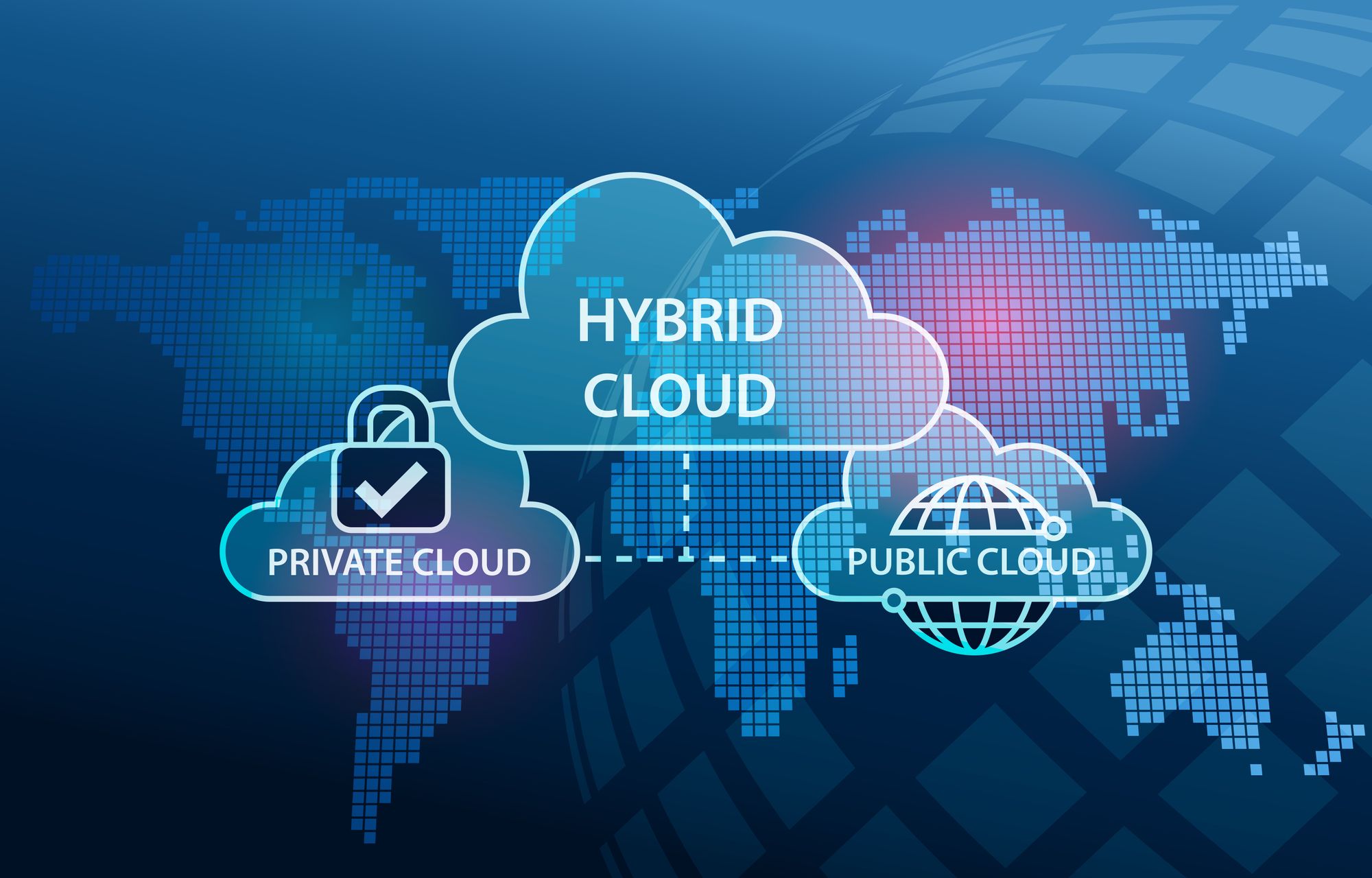
A hybrid cloud is a cloud computing environment that uses a mix of on-premises, private cloud, and third-party, public cloud services with orchestration between these platforms. This typically involves a connection from an on-premises data center to a public cloud. The connection also can involve other private assets, including edge devices or other clouds.

Top trends of 2021/2022 in the hybrid cloud market

  1. Businesses want platforms that enable Artificial intelligence (AI) and automation

This is one of the current trends in the hybrid cloud computing market today. The cloud service providers have to develop infrastructure that accommodates these new developments in technology. The use of AI and machine learning technologies is increasingly becoming popular making it an essential means through which the idea of hybrid cloud computing to be more effective. Different types of cloud computing have various advantages and disadvantages that need to be managed effectively for them to achieve their goals. Currently, a service has to support AI and machine learning technologies.

  1. A growing number of businesses expect a pay-for-what-you-use consumption model

Billing is one of the factors that are being taken into consideration by consumers of cloud computing services. They want to pay using a subscription or consumption-based model rather than paying a flat monthly fee because they prefer to pay for what they use and nothing more. However, a pay-for-what-you-use approach isn’t the right model for all situations, and, in some cases, a flat monthly fee will be more cost-effective in the long run.

2. The use of virtual cloud desktops is on the rise

Individuals and organizations are increasingly embracing working from remote locations. This is one of the major trends that a cloud service provider will have to deliver. It has become highly important to have an effective infrastructure to support this kind of work and service delivery.

3. Open hybrid cloud solutions are in; vendor lock-in is out

Open-source solutions are nothing new, and the open-source movement has been invaluable in the tech industry. Today the trend toward the open hybrid cloud is growing—that is, combining open source and open governance with the hybrid cloud model. In a 2020 O’Reilly Media survey, commissioned by IBM, 70% of respondents prefer a cloud provider based on open source, and 94% rated open-source software as equal to or better than proprietary software.

Providers and solutions are dominating the market

Various cloud service providers have developed hybrid solutions for organizations that need such services for their operations. The service providers understand the market better and develop solutions that need to be delivered for the clients. Amazon Web Service (AWS) is one of the most dominating service providers in this field. The service has various aspects that are advantageous to users making it highly popular in the market. AWS offers various services that are essential to the users.

Microsoft is one of the few vendors that can offer a true hybrid cloud solution because of its massive on-premises legacy. The Azure services are built on Windows Server, the .Net framework, and Visual Studio, making lift and shift of on-premise apps to the service relatively painless. And Microsoft didn’t fall into its not-invented-here mentality of the 90s. It has embraced Linux, containers, and Kubernetes with a bear hug, offering considerable support for open-source products. Microsoft also has a product called Azure Stack that essentially lets you replicate your entire Azure environment on-premises. This can be done for cost-cutting or to act as a disaster backup.

Redhat, Citrix, IBM Cloud are also some of the companies that focus on hybrid cloud computing and they play a vital role in developing systems that can be used to enhance the performance of organizations. These companies have been essential in building systems that deliver on the needs of organizations.

Infrastructure-as-a-service is one of the solutions being offered by hybrid cloud computing and it plays a vital role in the delivery of effective services to the organizations that seek the services. Most organizations cannot afford to purchase and maintain infrastructure and that is why this service is popular among the users of these services. The best service providers are the ones that have access to various forms of infrastructure which can be used to deliver an effective means of delivering a hybrid cloud computing service to the clients. There are other solutions offered by the service providers but this is one of the most essential solutions that hybrid cloud computing systems have achieved.

Key benefits for enterprises to utilize hybrid cloud techniques

Hybrid cloud service entails the use of public, private, and on-site databases and systems. This allows for flexibility and a benefit from all the advantages of using each platform. Various benefits accrue for the users of hybrid cloud services. Foremost, there is better support for the remote workforce. A hybrid cloud option gives organizations the flexibility to support their remote and distributed employees with on-demand access to data that isn’t tied to one central location. This flexibility is essential in ensuring there is the effective delivery of services that are required to perform various duties effectively.

Secondly, there is a benefit of reduced costs. Some infrastructures are costly to maintain, which calls for the development of an effective means through which the cloud can be used to substitute them. A hybrid cloud solution has a great advantage regarding minimizing operational costs.

Thirdly, there is increased agility and innovation when hybrid cloud systems are used. Individuals can access different forms of information and have a highly effective means through which they can develop different innovative solutions to their wellbeing. Increased speed in marketing and accessing various forms of information is critical to the development of an effective organization through hybrid cloud computing.

Fourth, business continuity is easily achieved as a result of having an effective means through which the backups can operate. In case of disasters, it is easy to manage the business without stopping due to the effects of the disaster. This is an essential factor to consider in the delivery of an effective business continuity process.

Finally, there is improved security and risk management when hybrid cloud computing is utilized. Information security is an essential factor to consider when technology is applied. The cloud can be secure but there are risks that arise due to exposure to various users. This is one disadvantage of the public cloud systems where many users can access data and can easily affect the security of other users of such a cloud service. This makes the hybrid systems more effective in improving security and mitigating risks.


https://bit.ly/3FPMRC6
https://bit.ly/3FUDhOn

https://guptadeepak.com/content/images/2021/11/AdobeStock_265247767.jpeg
https://guptadeepak.weebly.com/deepak-gupta/current-hybrid-cloud-computing-trends

Wednesday, 24 November 2021

Are Passwords Really Dead?

Are Passwords Really Dead?

For many years, we’ve heard: “The death of passwords is nigh!”

Now, after years of watching the decline, we shouldn't be surprised that everyone is proclaiming: “Passwords are dead!”

The real question is: What have you done to prepare for a passwordless future?

Before you answer, here’s a tidbit of history.

Did you know that digital passwords have been failing almost since they were invented?

One of the earliest examples of this dates back to the 1960s when MIT students began using passwords to log into a pioneering new computer.

Time on that shared computer was rationed at MIT. Each user was allotted only a few hours per week.

That is until one student located the file storing all the passwords. This wily student then began using multiple accounts to get all the usage time he wanted!

Fast forward to several decades later.

Unsurprisingly, with the proliferation of online passwords, the issues produced by their use—and misuse—have only multiplied.

Here are the most common password FAILS:

Too. Many. Passwords.

Most of your customers hate forgetting and resetting passwords. That’s why they reuse passwords! But, by choosing weak passwords, they put their sensitive data and your enterprise at risk.

Password fatigue is real.

If your customers have to reset a password, they’re likely to abandon whatever online service or product they were originally trying to access. Yes, the struggle is real when it comes to how this affects your revenue!

Passwords are easily cracked.

Weak passwords and the use of password dictionaries are a hacker’s dream. These allow hackers to use brute force attacks to gain access to your customer accounts. This can take seconds and can be done with cheap or free black-hat plugins.

Most hacks target passwords.

It’s no surprise that bad passwords are the easiest target for hackers. Even if most of your customers have exceptional password hygiene—using unique, complex, and randomly generated passwords—their data and your enterprise are still at risk. A previous hack on a different site may have released victim credentials that allow a “credential stuffing attack” to occur on your site.

Thankfully, there are secure, seamless solutions to these problems that LoginRadius can implement. Many of the options don’t require your customer to create a new password or remember an old one. Check these passwordless options below.

Passwordless authentication

Some passwordless options include multi-factor authentication where a one-time passcode and email link will allow account access. It’s just copy, paste, and enter—no passwords to remember.

Other options include social login or third-party login—again, no new password to set (or forget)!

What’s the face of the future? Passwordless fingerprint sign-in and face ID login—AKA biometric login, if you’re fancy.

These methods can either replace passwords or double down on security (or both). Plus, they’ll help prepare your enterprise for a passwordless future.

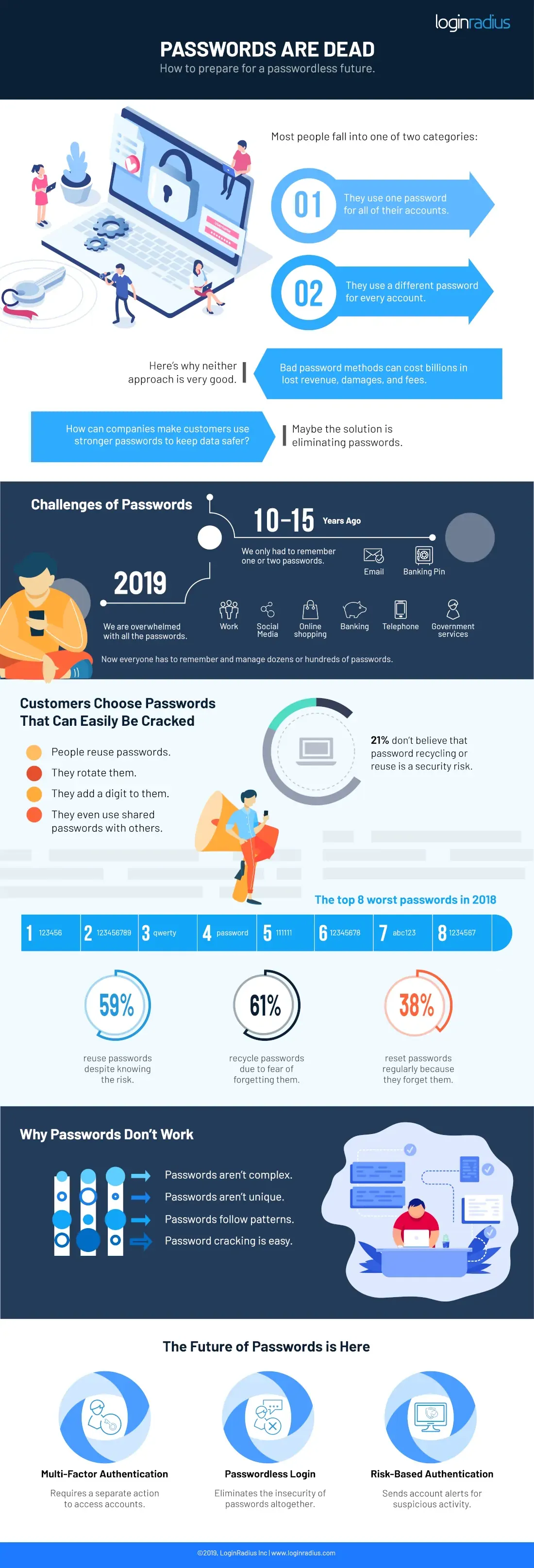
For more facts about the death of passwords and how it affects you, check out this handy infographic, created by LoginRadius, a customer identity and access management solution.

Are Passwords Really Dead?

Originally published at IFP

Are Passwords Really Dead?
These easy login methods might be the nail in the coffin. We take a brief look at the death of passwords, and how to prepare for a passwordless future.
Are Passwords Really Dead?

https://bit.ly/2ZjAAGg
https://bit.ly/3HRPFQH

https://guptadeepak.com/content/images/2021/11/Are-Passwords-Really-Dead-WebP-Test.webp
https://guptadeepak.weebly.com/deepak-gupta/are-passwords-really-dead

Monday, 22 November 2021

How CXOs Can Leverage 5G Edge Networks

How CXOs Can Leverage 5G Edge Networks

The modern digital landscape has offered new horizons and capabilities to organizations embarking on a journey to unleash the next level of innovation and agility. Whether we incorporate smart computing or leverage powerful networking technologies, every aspect has sweetened the kitty to yield better results by delivering a flawless user experience.

However, businesses should now gear up to reap the next phase of efficiency, agility, and innovation through 5G edge networks since renowned manufacturers like Apple and Samsung have already jumped on the 5G bandwagon. Moreover, the estimates from this year’s Ericsson Mobility report reveal that the total number of 5G subscriptions worldwide would reach 580 million this year, which is almost double from 2020.

So does it mean that consumers are already expecting vendors to deliver up-to-snuff experiences in the coming months since modern apps and systems are becoming data gourmands?

Undeniably, yes!

Since the conventional 4G-LTE coupled with centralized computing isn’t efficient enough to predict the surging data volumes and meet the demands, 5G is undoubtedly on the verge of offering immersive experiences and business opportunities. Hence, every CXO (chief experience officer) must put their best foot forward to navigate their enterprise’s digital transformation journey from 4G-LTE to cutting-edge 5G edge technology.

Let’s dig deeper into the role of 5G technology and how CXOs can leverage it for thriving business success through a new level of agility and efficiency.

5G Edge Unleashing New Opportunities

We’ve witnessed a drastic change coupled with endless business opportunities with every generation of wireless networking technology. The same goes for the case of 5G. The 5G network is expected to serve billions of customers and provide enterprises the scalability and flexibility they’ve been looking for as they could deploy powerful technologies to cater to the surging demands of users.

CXOs can combine advanced technologies like artificial intelligence and machine learning with high-speed data transfers that create a whole new experience for consumers and provide valuable insights to enterprises in real-time.

Let’s have a quick look at some of the 5G possibilities that can be fruitful for both consumers and service providers.

Innovation With New Data Models

Since we already discussed the emergence of future data-hungry applications and systems, 5G would surely help CXOs design the most immersive experiences through new business models.

Many enterprises, including the e-commerce giants, are developing new data models that allow quick responses and faster data transfers by leveraging cutting-edge networking infrastructure.

The next generation of mobile networks would surely lend a hand in crafting the most pleasing user experience and eventually open doors to collect valuable user data for businesses, including purchase history, behavior, and more, without affecting the overall user experience.

This would further help retailers enhance efficiency as they have real-time control over inventory management.

The Dawn Of New Era of Network Security

Undeniably, 5G is inherently diverse to any conventional mobile generation and enables machine-type communication — perhaps its most anticipated and unique selling point.

5G networks would soon serve diverse infrastructures that facilitate automation, robots, connectivity to machines, and digitization. This means a reliable and robust network security mechanism becomes the need of the hour.

In recent years, the number of security threats has surged across the globe, and different industries are drastically affected by the same. Many businesses have faced losses worth millions of dollars and even compromised their sensitive consumer identity information. These attacks can impact the confidentiality and integrity of a network system, which ought to be reliable enough to maintain the privacy and security of users.

The 5G network introduces IMSI (international mobile subscriber identity) encryption that secures interoperability between the overall functions required to provide network connectivity.

The network utilizes 256-bit encryption, which is perhaps the most advanced standard used to date. With 5G, a user’s identity and location are securely encrypted, making it more challenging for cybercriminals or unauthorized users to identify or locate a user.

The Next Level Of Efficiency And Scalability

Whether we consider self-driving automobiles or smart assistants paving the way for a seamless experience, a slight network delay or latency could be pretty vexing. Moreover, streaming 3D videos or experiencing immersive apps require consistently high bandwidth. This cannot be fulfilled with the conventional 4G-LTE networks.

With 5G network technology, CXOs can better focus on enhancing experiences for users in a way that mitigates latency and helps cater to the sudden increased demand for data.

Since the demands on mobile networks are usually complex, 5G would help densify data requirements, which can be delivered in real-time based on the arising situations.

Final Thoughts

Business investments in 5G over the next couple of years could be a game-changer for any enterprise as the technology standardizes globally.

However, 5G is undoubtedly a new trend. It would surely take a reasonable amount of time to set up networks and devices and customization as per the business needs.

As a CXO, one should begin embracing the technology in the earlier stages to maintain a competitive advantage, which assures good ROI and eventually helps deliver seamless experiences to consumers.


Originally published at Forbes

Council Post: How CXOs Can Leverage 5G Edge Networks
The 5G network is expected to serve billions of customers and provide enterprises the scalability and flexibility they’ve been looking for as they could deploy powerful technologies to cater to the surging demands of users.
How CXOs Can Leverage 5G Edge Networks
-

https://bit.ly/3r20rOC
https://bit.ly/2Zc1ShK

https://images.unsplash.com/photo-1592862037671-e8b981b49dcf?crop=entropy&cs=tinysrgb&fit=max&fm=jpg&ixid=MnwxMTc3M3wwfDF8c2VhcmNofDEyfHw1Z3xlbnwwfHx8fDE2MzU0NzQwNTQ&ixlib=rb-1.2.1&q=80&w=2000
https://guptadeepak.weebly.com/deepak-gupta/how-cxos-can-leverage-5g-edge-networks

Saturday, 20 November 2021

Top Five Customer Data Management And Security Challenges

Top Five Customer Data Management And Security Challenges

For companies to take advantage of the mobile and digitally dynamic customer base that expects a customized and streamlined experience, digital advancement is incredibly vital. One of the undeniable necessities of business enterprises to support all the procedures is ensuring that excellent customer data management exists. It could be quite lucrative for marketers to have accurate customer data. But if the venture doesn't have the important assets to manage such a high volume of data, it can prove to be impossible for the enterprise to acquire and evaluate the data.

Today, business endeavours have ample of customer data which, if utilized correctly, can assist the enterprise in serving individual clients successfully. Business ventures concentrating on data first technique can altogether increase auxiliary income, cut expenses and accomplish faithfulness from their top customers.

But unfortunately, businesses face myriads of challenges in this process. Five most prominent ones are listed below-

Huge Volume of Data

Business endeavours need to be able to process enormous volumes of customer data so that essential data is settled and is accessible to the decision-makers whenever they need it. Ventures consistently face the challenge of gathering, managing and creation of something valuable from the data. Moreover, the expanding number of gadgets and platforms and the ceaselessly decreasing cost of storage have compounded the hurdle of the administration and expulsion of old data. The amount of organized and unstructured data that is being gathered along with numerous data accumulation channels has changed customer data management into a significant, yet tricky goal.

“Businesses are getting progressively competitive with each passing day, and consumer satisfaction is always the top priority. The quickly changing customer behaviour is causing problems for leaders to settle on what's best for the customers”

Executing the Right Technology

As of late, Cloud computing has quickly turned into a popular asset for CIOs from all foundations and for valid reasons. In large business organizations, choosing where to house information is a tricky question that is predominantly controlled by how that data will be used. Cloud is helping answer these inquiries. CIOs used to keep organizations' information close by and stored locally. This was quite hard for large organizations with workplace in different locations. But, financially savvy cloud alternatives are helping CIOs mitigate the dangers related to long haul investments in heritage systems and nearby servers. With organizations having an endless amount of data each day, storing information is precarious. CIOs today are utilizing a different avenue (using local servers as well as the cloud) as it gives a flexible alternative for storing data.

Facilitating systems and storing information on the cloud additionally provides a fortification in case of crisis. CIOs understand that human-made and cataclysmic events can harm hardware, shut off power and debilitate foundational IT works in an organization. Saving information on the cloud, hence, carries with it a significant boon for organizations.

Securing customer data:

With data being seen as a critical business asset by different enterprises, the security of that data is of paramount importance. Data breaches across various organizations around the globe have expanded unquestionably lately.

Business ventures are starting to acknowledge security intrusions as unavoidable and are concentrating predominantly on the preparation for the security breach and secure sensitive data of the enterprise. Preventing cyberattacks is practically almost impossible, but one thing businesses can do is to limit the harm. Besides overcoming customer data management hurdles and building enhanced client experiences, business endeavours should likewise advance their data management techniques.

Mapping the customer journey

Business endeavours must be furnished entirely with real-time customer data, contact points for connection, behavioural stages, opinion, cross group resourcing and a lot more than empowers the mapping of the customer journey that can be useful in providing the best client experience. Yet, even in the current digital age, it is hard to follow the process of how clients move from brand awareness to conversion. Clients may initially be acquainted with a brand on a billboard, explore it on their desktop and eventually make a purchase on their cell phone. For the client journey to genuinely be a piece of business strategy, business ventures should use different tools that can reveal some insight into the client's path and bridge any gap between online and offline customer experiences.

Data gathering and storage

Businesses are getting progressively competitive with each passing day, and consumer satisfaction is always the top priority. The quickly changing customer behaviour is causing problems for leaders to settle on what's best for the customers. Organizations are experiencing severe difficulties overseeing such vast amounts of data. Also, they are likewise attempting to choose whether to consider a single customer view or cohort view while making an evaluation.


Originally published at Cio Review India

Top Five Customer Data Management And Security Challenges By Deepak Gupta, CTO and Co-Founder, LoginRadius
Top Five Customer Data Management And Security Challenges By Deepak Gupta, CTO and Co-Founder, LoginRadius - For companies to take advantage of the mobile and digitally dynamic customer base that expects a customized and streamlined...
Top Five Customer Data Management And Security Challenges

https://bit.ly/30J49RS
https://bit.ly/3oJoY8l

https://guptadeepak.com/content/images/2021/11/jefferson-santos-9SoCnyQmkzI-unsplash.jpg
https://guptadeepak.weebly.com/deepak-gupta/top-five-customer-data-management-and-security-challenges

Friday, 19 November 2021

Why PKI Is Critical to Your Cloud Strategy

Why PKI Is Critical to Your Cloud Strategy

Modern businesses are becoming ever more reliant on digital data and electronic activities, and as a result, meet rigorous data privacy compliance hurdles and information security regulations. Also, with companies increasingly under threat of online cyber-attacks and malicious insiders, enterprise applications and interfaces are now reliant on using digital credentials to manage how users and companies access sensitive information and crucial system resources.

This is why businesses rely on several data authentication systems to guard their key customer and enterprise data. However, out of all different authentication systems, PKIs (Public Key Infrastructure) ensure the trustworthiness of identity credentials.

Public Key Infrastructure (PKI) is not a new concept and neither is its cloud strategy. PKI is principally about managing online identities that facilitate ways to safeguard data and understand the user identity when administering data over untrusted interfaces.

Role of PKI in Modern Businesses

In modern times, Public Key Infrastructure has emerged from a mechanism to guard websites into the essence of the digital administration role within the cyber security structure. Today, this PKI is employed to control digital identities, devices, and applications within businesses.

It further gets employed and deployed by IT teams in an organization to combat the ever-evolving cyber security threat, spanning DDoS (Distributed Denial of Service) attacks, malware and phishing attacks to the hacking of the IoT (Internet Of Things) devices.

However, the accurate management of PKI has lately become a challenge for several IT teams. This is why businesses are nowadays moving on the cloud platform to manage their PKI effectively. Here are some reasons PKI is crucial to your cloud strategy.

Reduced Complexity and Cost

Transferring your Public Key Interface to the cloud can help you save valuable time in exercising safety controls, maintenance responsibilities, and infrastructure expenses. Choosing the accurate cloud-hosted Public Key Infrastructure (PKI) as a service platform implies your infrastructure units can concentrate on other crucial enterprise plans.

Also, with the adoption of the cloud-based platform to PKI, traditional business costs got replaced with a flat-rate billing model and have become more predictable.

Availability

PKI (Public Key Infrastructure) supporting applications must remain accessible anytime and effectively fulfill the security requirements of billions of users, notwithstanding the ever-widening range of the business. Nevertheless, most PKI deployments demand the scalability it requires. The more its clients increase in numbers, the more complicated it grows.

A cloud-hosted Public Key Infrastructure becomes the eventual solution for companies that fancy seamless scalability and a safety system obtainable round the clock. Apart from this, cloud-hosted PKI service providers could assist you in designing and creating custom Public Key Infrastructure that aligns with your enterprise security requirements and purposes.

This implies you will receive it directly from the onset rather than considering deployment later on when your company purposes expand or safety requirements evolve.

Scalability

The scalability of meeting the modern growing requirements of an organization is pretty advantageous. The provider manages supplementary provisions like installing software, hardware, emergency rescue, backup, and other infrastructure, which will become one substantial responsibility for the owners of the on-premises Public Key Infrastructure cloud solutions.

Also, the Public Key Infrastructure method, the hybrid method of asymmetric and symmetric encryption, and the exchange method happen with asymmetric encryption for transferring the secret key. Moreover, when the cryptographic key gets swapped, the rest of the interaction occurs on asymmetric encryption. In such a manner, safety and performance get accomplished.

Business Continuation

Variations in Public Key Infrastructure ownership unavoidably boost the risk of security gaps as inexperienced hands happen on mission-critical support. Lapses in routine maintenance responsibilities such as endorsing and issuing CRLs (Certificate Revocation Lists) and restoring Certificate Authorities can create significant interruptions that demand days or even months to renegotiate.

Moreover, expanding Public Key Infrastructure on the cloud platform ensures that, regardless of transformations in your IT and safety team, infrastructure remains to function at capacity.

Cost Minimization

Moving Public Key Infrastructure to the cloud platform makes expense analysis more predictable for its customers. The repeated and set expense required to maintain and manage PKI cloud infrastructure is significant.

In addition, equating it to a team-managed Public Key Infrastructure has compelled many businesses to deploy PKI to the cloud as it is reasonable and operates on a flat-rate billing model.

The Bottom Line

To sum up, we can say that cloud-based Public Key Infrastructure services enable companies to decrease some of the expensive prices associated with PKI deployment. It comprises infrastructure and staff training.

In addition, cloud-based PKI assistance is a cost-effective solution for all crucial business activities. It implies that companies ought not to pick between costly security or a high-priced infringement any longer. Moreover, given the enhanced security challenges and cyber threats, Public Key Infrastructure is a must for business in modern times.


Originally published at DZone

Why PKI Is Critical to Your Cloud Strategy - DZone Security
Public Key Infrastructure has emerged from a mechanism to guard websites into the essence of the digital administration role within the cyber security structure.
Why PKI Is Critical to Your Cloud Strategy

https://bit.ly/3cxQQq6
https://bit.ly/3nuBR6F

https://guptadeepak.com/content/images/2021/11/photo-1629904888780-8de0c7aeed28-1.webp
https://guptadeepak.weebly.com/deepak-gupta/why-pki-is-critical-to-your-cloud-strategy

Palo Alto Networks CyberArk: The $25 Billion Deal Reshaping Cybersecurity

Deal Overview Transaction Details : Palo Alto Networks announced on July 30, 2025, its agreement to acquire CyberArk for $45.00 in cash...